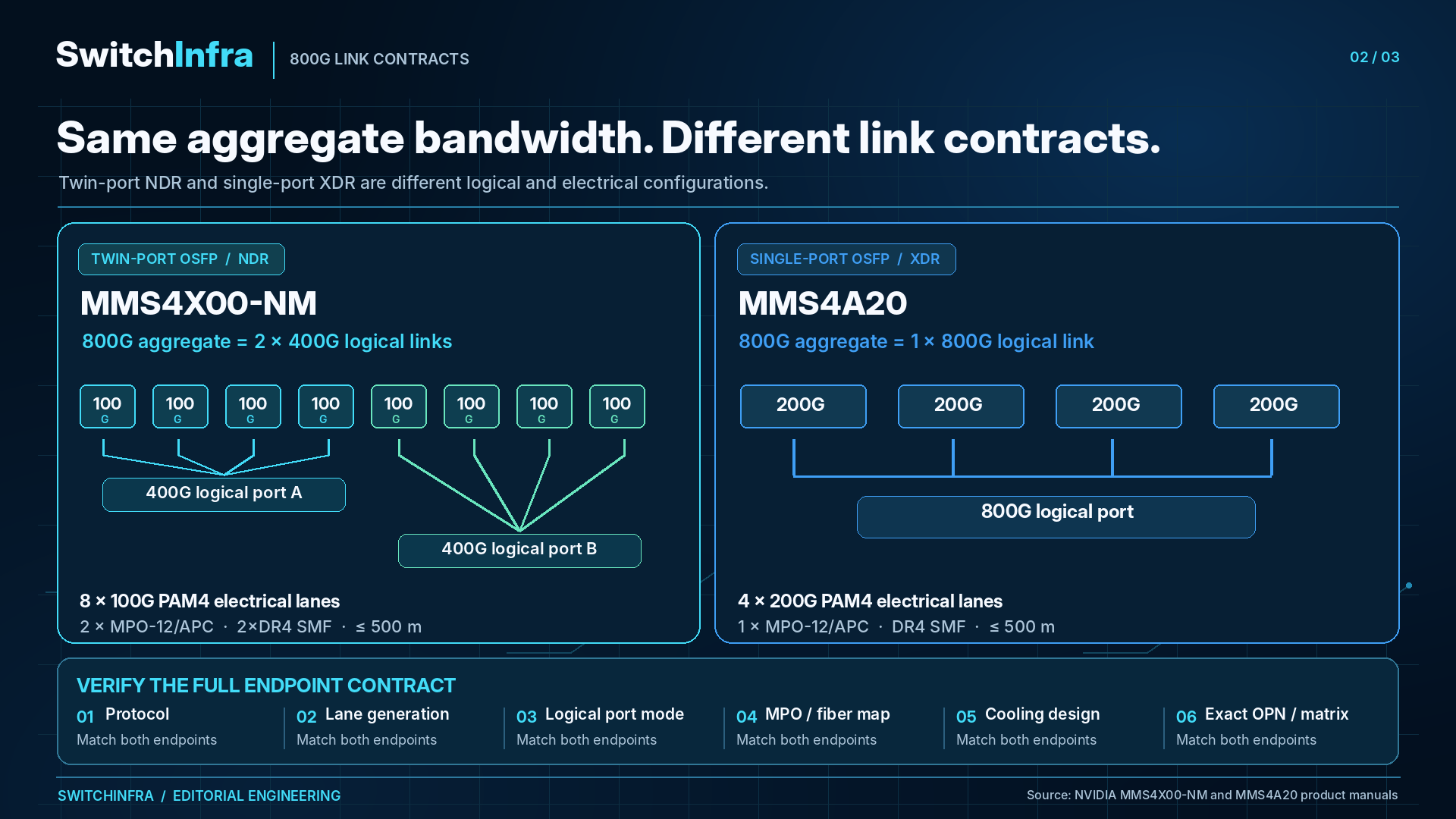
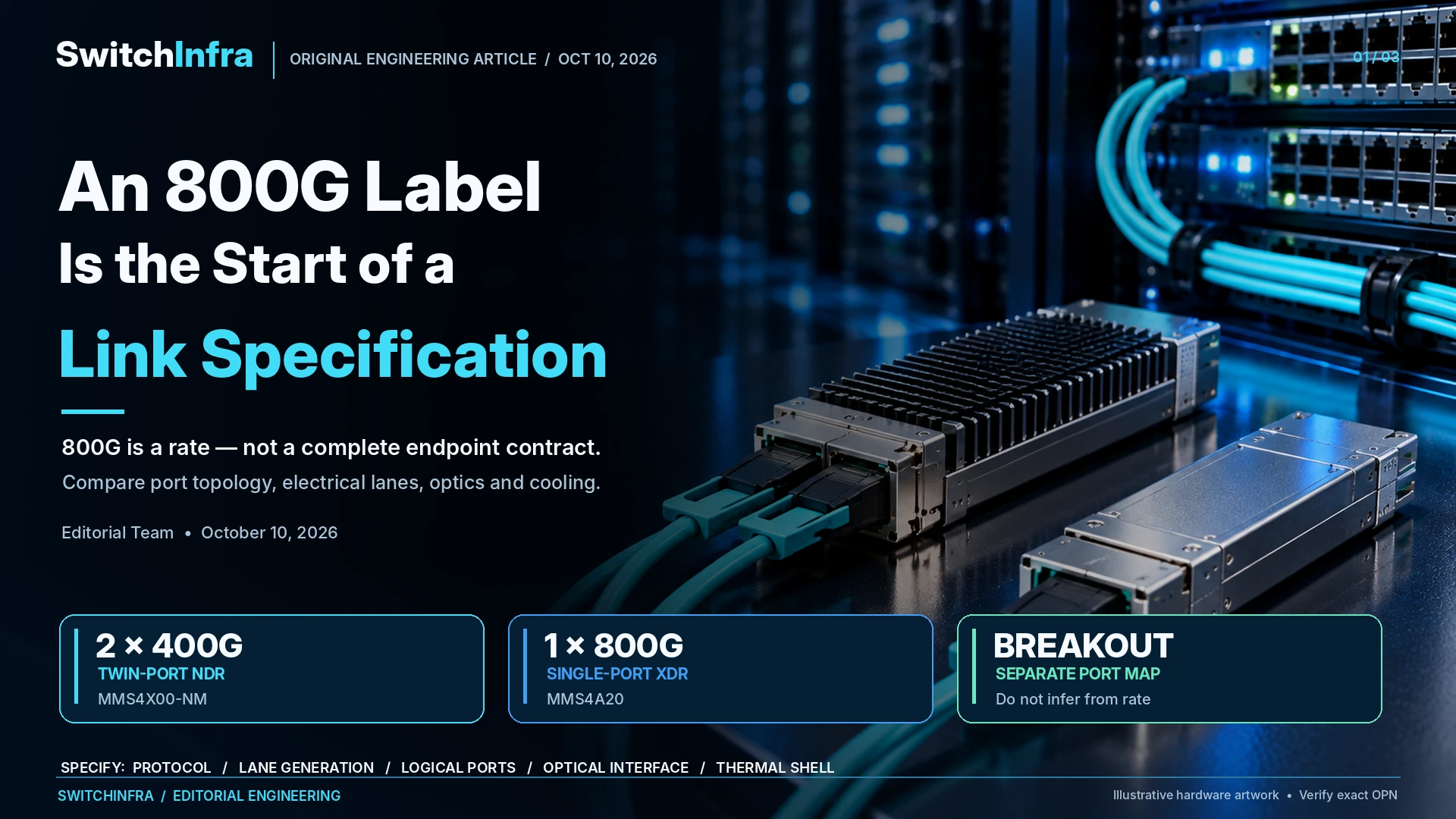
Two products can advertise the same aggregate bandwidth and still solve different engineering problems. A twin-port NDR optic can provide two 400G links, while a single-port XDR optic delivers 800G through a different lane generation. A splitter can divide a physical head into separate logical ports. None of those roles is captured completely by the number printed before “G.”
Write the link as a sequence: protocol, signaling generation, logical rate, electrical lanes, connector, optical format or copper architecture, and cooling arrangement. This sequence turns a product name into a design decision. It also makes a substitution review much clearer: the reviewer can see which property is changing and which endpoint must support that change.
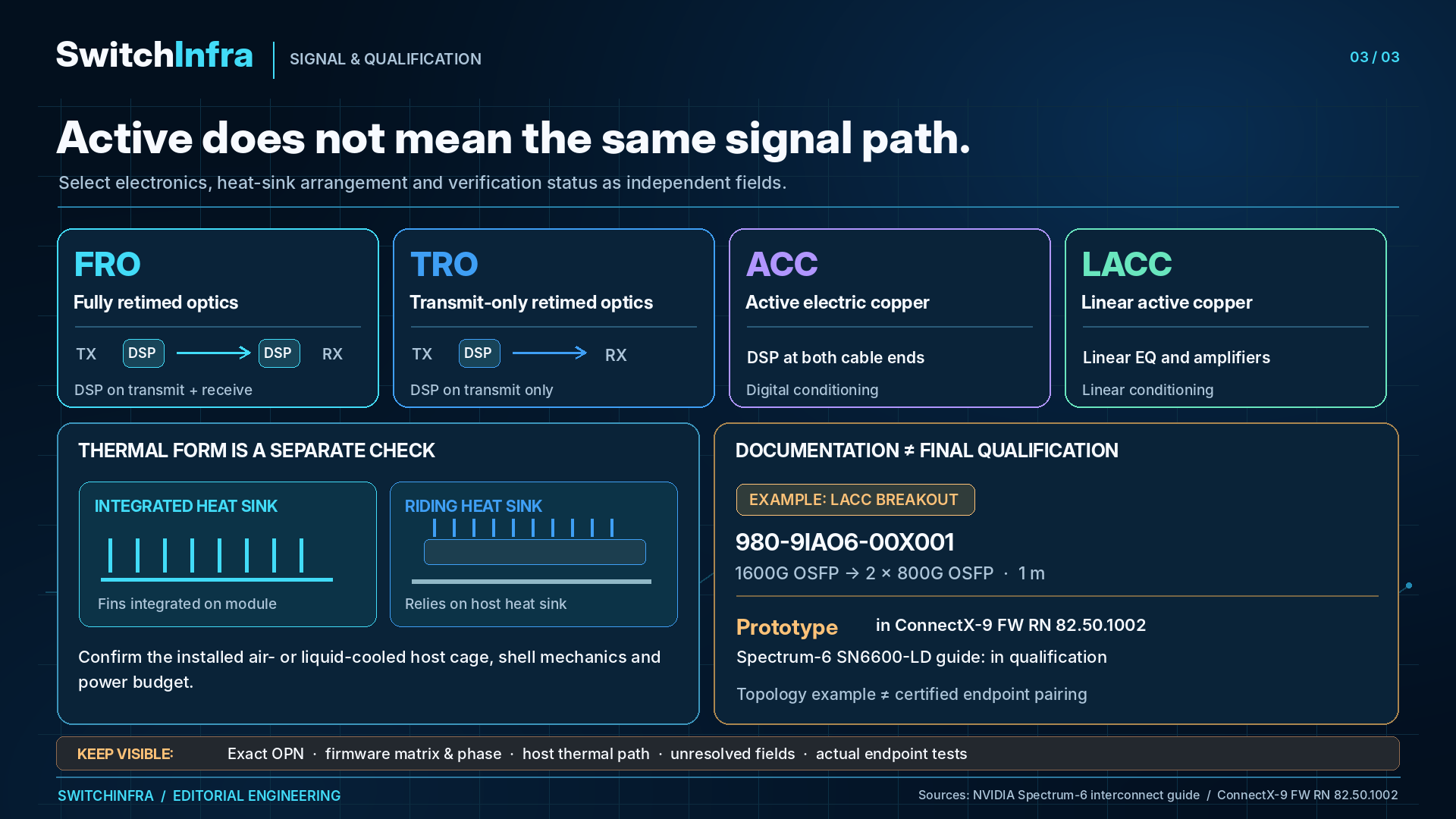
Retiming is a useful example. NVIDIA’s Spectrum-6 guide defines fully retimed optics as using DSP circuitry on transmit and receive paths, while transmit-only retimed optics use it on transmit. Active-electric copper and linear active copper likewise use different signal-conditioning approaches. These labels should stay visible in selection content, rather than being collapsed into a single “active” category or replaced with an unsupported LPO description.
Cooling is another independent choice. A riding-heat-sink module relies on the host cooling arrangement, while an integrated-heat-sink version has a different mechanical and thermal design. The exact selected shell matters even when the connector family and advertised data rate match.
Finally, distinguish a documented application from a completed qualification. A hardware guide can show a valid topology and still describe a particular optic as undergoing qualification. A firmware matrix can identify a real product while recording a Prototype or Last Time Buy phase. These facts add context to the selection; they do not invalidate an owner-confirmed product identity.
A useful catalog page therefore combines accepted manufacturer-origin identity data with clearly scoped public engineering evidence. It shows what the product is, explains the role it can play and leaves genuinely conflicting fields visible for resolution. That is more useful than either an unqualified compatibility claim or a page that disappears simply because an exact public document is hard to find.
Scope: Original technology-selection commentary derived from official manufacturer documentation; no benchmark or deployment outcome is invented.
Public references
- NVIDIA Interconnect for Spectrum-6 Based Ethernet Switches | NVIDIA Spectrum-6 SN6000 Switch Systems Hardware User Manual
- MMS4X00-NM 800Gbps Twin-port OSFP 2x400Gb/s InfiniBand and Ethernet Single Mode 2xDR4 500m | MMS4X00-NM 800Gbps Twin-port OSFP 2x400Gb/s InfiniBand and Ethernet Single Mode 2xDR4 500m
- NVIDIA MMS4A20 800Gbps, DR4 Single-port OSFP, MPO, 1310nm Single Mode, RHS Transceiver | NVIDIA MMS4A20 800Gbps, DR4 Single-port OSFP, MPO, 1310nm Single Mode, RHS (500m) Transceiver
- Validated and Supported Cables and Switches | ConnectX-9 Firmware RN
Technical illustrations