
Optical interconnects
When can a 40G QSFP port become four independent 10G links?
Check the host configuration and exact optical model before buying four 10G paths.
Four optical lanes do not automatically mean four configurable Ethernet ports. A breakout order must describe the host mode, the exact optic and all four endpoint paths.
The short answer
Use QSFP-40G-SR4 only with a supported 4 × 10G host configuration and appropriate breakout cabling. QSFP-40G-SR4-S is excluded from this role, despite supporting native 40G SR4 links.
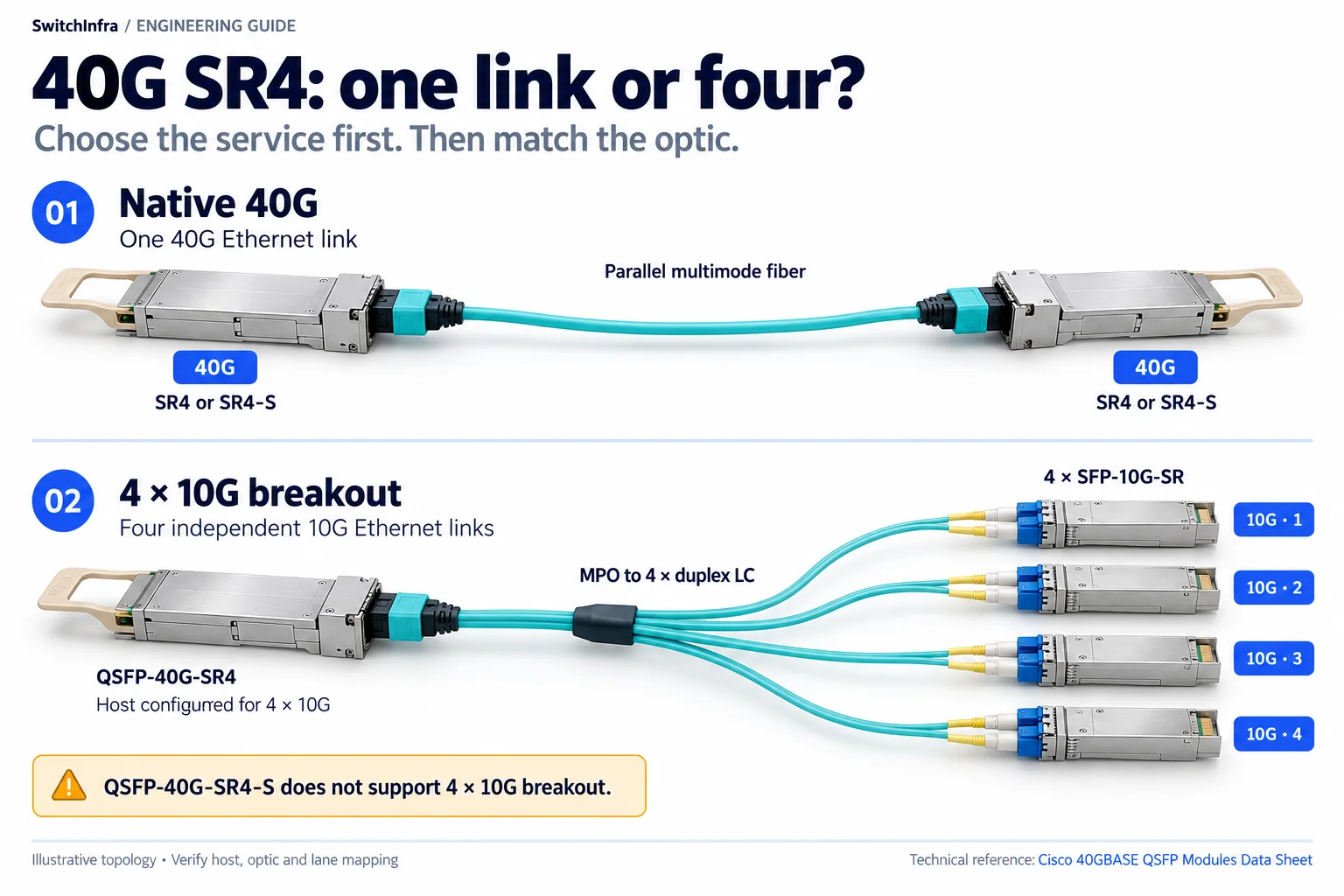
Native 40G uses one Ethernet link; supported SR4 breakout connects four separate 10G interfaces. QSFP-40G-SR4-S does not support this breakout arrangement. Conceptual illustration; equipment shapes are illustrative.
Official technical sources · Independent analysis by SwitchInfra
This is a documented design analysis, not a customer deployment claim. Candidate roles require verification for your configuration.
4 × 10G — means independent interfaces
SR4-S — has no 4 × 10G mode
3 checks — host, optic and mapping
Each lane — needs its own validation
What the technical reference establishes
Cisco distinguishes the breakout-capable SR4 model from SR4-S in the 40G data sheet. The NX-OS interfaces guide separately describes hardware-dependent breakout modes.
This guide treats them as two approvals. A host exposing four child interfaces does not prove that the installed optic can serve the intended peers; an appropriate optic cannot create a mode absent from the host.
Exact PID — SR4 and SR4-S have different breakout capabilities.
Software — Breakout support depends on platform and release.
Cabling — Every lane must reach its intended endpoint.
Service — Native 40G and four 10G services are distinct configurations.
Scope of the analysis: Independent engineering analysis of official documentation. The design exercises are illustrative; this guide does not describe a customer deployment.
Work through the engineering choices
Start with the documented constraint, then state the conditions for the proposed equipment role.
Define the service before dividing the port
Cisco documents native and breakout applications separately.
Design exercise: Design exercise: connect four separate 10G endpoints to one eligible high-speed host port.
Record whether the requirement is one 40G adjacency or four independent 10G adjacencies. For breakout, name each endpoint and the VLAN, routing or port-channel role it will use. Four lanes carrying one service inside an optic do not by themselves provide four separately configurable services.
Reserve the parent port in the port schedule. When it is allocated to four child interfaces, it is unavailable for a simultaneous native 40G uplink. Check whether the intended change affects neighboring ports or existing configuration, using the exact platform guide rather than a command copied from another switch.
Cisco NX-OS 10.3 interfaces guide · Cisco NX-OS 10.6 breakout support matrix
Match the optic to the supported host mode
SR4-S does not support 4 × 10G; SR4 can support it.
Design exercise: Conditional choice: breakout-capable optics on both approved host and peer interfaces.
Check the switch PID, software release, physical port and optic PID together. Confirm that each peer interface uses an interoperable 10G optical standard. A sales description shortened to “40G SR4” loses the suffix that decides whether this use is supported.
Keep the optical path within the documented breakout reach: 100 m on OM3 or 150 m on OM4 for this SR4 arrangement, subject to the channel conditions. The longer distance associated with an independent 10G SR link does not override the SR4 side of a breakout link.
Cisco 40G QSFP data sheet · Cisco NX-OS 10.6 breakout support matrix
QSFP-40G-SR4
Optical 4 × 10G breakout candidate
Verify a supported QSFP host mode and the complete multimode lane path.
QSFP-40G-SR4-S
Native 40G only for this comparison
Excluded from the four independent 10G role.
SFP-10G-SR
10G endpoint candidate
Use a supported peer and the SR4 breakout channel limits.
Commission and label all four child paths
The host guide represents breakout as separate logical interfaces.
Design exercise: Design exercise: validate four lanes before migrating four production endpoints.
Verify the lane-to-port labeling at both ends before moving services. Bring up each child interface, inspect errors and optical readings where supported, then test the intended traffic path. A working lane does not prove that the remaining lanes are correctly mapped.
Put the rollback mode and any configuration impact into the change plan. Keep spare assemblies identified by the full mapping and length, not just a QSFP connector description. The resulting BOM should distinguish one parent interface, four peer interfaces and the physical assemblies joining them.
Cisco NX-OS 10.3 interfaces guide · Cisco NX-OS 10.6 breakout support matrix
A breakout inquiry should identify every endpoint
Provide a lane schedule with the proposed host configuration.
Cisco 40G QSFP data sheet · Cisco NX-OS 10.6 breakout support matrix
Host evidence
Switch PID, port number, software and documented breakout mode.
Exact optics
Full suffixes and compatible peer PMDs, not family names.
Channel plan
Lane mapping, media, length, loss and four endpoint labels.
Candidate models and selection boundaries
These are conditional model or product-family inquiries for the documented equipment roles. Confirm the required rate and complete channel before finalizing any line.
| Model / family and status | Role and condition |
|---|---|
| QSFP-40G-SR4 Conditional model inquiry | Optical 4 × 10G breakout candidate Verify a supported QSFP host mode and the complete multimode lane path. Cisco 40G QSFP data sheet |
| QSFP-40G-SR4-S Excluded from 4 × 10G | Native 40G only for this comparison Excluded from the four independent 10G role. Cisco 40G QSFP data sheet |
| SFP-10G-SR Conditional model inquiry | 10G endpoint candidate Use a supported peer and the SR4 breakout channel limits. Cisco 40G QSFP data sheet |
| N9K-C93180YC-FX3 Conditional listed platform | Host platform under review Catalog listing only; specific port, release and optic combination requires review. Cisco NX-OS 10.6 breakout support matrix |
SR4, SR4-S and SFP-10G-SR have no exact listing in the targeted public checks. N9K-C93180YC-FX3 is listed as product 7512, on request; its presence is not a validated breakout bundle.
Continue in the relevant product family
Use the analysis to define the role before comparing catalog options.
Discuss this project
Carry the route, media, endpoint and loss requirements into the inquiry. Leave unknown quantities blank; reference port and fiber counts are not an equipment BOM.
Follow the next selection question.
Compare related decisions while keeping each source’s scope, hardware and link conditions separate.
Browse more engineering analyses →
MPO trunk, LC front: identify the actual 40G path
A practical channel map prevents a connector match from becoming an optical mismatch.
Read the engineering analysisOfficial technical source
100G single-mode: select with a budget
Use distance, loss, receive power and FEC to distinguish two duplex-LC candidates.
Read the engineering analysisOfficial technical source
25G migration: select the operating mode
Match NIC capability, optical media and FEC before changing server link rates.
Read the engineering analysisOfficial technical source
Before you finalize the channel
Can SR4-S be substituted for SR4 in this order?
Not for the 4 × 10G role described here.
Does a breakout cable enable the switch feature?
No. The host must independently support the required mode.
Does one working lane validate all four?
No. Verify each child path and service separately.
Can the parent remain a native 40G uplink?
Not simultaneously while its lanes provide these child interfaces.
Trace the project facts and technical limits
- Cisco 40G QSFP data sheet
- Cisco NX-OS 10.3 interfaces guide
- Cisco NX-OS 10.6 breakout support matrix
Source check: 19 October 2026. Catalog status is stated per candidate.
Official sources checked 19 October 2026. Final host, software, channel and offered-unit compatibility require project-specific verification.