Network engineering
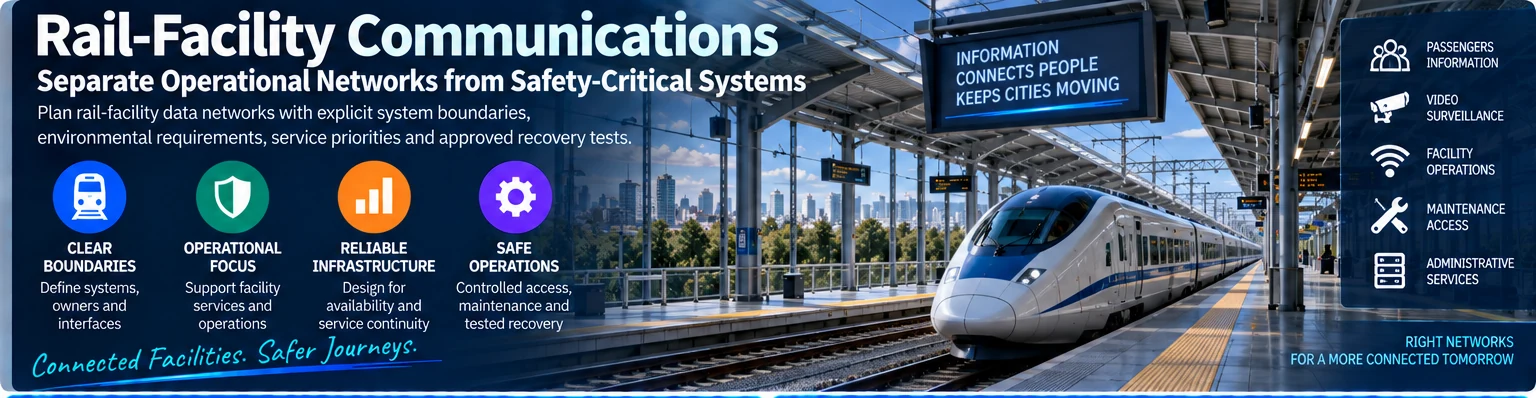
Rail-Facility Communications: Separate Operational Networks from Safety-Critical Systems
Plan rail-facility data networks with explicit system boundaries, environmental requirements, service priorities and approved recovery tests.
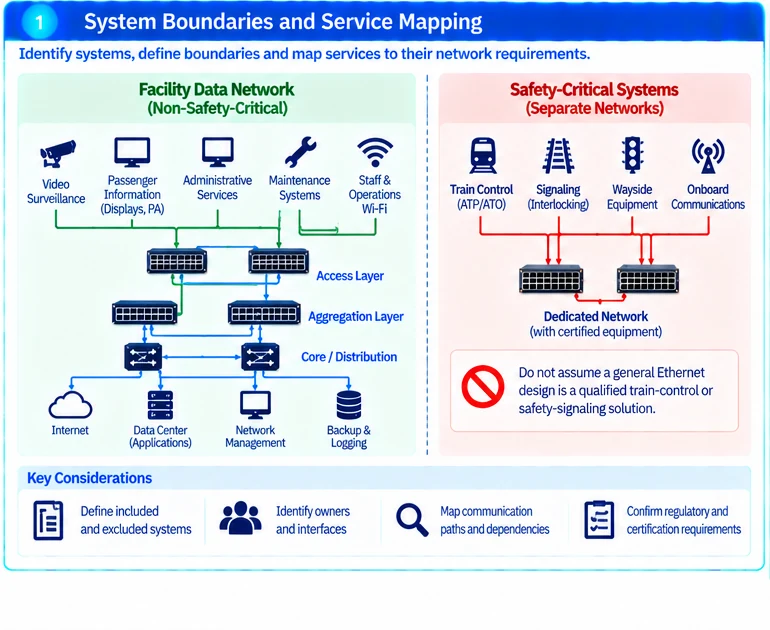
Rail facilities can contain passenger information, video surveillance, office services, maintenance access and operational subsystems. Their network requirements should be identified separately. A general Ethernet design must not be presented as a qualified train-control or safety-signaling solution without the applicable system engineering and certification evidence.
Define the system boundary
List the services included in the project and the systems explicitly excluded. Identify owners, interfaces and approved communication paths. Distinguish a facility data network from onboard, signaling or other safety-critical communications.
Operational technology requires attention to availability, timing, safety and controlled maintenance. NIST’s OT guidance provides a general security and operational framework, not rail-specific certification. R34
Map service priority to real dependencies
Record cameras and recording systems, passenger-information endpoints, maintenance systems and administrative services. Identify the impact of losing each path and the acceptable recovery procedure.
| Requirement | Evidence needed |
|---|---|
| Service scope | Named subsystem, owner and interface boundary |
| Environment | Required temperature, power, enclosure and installation suitability |
| Availability | Protected fault and surviving service behavior |
| Segmentation | Approved communications and enforcement ownership |
| Operations | Maintenance window, access control and restoration procedure |
Do not infer suitability from the word industrial in a product description. Environmental and regulatory requirements must be established for the exact equipment and installation through the responsible specialists.
Design redundancy within a reviewed domain
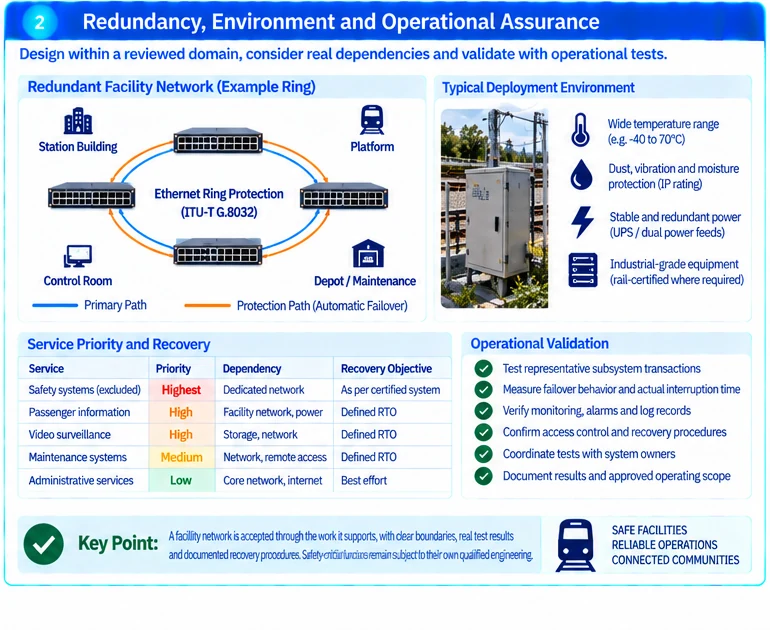
Where an Ethernet ring is appropriate, define its members, protocol roles and connections to other network domains. G.8032 describes Ethernet ring protection, but its presence does not prove application recovery time or compliance with a rail system’s requirements. R38
Identify common power supplies, cable routes and equipment rooms. A ring drawing can conceal physical dependencies that defeat the intended protection.
Control maintenance and access
Restrict administrative paths and document authorized remote access. Preserve configuration backups and a restoration method that does not depend entirely on the affected production network.
Coordinate testing with the subsystem owners. Do not perform disruptive load, reboot or fault tests on operational systems without approved scope and protection arrangements. Security changes must be evaluated for their operational effect as well as their intended restriction. R34
Accept against the agreed service specification
Verify representative subsystem transactions, traffic behavior, monitoring and approved fault recovery. Record the actual interruption and restoration action. A successful interface failover should not be reported as proof that every application continued uninterrupted.
The deliverable is a clearly bounded facility-network design with traceable requirements and evidence. For project scoping, provide subsystem interfaces, environmental requirements, physical routes and the applicable approval process. Safety-critical functions remain subject to their own qualified engineering and acceptance regime.
Engineering illustrations
These figures illustrate the design concepts discussed here. They are not measured results, certified configurations or a supplied-equipment list.