
Switching platforms
Why a gigabit campus switch is not a 10G server-access switch
Endpoint rate and shared uplink capacity require different checks.
A switch can have fast uplinks while each attached device remains limited to a gigabit port. Read the exact model’s access and uplink rows separately.
The short answer
C9200L-24T-4G-E is a conditional 1G campus or management choice, not a 10G server-link choice. If servers require 10G, select access ports that support their NICs, then size the shared uplinks independently.
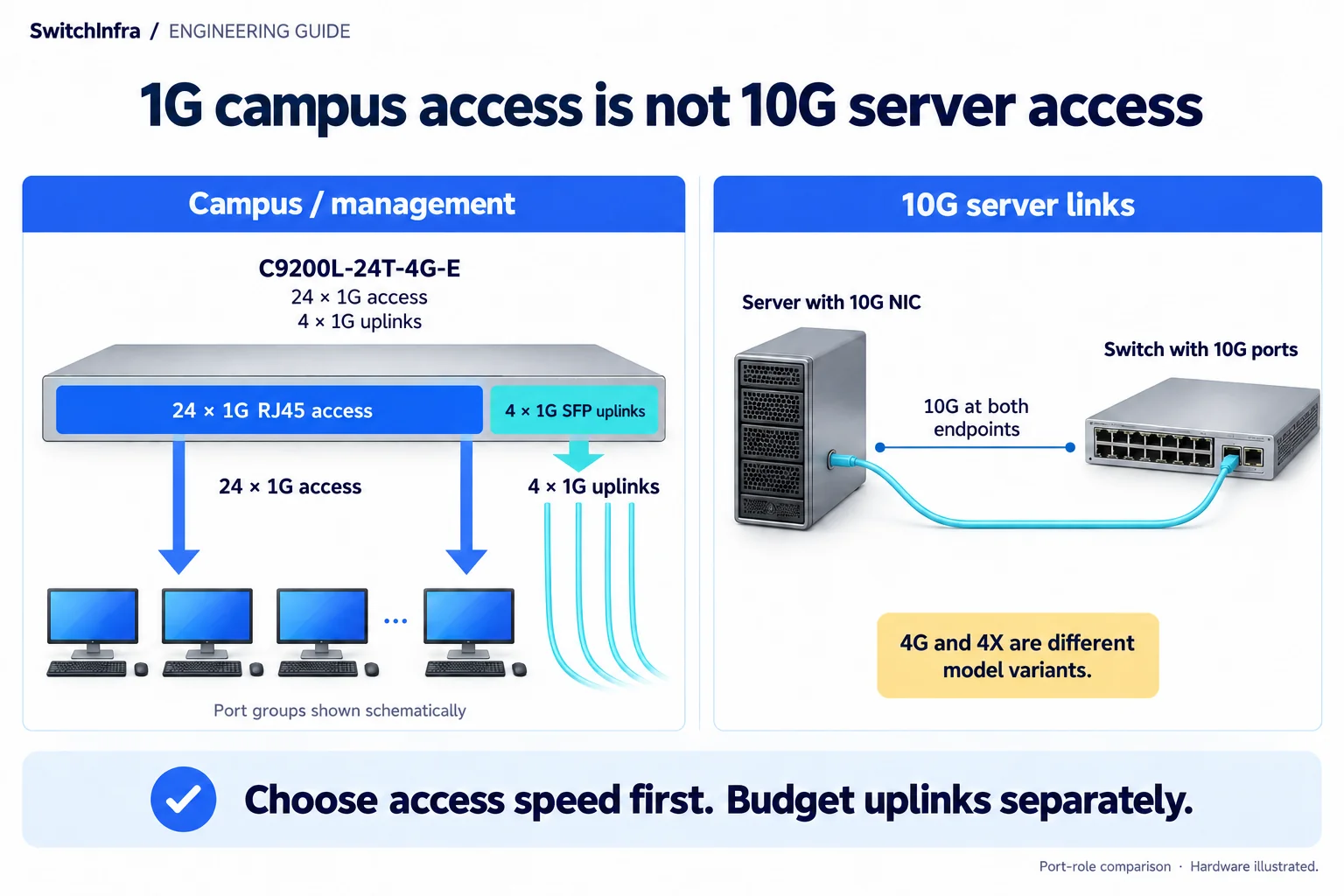
C9200L-24T-4G-E provides 24 gigabit access ports and four gigabit SFP uplinks. A 10G server link requires suitable interfaces at both endpoints. Conceptual illustration; equipment shapes are illustrative.
Official technical sources · Independent analysis by SwitchInfra
This is a documented design analysis, not a customer deployment claim. Candidate roles require verification for your configuration.
24 × 1G — access ports on the cited model
4 × 1G — fixed uplink ports
6:1 — illustrative 24:4 capacity ratio
10G — requires a suitable endpoint port
What the technical reference establishes
Cisco’s architecture paper separates the C9200L-24T-4G from the 4X version: both provide gigabit access, but their fixed uplink rates differ. The ordering guide identifies the E software package.
The independent selection problem has two layers. First, can an individual endpoint establish its required link? Second, does the collection of endpoints have enough usable shared capacity for its workload and failure plan?
Cisco Catalyst 9200 architecture white paper
Exact model — The 4G and 4X endings describe different uplink options.
Access rate — A faster uplink does not upgrade the access PHY.
Software — A package choice does not change the physical port rate.
Topology — Only usable, configured paths count toward shared capacity.
Scope of the analysis: Independent engineering analysis of official documentation. The design exercises are illustrative; this guide does not describe a customer deployment.
Work through the engineering choices
Start with the documented constraint, then state the conditions for the proposed equipment role.
Place each endpoint in the correct port role
The architecture paper documents access and fixed-uplink interfaces separately.
Design exercise: Design exercise: separate office endpoints, out-of-band management and production server traffic.
Record each endpoint’s required rate, connector and network role. A server’s management port may need only a gigabit while its production NIC needs a much faster data link. Put those on different rows instead of treating the whole server as one undifferentiated connection.
Reject a candidate immediately if the required physical link cannot be established. A 10G-capable NIC negotiating down to 1G may produce a working link, but it does not meet a 10G requirement. Conversely, do not require an expensive server-access platform merely to connect a set of gigabit management interfaces.
Cisco Catalyst 9200 architecture white paper · Cisco Nexus FX3 platform data sheet
Conditional gigabit campus or management access
Not a 10G server access or 10G-uplink platform.
C9200L-24T-4X-E
Gigabit access with 10G uplinks
The faster uplinks do not change its 1G access-port rates.
Conditional optical server-access platform
Choose supported SFP+/SFP28 endpoints and size the shared uplinks.
Calculate usable uplinks rather than adding labels
The cited 4G model has four fixed gigabit uplinks.
Design exercise: Design exercise: compare normal and reduced-path capacity for an access block.
As a simple capacity comparison, twenty-four fully populated 1G access ports total 24 Gbps in one direction. If four 1G uplinks are usable by the chosen topology, their 4 Gbps aggregate gives a 6:1 ratio. If only two remain usable, the same comparison becomes 12:1.
These ratios do not predict actual traffic or create a single 4G connection for one flow. Check the active topology, aggregation behavior and traffic distribution. Size for the defined workload and failure condition, not for a port count that includes blocked, reserved or disconnected uplinks.
Cisco Catalyst 9200 architecture white paper · Cisco NX-OS 10.3 interfaces guide
Compare a port upgrade with a role change
Cisco lists platforms with different access-port capabilities.
Design exercise: Design exercise: decide whether to retain a gigabit access block and add server switching.
If office or management requirements remain gigabit, retaining that role may be reasonable while a separate platform serves the production NICs. Compare the additional uplink, rack, management and support requirements of this split with replacing the access block. Do not assume that either option is universally cheaper.
For the server platform, specify the actual NIC media and rate, port count, redundancy and upstream links. Optical SFP+/SFP28 access is different from RJ45 copper access. A family label or data-center marketing category is insufficient evidence that a particular server cable plugs into the proposed ports.
Cisco Nexus FX3 platform data sheet · Cisco Catalyst 9200 ordering guide
State access and uplink requirements separately
A good inquiry identifies the endpoint role before the preferred switch brand or family.
Cisco Catalyst 9200 architecture white paper · Cisco Catalyst 9200 ordering guide
Endpoint schedule
Count ports by 1G management, 10G production or other actual NIC rates.
Shared capacity
Define usable uplinks, traffic destinations and failure-state capacity.
Complete order
Confirm software package, optics, power, support and delivery scope.
Candidate models and selection boundaries
These are conditional model or product-family inquiries for the documented equipment roles. Confirm the required rate and complete channel before finalizing any line.
| Model / family and status | Role and condition |
|---|---|
| C9200L-24T-4G-E Conditional listed 1G platform | Conditional gigabit campus or management access Not a 10G server access or 10G-uplink platform. Cisco Catalyst 9200 ordering guide |
| C9200L-24T-4X-E Conditional model inquiry | Gigabit access with 10G uplinks The faster uplinks do not change its 1G access-port rates. Cisco Catalyst 9200 architecture white paper |
| N9K-C93180YC-FX3 Conditional listed platform | Conditional optical server-access platform Choose supported SFP+/SFP28 endpoints and size the shared uplinks. Cisco Nexus FX3 platform data sheet |
C9200L-24T-4G-E is verified as 7519; FX3 as 7512. The targeted 4X query returned the different 4G model, so no exact 4X listing was established. Listed status does not establish supply or a complete configuration.
Continue in the relevant product family
Use the analysis to define the role before comparing catalog options.
Discuss this project
Carry the route, media, endpoint and loss requirements into the inquiry. Leave unknown quantities blank; reference port and fiber counts are not an equipment BOM.
Follow the next selection question.
Compare related decisions while keeping each source’s scope, hardware and link conditions separate.
Browse more engineering analyses →
ACI selection: turn the diagram into a port budget
Count fabric and server interfaces separately before selecting optical channels.
Read the engineering analysisOfficial technical source
Catalyst 9400 expansion: quote the whole system
Supervisor choice changes the slot bandwidth behind forty-eight optical ports.
Read the engineering analysisOfficial technical source
Nexus 3172 reuse: check the remaining horizon
Review copper access, the separate optical uplink and the actual support scope.
Read the engineering analysisOfficial technical source
Before you finalize the channel
Does 4X mean the access ports become 10G?
No. The cited 4X variant changes uplinks while retaining gigabit access.
Can a server management switch also carry production traffic?
Only if its actual rates, capacity and required functions meet that separate role.
Are four gigabit uplinks equivalent to one 4G flow?
No. Aggregate path capacity and per-flow behavior are different questions.
Does a software license make 1G ports run at 10G?
No. The physical port capability remains a hardware constraint.
Trace the project facts and technical limits
- Cisco Catalyst 9200 architecture white paper
- Cisco Nexus FX3 platform data sheet
- Cisco NX-OS 10.3 interfaces guide
- Cisco Catalyst 9200 ordering guide
Source check: 19 October 2026. Catalog status is stated per candidate.
Official sources checked 19 October 2026. Final host, software, channel and offered-unit compatibility require project-specific verification.