Network solutions
A Repeatable Workflow for InfiniBand Congestion Diagnosis
Use service-level observations, routing checks and controlled retests to investigate InfiniBand congestion with UFM.
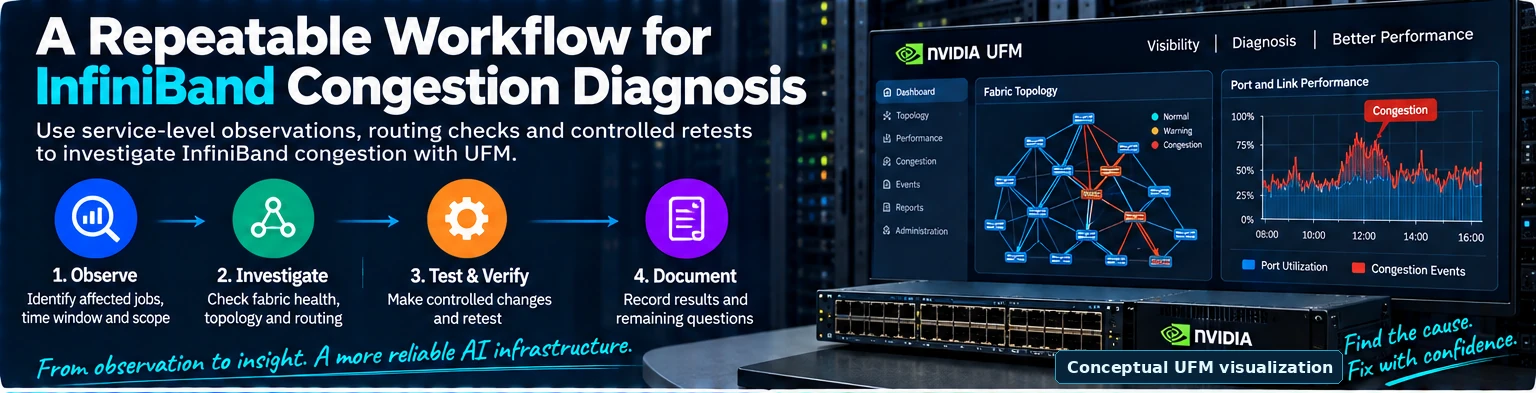
When a distributed application slows down, replacing hardware is an expensive first experiment. Begin by identifying the affected jobs, the timing of the slowdown and the paths those jobs share.
A historical example with useful limits
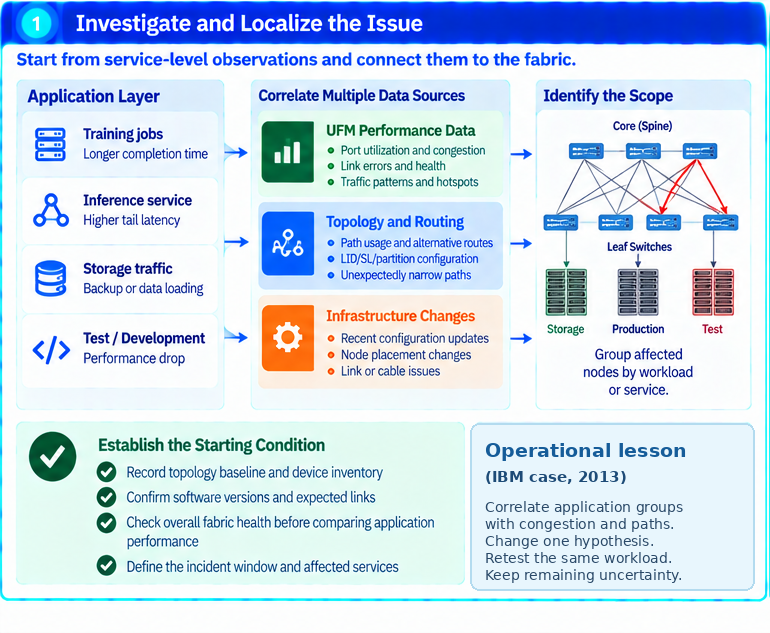
A Mellanox case from 2013 describes IBM using UFM to investigate congestion in a fabric containing storage, production and test groups. Routing corrections improved the condition, although congestion was not eliminated. The end customer, current appliance model and numerical improvement were not disclosed. IBM implementation case
The enduring lesson is operational: connect traffic observations to application groups, test the suspected cause and inspect the result after the change.
Establish the starting condition
For a proposed operating procedure, retain a topology baseline, device inventory and software versions. Record which links should exist and which are intentionally unused. Check the fabric’s health before comparing application performance.
NVIDIA’s later operations guidance organizes this work around initial provisioning, health and topology validation, performance verification and continuing maintenance. NVIDIA operations guidance
Investigate one hypothesis at a time
Begin with a bounded incident window. Match application slowdowns against congestion observations, link errors and placement changes. Group affected nodes by workload or service so a localized issue does not disappear inside a cluster-wide average.
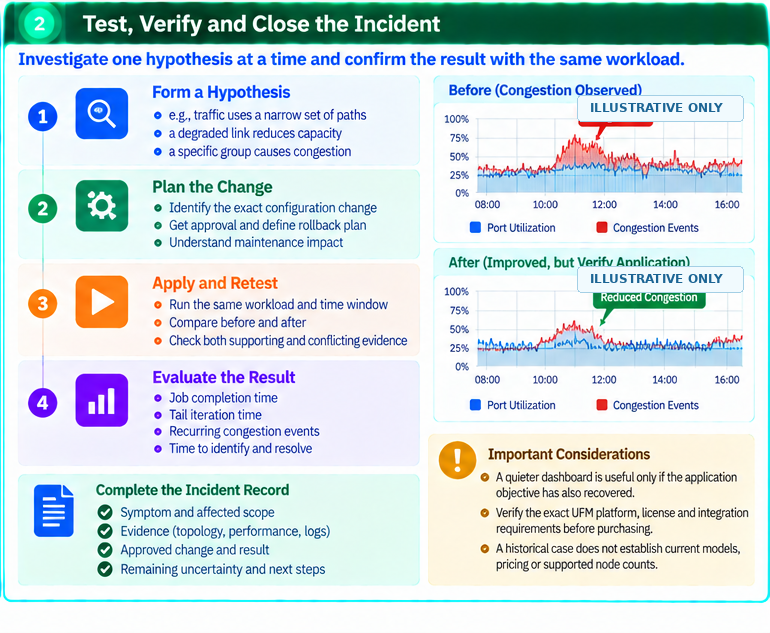
Write down the suspected mechanism before making a change. For example: a subset of jobs may be using an unexpectedly narrow set of paths, or a degraded link may be reducing capacity for one group. These are diagnostic hypotheses, not conclusions from a dashboard alone.
Have the authorized operator review any routing or configuration change, with a rollback plan and maintenance impact understood. Then rerun the same workload and compare the same observation window. Preserve evidence that would disprove the hypothesis as carefully as evidence that supports it.
Define recovery in application terms
Useful acceptance measures include job completion time, tail iteration time, recurring congestion and the time needed to identify the fault. A quieter dashboard is helpful only if the application objective has also recovered.
Keep a short incident record: symptom, affected scope, evidence, approved change, result and remaining uncertainty. This turns troubleshooting into a repeatable practice instead of a collection of one-off fixes.
Select management tooling separately
The historical case supports the value of fabric visibility. It does not identify a current UFM-SDN appliance, licensing entitlement or supported node count. Verify the exact platform, supported release, entitlement and integration requirements before purchasing. An operational success story cannot establish those commercial or technical details.
Sources checked: 10 October 2026. This article discusses third-party evidence or an explicitly labeled engineering scenario; it does not establish a reseller’s delivery history, current stock or exact-SKU deployment.
Technical illustrations