Network solutions
Plan a Four-Branch 400G Edge Without Losing the Physical Port Map
Map four 400G branches to their physical ports before selecting cables, optical modules and breakout modes.
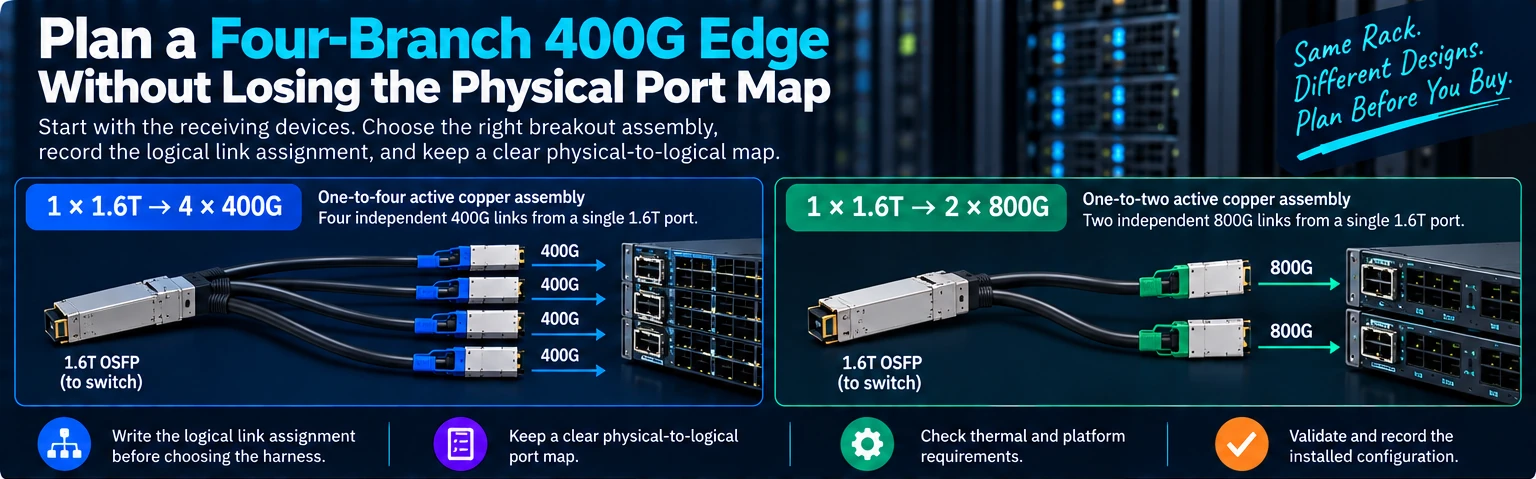
Start with the receiving devices. A one-to-four active copper assembly is useful when four separate 400G links must share a 1.6T physical head. A one-to-two assembly serves a different requirement: two independent 800G links. The cable count can look similar from the rack aisle, so write the logical link assignment before choosing the harness.
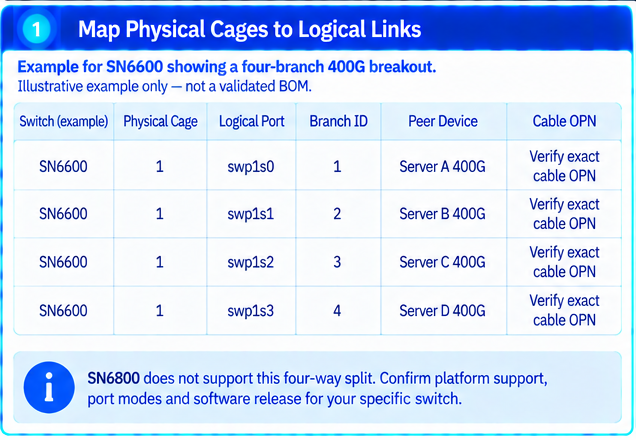
NVIDIA’s Spectrum-6 hardware guide documents both OSFP breakout arrangements and identifies the corresponding linear equalizer/amplifier cable architecture. It also separates physical connectors from the logical subinterfaces shown by the network operating system. Use that distinction to build a port schedule containing switch model, physical cage, logical port, cable OPN, branch label and receiving port. This is a design method, not a statement that every listed cable has completed qualification on every Spectrum-6 switch.
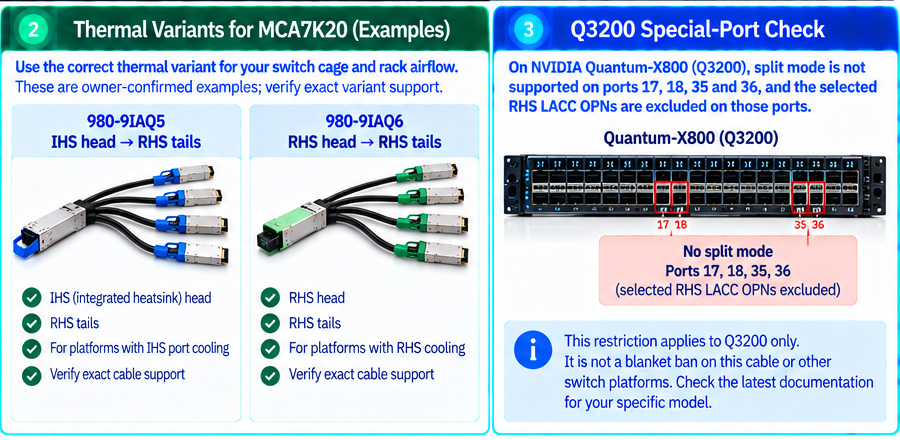
For the owner-confirmed MCA7K20 range, preserve the thermal choice: 980-9IAQ5 variants have an IHS head and RHS branches, while 980-9IAQ6 variants are RHS-to-RHS. Check the cage cooling arrangement against the exact cable. A familiar OSFP outline is insufficient evidence of thermal fit.
A Quantum-X800 design needs its own port check. NVIDIA’s Q3200 guidance excludes split mode on ports 17, 18, 35 and 36 and explicitly excludes the selected RHS LACC codes there. Allocate breakout links only after applying that exception. This restriction does not turn into a blanket rejection of the cable or an assertion about every other Quantum model.
During assembly, label the head and each tail, reserve connector-exit bending space and document the expected link speed for each branch. Validate one complete endpoint pair at a time, then retain the configured port mode and cable identity with the installation record. This makes later service a repeatable physical-to-logical mapping exercise rather than a search for a generic “1.6T cable.”
Scope: Original engineering scenario based on documented NVIDIA applications; not a customer deployment claim.
Public references
- NVIDIA Interconnect for Spectrum-6 Based Ethernet Switches | NVIDIA Spectrum-6 SN6000 Switch Systems Hardware User Manual
- Appendix—Design Consideration Using Q3200 - NVIDIA Docs
- Validated and Supported Cables and Switches | ConnectX-9 Firmware RN
Technical illustrations