Network architecture has evolved significantly over the last decade. What started as simple, flat LAN designs has matured into complex, scalable infrastructures capable of supporting massive data center networks, multi-tenant clouds, and hybrid cloud environments. In the transition from legacy architectures to modern high-performance designs, two protocols stand out as pivotal: Spanning Tree Protocol (STP) and EVPN-VXLAN. While STP was the backbone of the network for decades, it is increasingly viewed as a bottleneck for modern requirements. This guide explores the technical distinctions between these two approaches and explains why shifting toward a Layer 3 overlay is essential for the future-proofing of your data center.
Understanding the Legacy: STP and Spanning Tree Protocols
For a long time, Spanning Tree Protocol (STP) served as the universal solution to prevent loops in Ethernet networks. As introduced by IEEE 802.1D, STP operates strictly at Layer 2. Its primary function is to logically divide a network into multiple broadcast domains, ensuring that no packets circulate infinitely. This is crucial because physical switches often have redundant paths to ensure hardware reliability.
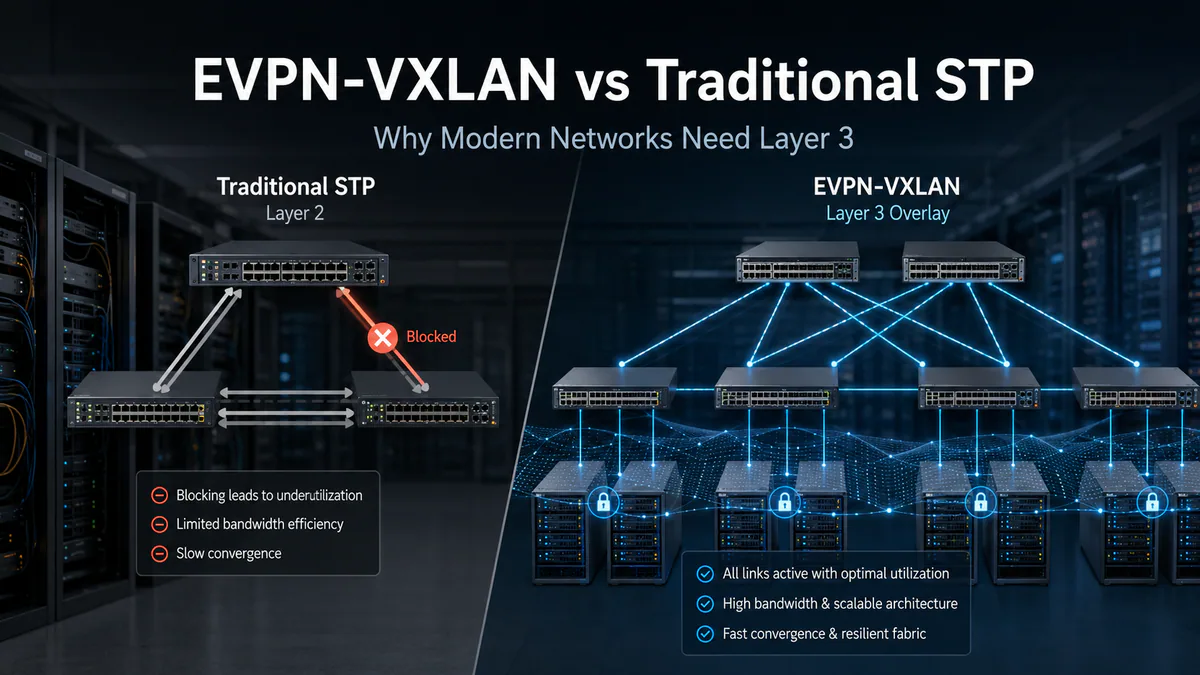
However, in the modern era of high-speed connectivity and virtualization, STP faces several inherent challenges. First, convergence time is slow. When a link fails, STP requires a series of timers (hello intervals, forward delays, and maximum age) to recalculate the topology. During this window, the network could lose connectivity for 30 to 50 seconds, which is unacceptable for real-time applications and cloud services.
Second, STP is inherently Layer 2 based. A Layer 2 broadcast domain can span the entire data center. If you have 500 virtual machines (VMs) running in a single data center, they all reside on a common Layer 2 broadcast domain. As the network grows, the broadcast traffic increases linearly, leading to sub-optimal performance and “broadcast storms.” This lack of segmentation is particularly problematic in large-scale cloud environments where multi-tenancy is key.
The Evolution of Data Center Architectures
As enterprises moved from three-tier collapsed-spine networks to leaf-spine architectures, the limitations of STP became more apparent. Modern data centers are built on the principle of scalability and redundancy. A leaf-spine topology often involves hundreds of spine switches and thousands of compute nodes.
In a traditional Layer 2 design using STP, every access switch must participate in the Spanning Tree logic to prevent loops. This requires significant CPU overhead on edge switches and limits the maximum VLAN count to 4096. Once you hit this limit, you are forced to implement VLAN translation or complex mapping schemes (like VDCs), which introduces complexity and risk.
To overcome these constraints, the industry shifted toward Layer 3 segmentation. By moving the routing boundary up, network engineers could segment the network logically rather than physically. This is where the convergence of EVPN and VXLAN protocols revolutionized the way data center networks operate.
Enter EVPN-VXLAN: The Layer 3 Overlay Solution
EVPN (Ethernet Virtual Private Network) combined with VXLAN (Virtual Extensible LAN) represents the new standard for data center networking. While STP relies on the underlying Layer 2 fabric, EVPN-VXLAN decouples the control plane from the data plane.
VXLAN creates a virtual overlay network, encapsulating Layer 2 frames within Layer 3 UDP packets. This encapsulation allows Layer 2 segments to be transported across a Layer 3 backbone without the overhead of complex STP calculations. EVPN provides the control plane, using BGP (Border Gateway Protocol) to distribute MAC address and IP reachability information across the network.
Key Benefits of EVPN-VXLAN over STP
- Faster Convergence: Because EVPN uses BGP, network updates happen in milliseconds. There is no reliance on STP timers for loop prevention. The underlying physical network design prevents loops naturally through Layer 3 routing.
- Scalability: VXLAN introduces a 24-bit Network Identifier (VNI). This allows for millions of virtual networks, far exceeding the 4094 VLAN limit of STP.
- Multi-Tenancy: With Layer 3 isolation, you can easily create separate virtual tenants within a single physical infrastructure, each with its own security policies and broadcast domains.
- Hardware Agnostic: EVPN implementations often allow for easier integration between multi-vendor environments compared to proprietary STP enhancements.
STP vs EVPN-VXLAN: Key Technical Differences
To better understand the shift, it is helpful to compare the two protocols side-by-side. The table below outlines the critical differences in convergence, scalability, and architecture.
| Feature | STP (802.1D/S/T) | EVPN-VXLAN |
|---|---|---|
| Primary Protocol | Spanning Tree | BGP-EVPN + VXLAN |
| Layer of Operation | Layer 2 | Layer 2 over Layer 3 |
| Convergence Time | Slow (30-50 seconds) | Near Instant (Milliseconds) |
| Broadcast Domain | Limited (Single VLAN) | Unlimited (Per VNI) |
| VLAN Limit | 4096 (12-bit VLAN ID) | 16 million (24-bit VNI) |
| Loop Prevention | Software Logic (Blocking ports) | Network Design (Layer 3 Boundaries) |
| MAC Mobility | Requires Special Config (RSTP/CIST) | Native Support (BGP Active Sync) |
As seen in the table, STP relies on blocking ports to prevent loops, whereas EVPN-VXLAN prevents loops by design through the Layer 3 routing of the underlay. This architectural shift allows network engineers to focus on application performance rather than managing spanning tree states.
Why Layer 3 Networking is Essential for Modern Infrastructure
The transition to a fully Layer 3 network isn’t just about upgrading switches; it is about adopting a methodology that aligns with modern IT demands. Here is why Layer 3 is non-negotiable for scaling networks.
1. Broadcast Control
In a flat Layer 2 domain, broadcast traffic travels every switch in the path. In a modern data center network, broadcast storm mitigation is critical. EVPN-VXLAN isolates these broadcasts logically. Even if a broadcast happens in one tenant’s segment, it never reaches another tenant’s segment.
2. Simplified Migration
Legacy networks often suffer from “VLAN hell,” where managing hundreds of VLAN IDs across different data centers is a nightmare. Layer 3 routing allows you to change IP subnets independently of physical connectivity. If you move a server from one rack to another, you can change its IP without affecting the whole VLAN structure.
3. Security and Policy Enforcement
Layer 3 networks allow for the implementation of Access Control Lists (ACLs) and Quality of Service (QoS) based on IP addresses. Since STP operates at Layer 2, security policies must be applied at the edge, which creates single points of failure. EVPN-VXLAN allows for centralized policy enforcement via the control plane.
4. Support for SD-WAN and Cloud
Modern hybrid cloud environments require networks that understand where traffic is going. Layer 3 protocols like OSPF or BGP are essential for SD-WAN implementations. EVPN-VXLAN integrates seamlessly with SD-WAN controllers, allowing for intelligent path selection and traffic engineering that STP simply cannot support.
Real-World Use Cases for EVPN-VXLAN
Understanding the theory is one thing, but seeing how it applies to real-world scenarios is another. Here are a few examples where organizations are moving from STP to EVPN-VXLAN.
Case Study 1: Hypervisor Migration
A large enterprise IT department was migrating from on-premises servers to a hybrid cloud setup. Their legacy VLANs were reaching the 4096 limit. By implementing VXLAN, the network team could create new Virtual Networks (VNs) for the VMware environment without running out of VLAN IDs. The result was a more modular network where virtualization teams could request isolated networks quickly.
Case Study 2: Multi-Data Center Consistency
A global bank needed consistent network visibility across three geographic data centers. With STP, they had to configure complex MSTP regions to sync the state between sites. By deploying EVPN, BGP synchronization ensured that MAC addresses were visible globally. If a VM moved from Data Center A to Data Center B, the EVPN control plane immediately updated the routing tables, ensuring seamless connection without downtime.
Case Study 3: Network Virtualization
Service providers often need to slice their physical network to sell as a service. EVPN-VXLAN allows service providers to easily slice the network based on tenant requirements. They can offer Layer 2 segments over a Layer 3 underlay, providing true multi-tenancy with independent security zones, which is impossible to achieve efficiently with legacy STP.
EVPN-VXLAN Procurement Checklist
Selecting hardware for EVPN-VXLAN should focus on open standards support, routing scale, observability, and operational fit rather than brand alone.
What to Validate Before Purchase
- Open Standards: Confirm BGP-EVPN, BFD for fast convergence, VXLAN VTEP support, and interoperability with the existing routing stack.
- Hardware Performance: Validate 25G/100G/400G port options, buffer depth, forwarding capacity, and optics compatibility for the target data center design.
- Automation Support: Check whether the platform exposes APIs, telemetry, configuration templates, and rollback workflows that match the team’s operating model.