In the competitive landscape of modern industrial automation, network infrastructure is no longer just a utility; it is a critical component of operational efficiency. For a prominent German manufacturing company specializing in precision machinery, the legacy network architecture was becoming a bottleneck that stifled productivity and inflated operational expenditures (OpEx). By transitioning from an aging vendor ecosystem to a modernized solution, the company successfully executed a network cost reduction strategy that yielded a 40% savings within the first year.
This article explores the technical challenges faced by industrial enterprises and details the implementation of open network switches to resolve them. Whether you are managing a multi-site factory floor or a regional distribution center, this case study provides actionable insights into optimizing network reliability while slashing capital expenditure.
The Network Cost Challenge in German Manufacturing
Industrial environments present unique demands for network infrastructure. Machines require high-bandwidth connectivity for data collection, video surveillance systems need low-latency connections, and IoT sensors demand reliable Power over Ethernet (PoE). However, many manufacturing firms still operate on infrastructure acquired a decade ago.
Aging Infrastructure and Downtime Risks
The primary driver for the German manufacturer’s decision was a looming risk of unplanned downtime. Their previous equipment, largely sourced from vendors with limited local support, was suffering from increasing packet loss and latency issues. In a manufacturing setting, a single minute of network interruption can translate to thousands of Euros in lost production time. Furthermore, older switches often lack the necessary firmware updates to support newer IoT standards, creating security vulnerabilities that could halt production lines.
Rising Operational Expenditures (OpEx)
Beyond hardware failure, the cost of ownership for legacy gear was escalating. The company faced significant licensing fees and expensive spare parts procurement. Each service ticket resolved by the legacy vendor’s remote support team cost hundreds of dollars, plus the indirect cost of technician downtime. As the hardware reached end-of-life (EOL), maintaining warranty coverage became prohibitively expensive. The finance department flagged the need for immediate network cost reduction before the current contract expired.
Strategic Migration to Open Network Switches
The decision to migrate to open network switches was based on a comprehensive Total Cost of Ownership (TCO) analysis. The selected architecture balanced price performance, feature coverage, operational simplicity, and local support availability in the DACH (Germany, Austria, Switzerland) region.
Leveraging Industrial-Grade Reliability
The manufacturer prioritized switch models designed for 24/7 operation. The selected core and access switches provided redundant power supplies, high-capacity thermal management, and hardware monitoring suitable for factory floors where dust and humidity are common concerns. Unlike consumer-grade networking gear, the open network switches selected were validated for the operating environment, ensuring that the network backbone would remain stable regardless of seasonal temperature fluctuations typical in a European facility.
PoE+ for Automation and Surveillance
A critical requirement for the modern factory floor was supporting a wide array of networked devices without a separate power infrastructure. This is where the Power over Ethernet (PoE) capabilities of the new infrastructure played a pivotal role. The implementation included upgrading switch ports to support IEEE 802.3at (PoE+) and IEEE 802.3bt (PoE++) standards.
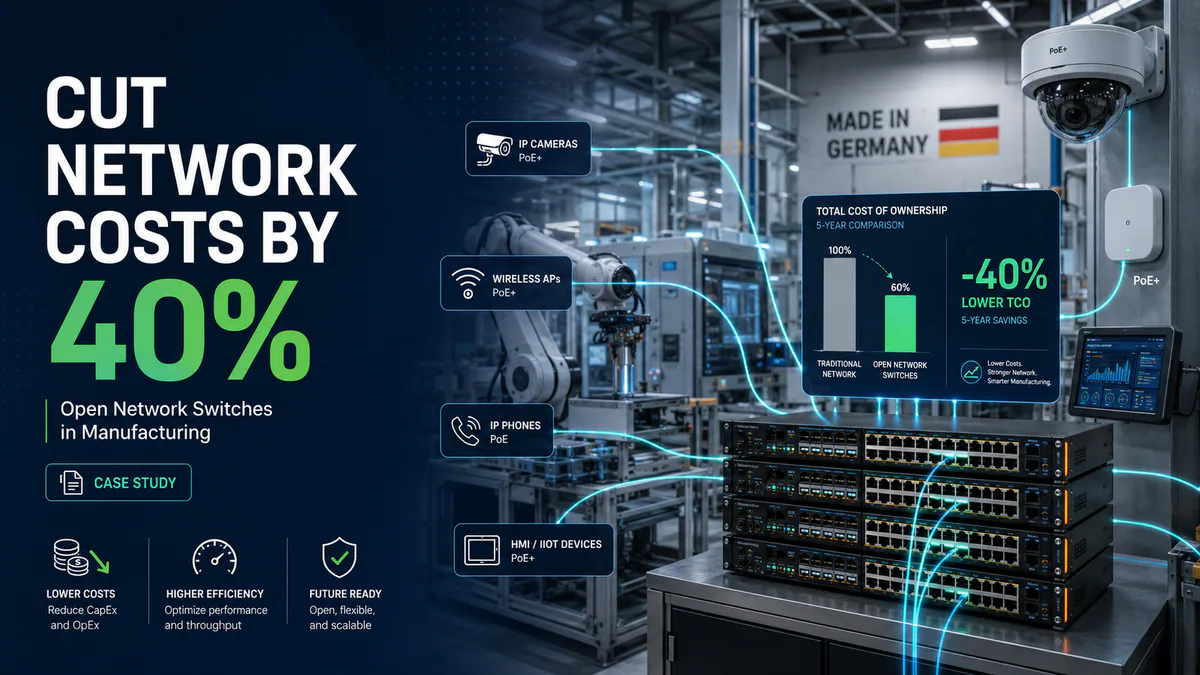
By utilizing these features, the IT team could power Wi-Fi Access Points, VoIP phones, and security cameras directly through the Ethernet cable. This eliminated the need for costly separate electrical cabling runs to every corner of the facility. Replacing legacy PoE switches with 24-port and 48-port managed PoE access switches allowed the company to power IP cameras and APs at scale, enhancing security monitoring for assembly lines without adding separate power adapters at every endpoint.
Quantifying the Impact of Network Cost Reduction
The migration was executed in phases, starting with the core layer distribution switches before moving to the access layer. After six months of operation, the results were measurable. The financial team utilized standard accounting methodologies to track the network cost reduction achieved.
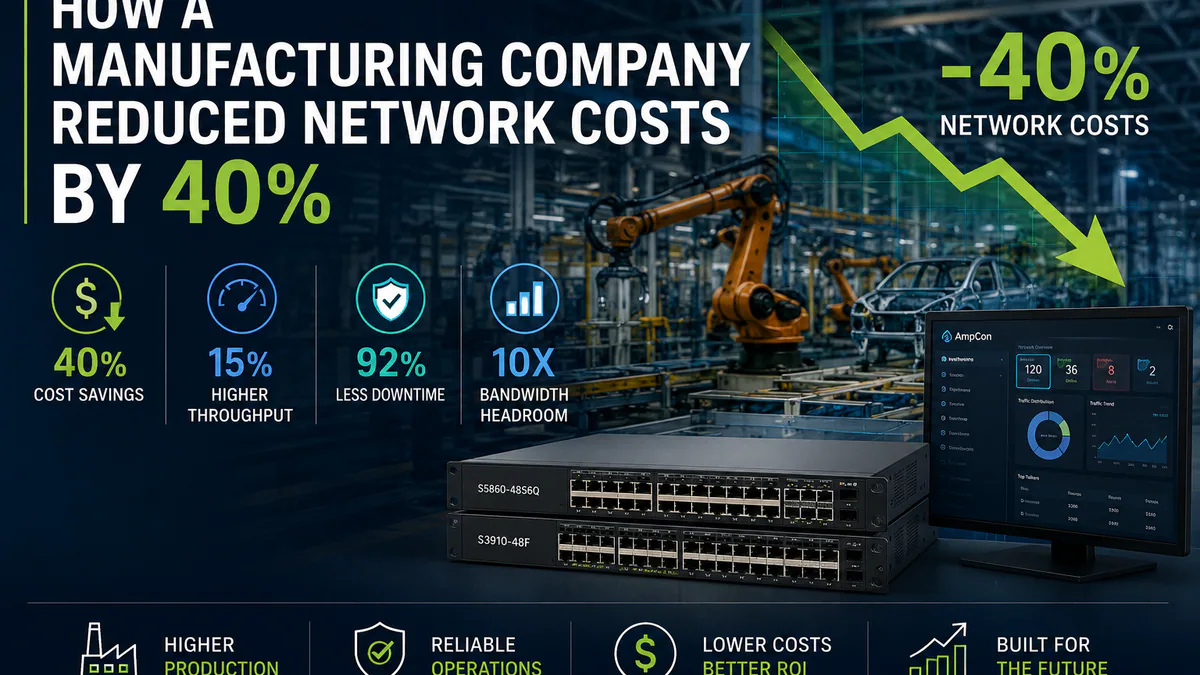
By 2023, the company reported a 40% reduction in total network spending. This figure accounted for the elimination of legacy support fees, the savings from lower-priced hardware replacements, and the reduction in energy consumption from more efficient silicon and power supplies.
Key Performance Indicators (KPIs)
| KPI | Legacy Architecture | Post-Migration Architecture |
|---|---|---|
| Network Uptime | 99.4% | 99.99% |
| Average Packet Loss | 0.5% | <0.1% |
| Support Ticket Cost | €150 per ticket | €0 (Self-service) |
| Power Consumption | High (Legacy PSU) | Optimized (Efficient PSU) |
The ability to self-manage the infrastructure and handle minor firmware updates locally, rather than waiting for external vendors, provided an additional efficiency boost that was not fully captured in the hard costs alone.
Recommended Product Categories
To replicate this approach, other manufacturing facilities should evaluate the following product categories:
- Industrial Core Switches: Rugged, high-throughput platforms for factory backbones and aggregation layers.
- Managed PoE Access Switches: Cost-effective access-layer switches for cameras, APs, phones, and industrial endpoints.
- Network Management Platforms: Tools that improve visibility, configuration consistency, and change-control discipline.
- Ruggedized Edge Switches: DIN-rail or hardened switches for production zones with heat, vibration, dust, or limited cabinet space.
These products provide a scalable path for industrial networks to modernize.
Conclusion
Transitioning from legacy hardware to a modern, robust network architecture is not merely an IT upgrade; it is a strategic business move. For the German manufacturer, the adoption of open network switches unlocked significant network cost reduction while simultaneously improving network reliability and operational safety. This case study demonstrates that by focusing on Total Cost of Ownership and selecting industrial-grade hardware, manufacturing companies can protect their production lines from downtime and secure their data.
For industrial network architects, the message is clear: Invest in a future-proof infrastructure that supports the next generation of IoT and industrial automation. By leveraging the flexibility and reliability of open network switches, your network will become a strategic asset rather than a cost center, driving productivity and profitability in the modern industrial landscape.