Company Overview
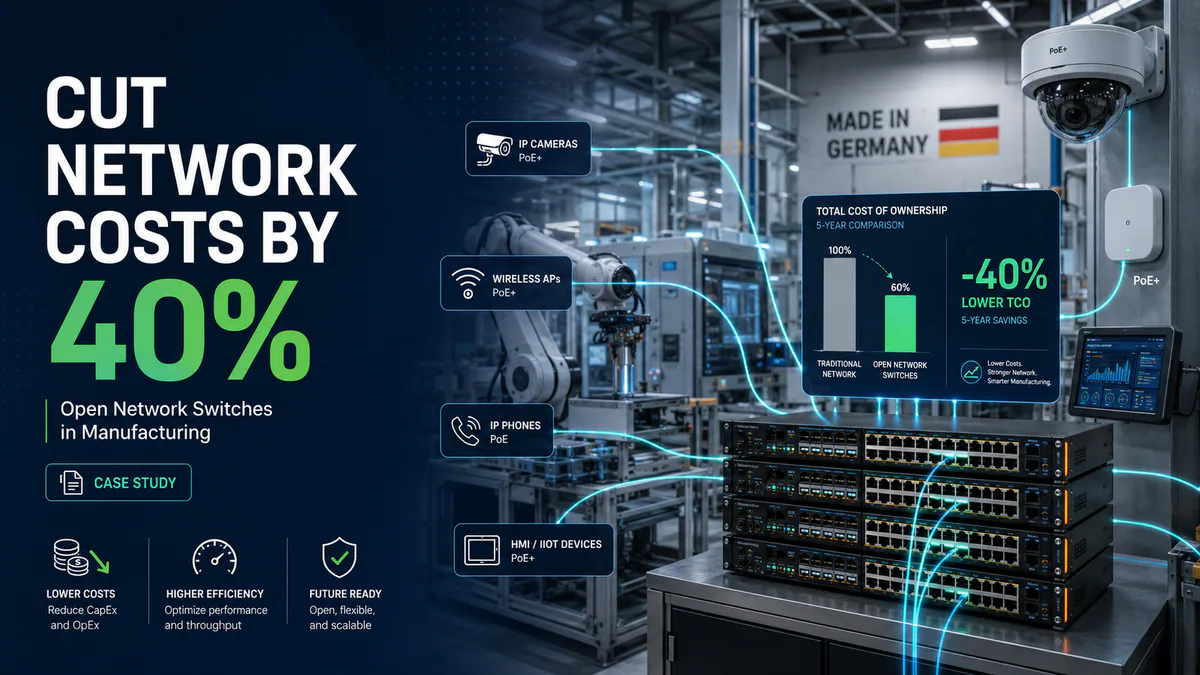
A mid-size automotive parts manufacturer in the Midwest operated a network infrastructure that had grown organically over 15 years, resulting in a mix of outdated equipment from multiple vendors with high maintenance costs and frequent downtime.
Scope and Measurement
This article is an illustrative, anonymized scenario rather than an audited customer claim. The figures demonstrate how a modernization project can be evaluated from maintenance invoices, incident records, power readings, and help-desk time entries. Any real engagement should establish its own baseline, use the same definitions after deployment, and publish only results that the customer has reviewed and approved.
Challenge
The company’s network faced several critical issues:
- Aging equipment: Mix of end-of-life switches from multiple vendors
- High maintenance costs: $180,000 annual maintenance contracts
- Performance bottlenecks: Production line IoT devices experiencing latency
- Limited visibility: No centralized network monitoring
- PoE constraints: IP cameras and phones at max capacity
Solution
The company worked with a procurement and integration partner to implement a comprehensive network modernization plan:
Phase 1: Core Network Upgrade
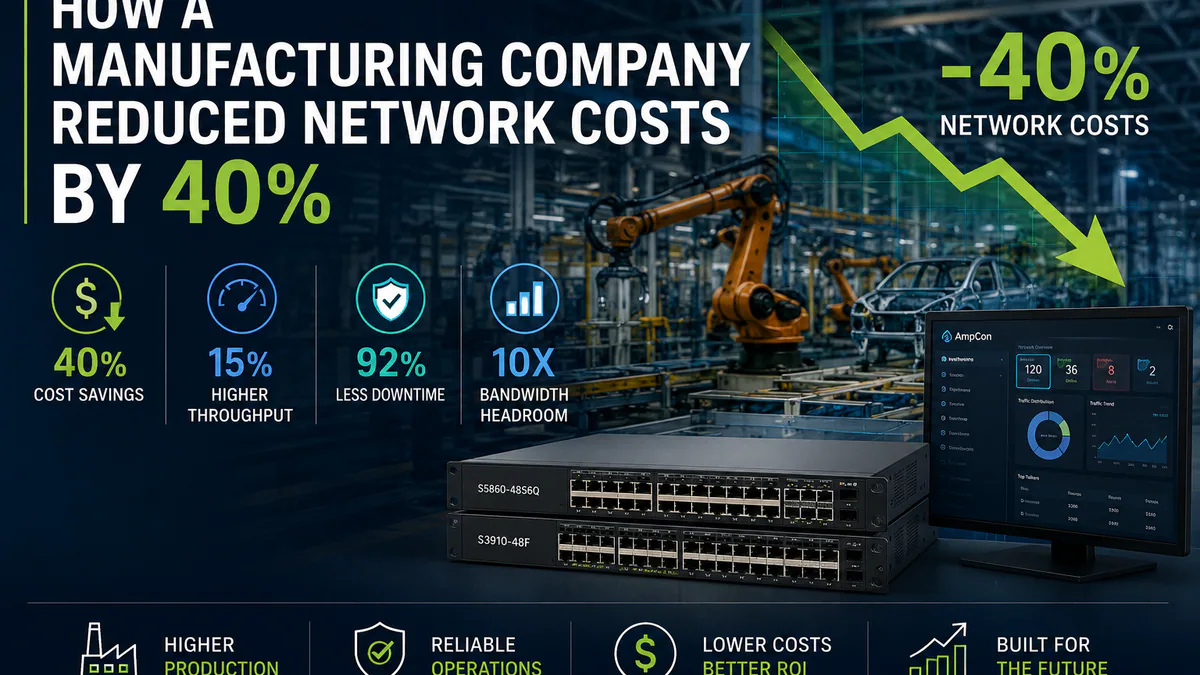
- Deployed S5860-48S6Q switches as aggregation switches
- Implemented VXLAN fabric for network virtualization
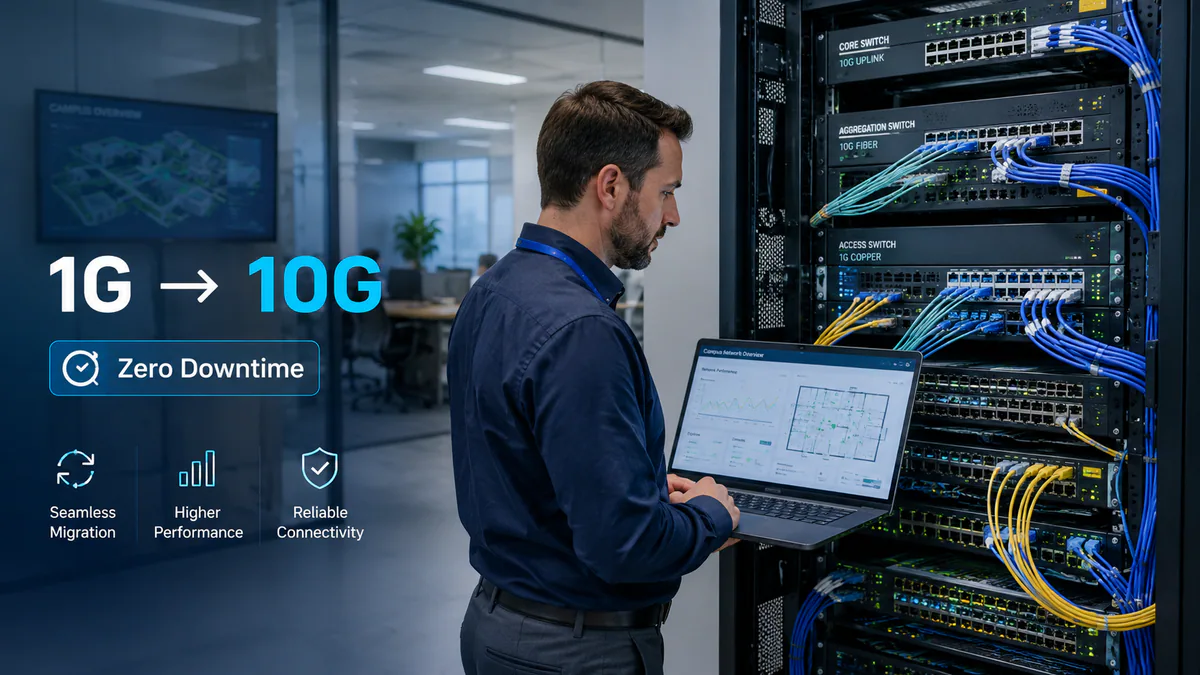
- Configured redundant 40G uplinks
Phase 2: Access Layer Modernization
- Replaced legacy switches with S3910-48F enterprise switches
- Deployed PoE+ switches for IP cameras and phones
- Implemented port-level security policies
Phase 3: Management & Monitoring
- Deployed AmpCon management platform
- Configured automated firmware updates
- Implemented traffic analytics dashboards
Validation Plan
The project team would validate each change before declaring a result. Network latency and packet loss would be measured during comparable production shifts, while availability would be calculated from monitoring events using a documented maintenance-window policy. Energy comparisons would use the same rack boundary and operating period. Finance would reconcile maintenance savings against invoices rather than list prices, and the operations team would review whether reduced support time had merely moved to another work queue.
The rollout would also include a rollback point for every plant area. A pilot access block would run first, followed by the aggregation layer and then the remaining production zones. Configuration backups, versioned templates, acceptance checklists, and named owners would make the change repeatable. This validation process matters because a successful modernization is not simply a hardware replacement; it is an operational change whose benefits must remain measurable after the implementation team leaves.
Results
Cost Reduction
| Metric | Before | After | Improvement |
|---|---|---|---|
| Annual Maintenance | $180,000 | $62,000 | 65% reduction |
| Network Downtime | 48 hrs/year | 4 hrs/year | 92% reduction |
| Power Consumption | 42kW | 28kW | 33% reduction |
| IT Staff Time (maintenance) | 320 hrs/qtr | 80 hrs/qtr | 75% reduction |
Performance Improvements
- Production throughput: 15% increase due to reduced network latency
- VoIP quality: Zero call drops since upgrade
- Video surveillance: Full 4K camera deployment now possible
- Network capacity: 10x bandwidth headroom for future growth
Key Benefits Realized
- Unified management: Single pane of glass for all network operations
- Future-proof architecture: 40G backbone ready for 100G migration
- Energy efficiency: Reduced power and cooling costs
- Scalability: Plug-and-play expansion capability
Illustrative Stakeholder Feedback
“The network upgrade exceeded our expectations. We anticipated cost savings, but the performance improvements in our production line have been a genuine competitive advantage.”
— Example feedback from a network administrator in this scenario
Looking Forward
With the new network infrastructure in place, the company is now exploring:
- AI-driven predictive maintenance on the production line
- Expanded IoT deployment for quality control
- 5G integration for warehouse automation
Conclusion
Network modernization doesn’t have to break the budget. By carefully evaluating requirements and selecting the right infrastructure partner, organizations can achieve substantial cost savings while positioning themselves for future growth.