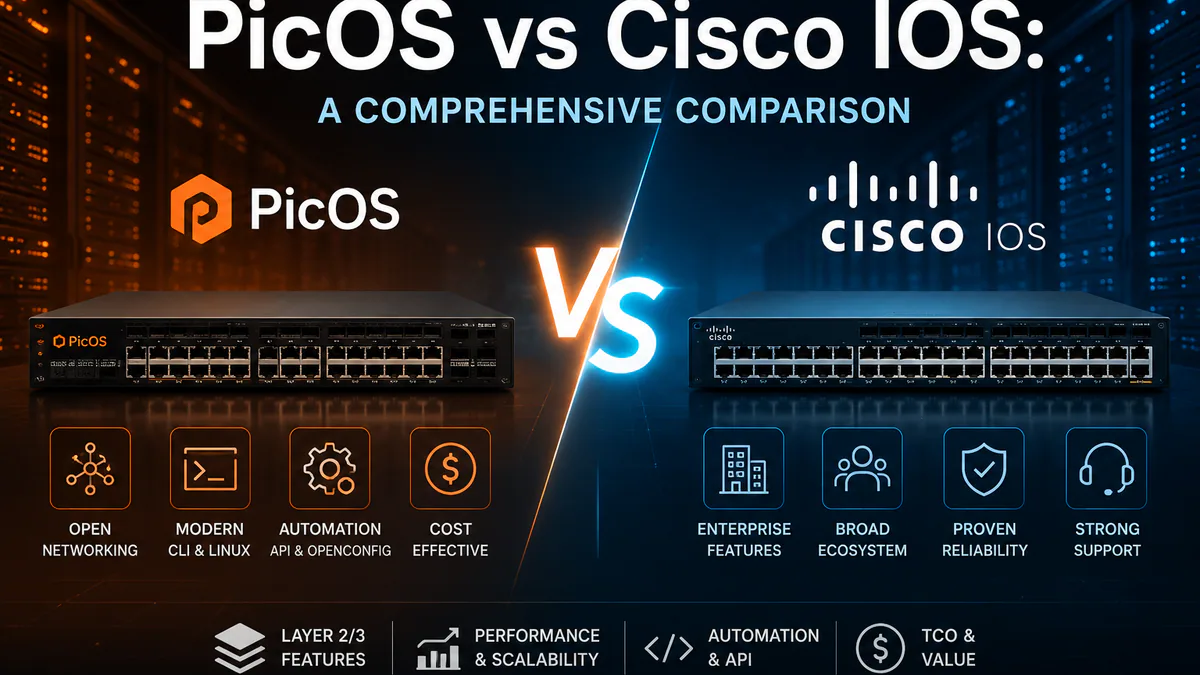
When selecting an operating system for enterprise switches, two prominent options stand out: PicOS for open networking platforms and Cisco IOS from Cisco Systems. This comparison helps you understand the strengths and trade-offs of each platform.
Overview
| Aspect | PicOS | Cisco IOS |
|---|---|---|
| Target | Enterprise/Campus | Enterprise/Campus/Core |
| Hardware | open network switches | Cisco hardware |
| Licensing | Subscription-based | Subscription-based |
| CLI Style | Linux-based, modern | Traditional Cisco CLI |
Feature Comparison
Layer 2 Features
PicOS:
- 802.1Q VLANs with voice VLANs
- Link Aggregation (LACP, static)
- Spanning Tree (STP, RSTP, MSTP)
- LLDP and CDP
Cisco IOS:
- Full 802.1D/1Q/1s support
- EtherChannel (PAgP, LACP)
- All STP variants
- Legacy protocol support
Layer 3 Features
Both platforms offer comprehensive Layer 3 capabilities:
| Feature | PicOS | Cisco IOS |
|---|---|---|
| Static Routing | Yes | Yes |
| RIP | Yes | Yes |
| OSPF | Yes | Yes |
| BGP | Yes | Yes |
| VRF | Yes | Yes |
| IPv6 | Full | Full |
Automation and Programmability
PicOS advantages:
- OpenConfig support
- REST API for management
- Ansible/Puppet integration
- Python SDK
- Linux-based shell access
Cisco IOS advantages:
- Wide vendor support
- Mature automation ecosystem
- Comprehensive Cisco DNA Center integration
- Strong enterprise support
Performance Considerations
PicOS on open network switches delivers competitive performance:
- Wire-speed forwarding on all ports
- Hardware-accelerated switching
- Low latency for time-sensitive applications
Total Cost of Ownership
| Cost Factor | PicOS/Open Networking | Cisco IOS/Cisco |
|---|---|---|
| Hardware | Lower cost | Premium pricing |
| Software | Subscription | Subscription |
| Support | 24/7 available | Smart Net |
| Training | Lower learning curve | Steeper learning curve |
When to Choose PicOS
PicOS is an excellent choice when:
- Budget constraints require cost-effective alternatives
- You prefer modern, Linux-based CLI
- Open automation is a priority
- You value competitive performance at lower cost
When to Choose Cisco IOS
Cisco IOS remains strong when:
- Existing Cisco infrastructure dominates
- Cisco DNA Center is part of your strategy
- Network team has deep Cisco expertise
- Compliance requires established vendor
Migration Considerations
Switch operating system migration should be treated as a network program, not a device swap. Teams moving from a Cisco-only environment to PicOS-based open networking should start with non-critical access or aggregation domains, then expand once monitoring, rollback, and support processes are proven.
Recommended migration sequence:
- Export the current configuration and identify features that must be translated, such as VLANs, trunks, ACLs, routing protocols, and QoS policies.
- Build a lab topology that mirrors the production uplink, routing, and management model.
- Validate optics and cable compatibility before scheduling the production cutover.
- Confirm monitoring integrations for logs, SNMP, telemetry, and alerts.
- Document rollback steps for both configuration and physical cabling.
Risk Checklist
The main risks are not usually basic switching features. They are operational details: command syntax differences, automation scripts that assume Cisco output formats, support escalation paths, and edge cases in routing or spanning-tree behavior. A proof of concept should include failure testing, not only successful forwarding tests.
Useful checks include:
- Link failure and recovery timing.
- OSPF/BGP neighbor convergence.
- VLAN trunk behavior with existing Cisco devices.
- ACL parity and logging output.
- Configuration backup and restore workflow.
- Firmware upgrade process and maintenance window length.
Procurement Guidance
For greenfield deployments, PicOS-based open networking can be compelling when cost control and automation flexibility matter. For brownfield environments, the decision depends on how tightly the existing estate is coupled to Cisco tooling. Many organizations use a hybrid approach: keeping Cisco where platform standardization is mandatory while introducing PicOS in new capacity, lab environments, or cost-sensitive access layers.
Conclusion
Both PicOS and Cisco IOS are capable operating systems. The choice depends on your specific context—existing infrastructure, budget, team skills, and long-term strategy. PicOS-based open networking can offer compelling value without sacrificing enterprise features, making it an increasingly popular choice for organizations seeking alternatives to traditional vendor stacks.