
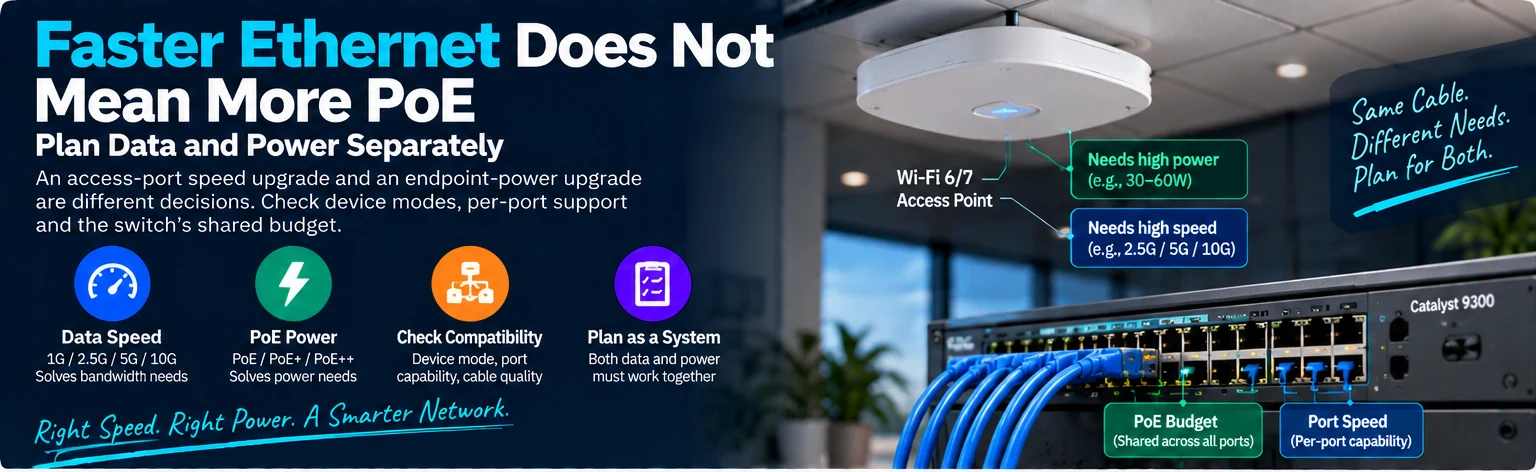
An access point can have a multigigabit Ethernet interface and still require more power than its switch port can provide. Conversely, a port may provide sufficient power while its data rate limits the intended workload. These are separate constraints, even when they appear on the same RJ45 connector.
A campus upgrade should therefore have two linked plans: one for communication and one for endpoint power.
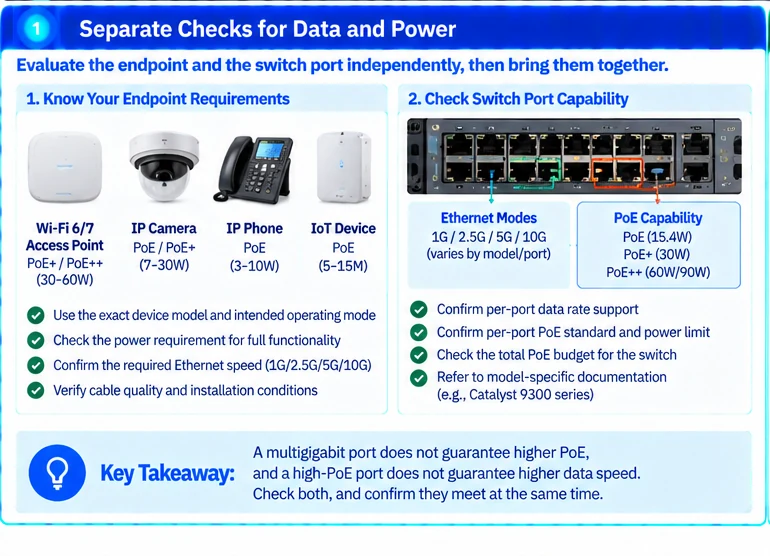
Start with the endpoint’s intended operating mode
Record the device model and the functions that must be enabled. Consult its power requirements for that mode rather than using an idle reading or assuming that successful boot means full functionality.
Then check the proposed switch port’s supported Ethernet modes and PoE capability independently. Cisco’s Catalyst 9300 documentation distinguishes model-specific interfaces, power capabilities and system options; a family name is not enough to establish them. R12
The required cable channel must also be suitable for the intended application. Reusing a working low-speed link is a proposal to qualify, not evidence that every new data and power requirement is already satisfied.
Per-port capability is not the total budget
PoE documentation distinguishes the power-sourcing equipment, or PSE, from the powered device, or PD. Power available at the PD is lower than the PSE’s allocation because the channel has losses. Compare values at the same boundary. R32
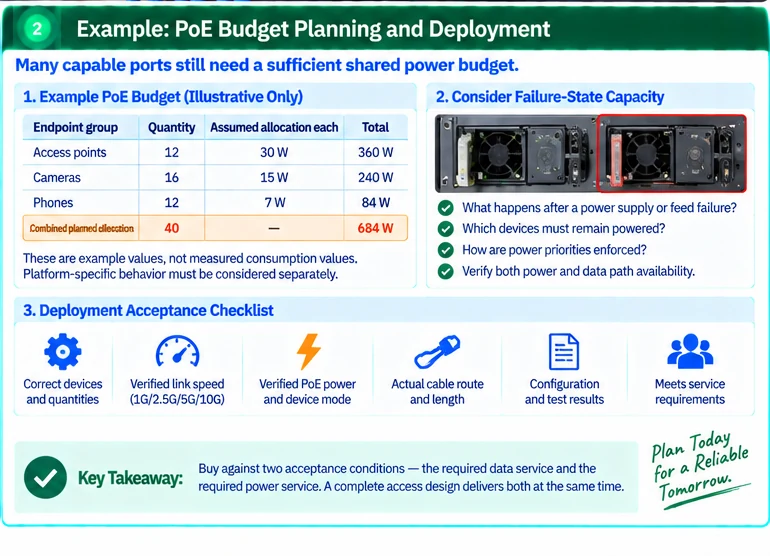
Now add the allocations across the switch. An illustrative budget, using assumed PSE-side planning values, is:
| Endpoint group | Quantity | Assumed allocation each | Total |
|---|---|---|---|
| Access points | 12 | 30 W | 360 W |
| Cameras | 16 | 15 W | 240 W |
| Phones | 12 | 7 W | 84 W |
| Combined planned allocation | 40 | — | 684 W |
These are not measured consumption values or guaranteed allocations for a particular product. They illustrate why a switch with many capable PoE ports still needs a sufficient shared budget. Hardware-specific reservation and negotiation behavior must be considered separately.
Failure-state capacity changes the answer
A design that supports all endpoints during normal operation may not support them after a supply or feed failure. Decide which devices must remain powered and how priorities are enforced on the selected platform.
Check both the remaining power and the remaining data path. Keeping an access point powered is not useful if its required uplink service has failed; restoring its data path is not enough if it reboots because power was shed.
Buy against two acceptance conditions
The communication test should verify the intended link rate and representative service behavior. The power test should verify allocation, device operating mode and the agreed failure response. Record both results and their configuration context.
A good enquiry therefore includes endpoint quantities, desired operating modes, per-device power requirements, cable conditions and uplink demand. The question is not “which switch is faster?” It is “which complete access design delivers the required data and power at the same time?”
Engineering illustrations
These figures illustrate the design concepts discussed here. They are not measured results, certified configurations or a supplied-equipment list.
Related reading
- Multigigabit Campus Design: Balance Access Speed, PoE and Uplinks
- C9300X Multigigabit Selection: Verify the Port Mix and PoE Budget