

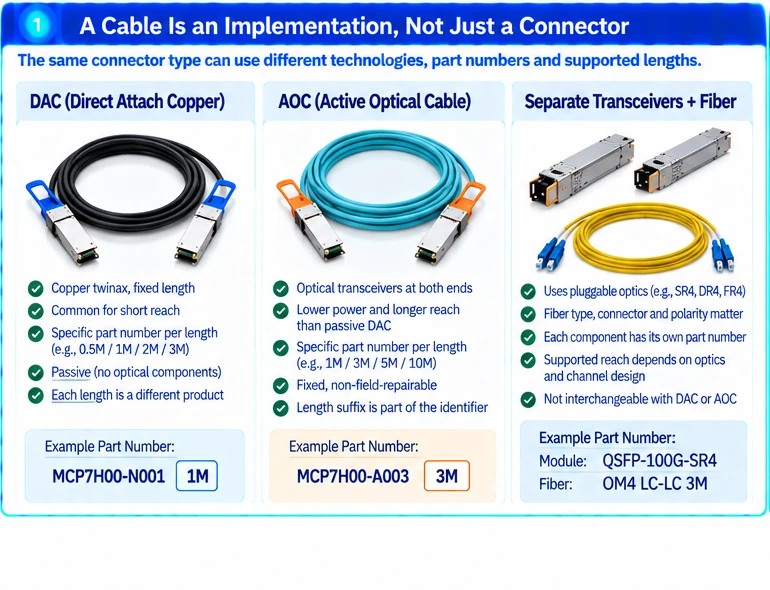
A cable quotation is often shortened to speed, connector and length. That can be useful for an initial enquiry, but it is too imprecise for an approved installation. In a fixed DAC or AOC assembly, the length suffix is part of the product identity—not an optional note after the model number.
Changing that suffix may change the assembly being qualified. Its suitability must be checked against both endpoints and the actual routing requirement.
A cable is an electrical or optical implementation
A direct-attach assembly is not interchangeable with any other item carrying the same connector name. Vendor support lists distinguish cable and transceiver variants, operating modes and applicable lengths. NVIDIA’s interconnect guidance and Cisco’s 100G module documentation provide examples of this component-level treatment. R01R25
Do not invent a universal distance at which every passive cable becomes unsuitable or every active cable becomes necessary. The boundary depends on the interface and supported product implementation.
For an AOC, retain the complete fixed assembly identifier. For separate transceivers and fiber, retain both module identifiers and the channel components. These are different replacement units and should not share an ambiguous inventory description.
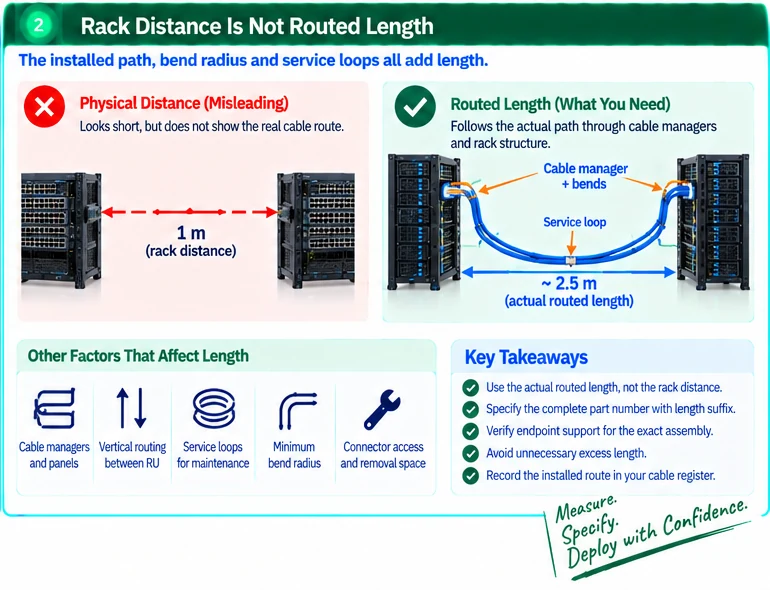
Rack distance is not routed length
A one-meter separation between devices does not prove that a one-meter assembly will reach. The installed route may pass through horizontal managers, rise between rack positions and require a service loop. Connector access and permitted bend radius also consume space.
As an illustrative planning example, a physically adjacent pair of devices may require a longer route because their ports face opposite service areas. The right answer comes from the rack drawing and supported assembly options, not simply from the shortest distance between chassis.
Excess length has a cost too: it can obstruct service access and create avoidable handling risk. The design should provide enough reach without treating extra cable as harmless.
Substitution is a controlled change
A supplier may offer a cable that appears equivalent but differs in length or implementation. Before approval, compare the full part number, endpoint support, operating mode, environmental requirements and planned route.
| Original requirement | Substitution review |
|---|---|
| Exact fixed assembly | Does the offered part identify the same supported implementation? |
| Defined endpoint pair | Is the alternative qualified at both ends? |
| Measured routing path | Does the length work without tension or unsupported bends? |
| Maintenance plan | Can the assembly be replaced without disturbing unrelated links? |
An approved alternative should be entered into the link schedule. Otherwise receiving inspection and future fault replacement will still use the original description, creating uncertainty precisely when fast recovery is needed.
Keep the label through the lifecycle
Record the received identifier, actual endpoints and installed route in the cable register. Where practical, label the physical link so that technicians can match it to the inventory without tracing it from memory.
The small discipline of preserving a suffix prevents a larger mistake: assuming that equal headline speed makes two fixed assemblies equivalent. Buy the exact link implementation the design needs, and treat any change as something to verify rather than silently accept.
Engineering illustrations
These figures illustrate the design concepts discussed here. They are not measured results, certified configurations or a supplied-equipment list.
Related reading
- Short-Reach Network Links: Choosing DAC, AOC or Separate Optics
- 10G, 40G and 100G Short-Link Selection: DAC, AOC and SR-BD Checks