
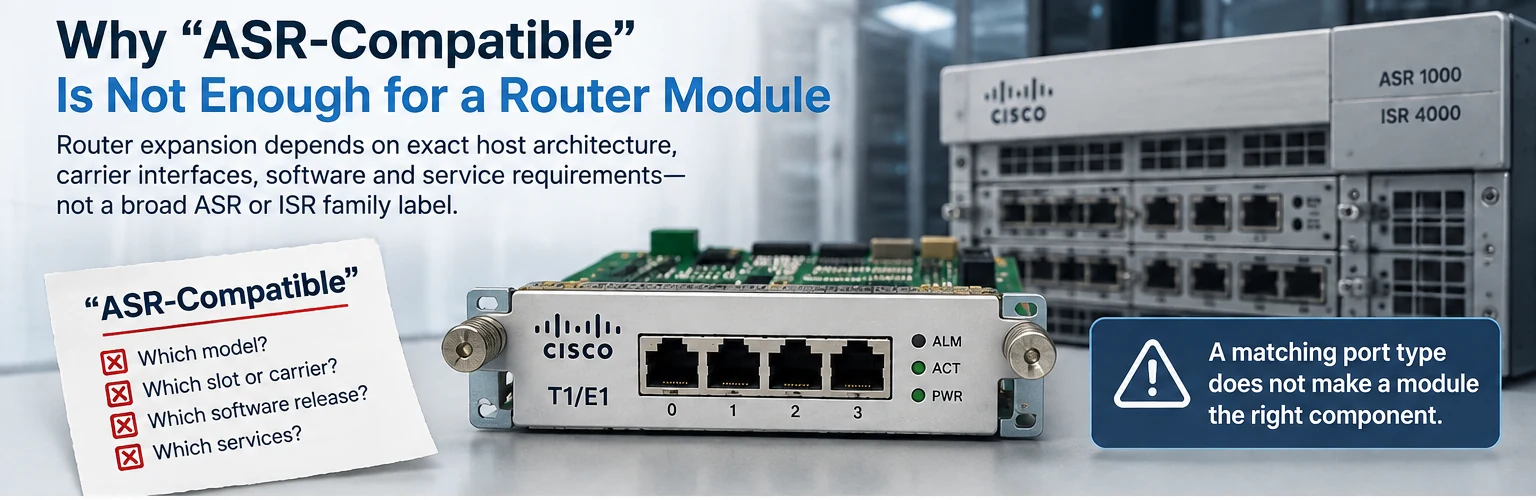
A router module can match the required port type and still be the wrong component for the installed system. The mistake often begins with a broad compatibility phrase such as “for ASR routers.” That phrase leaves the chassis generation, carrier arrangement and software support unresolved.
A module purchase should start with the installed architecture and the service being delivered—not the family name alone.
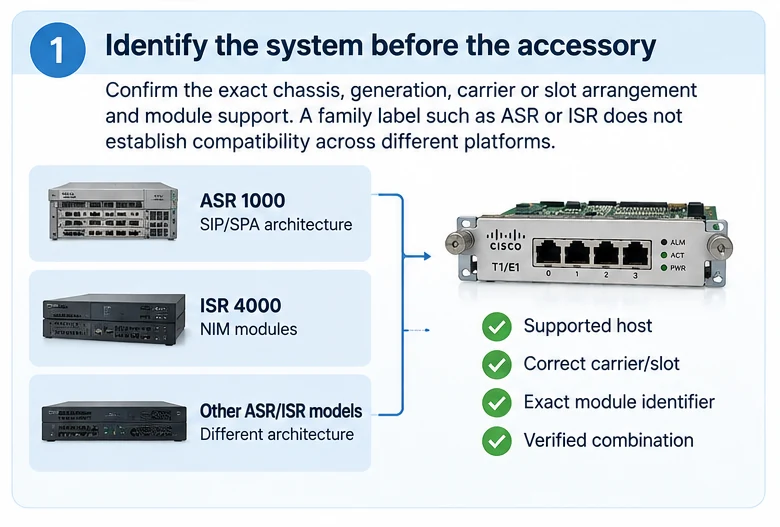
Identify the system before the accessory
Capture the full chassis and installed component identifiers. Establish where the proposed module would connect and what supporting hardware it requires.
Cisco’s ASR 1000 SIP/SPA documentation describes a particular modular architecture. It should not be used as evidence that every ASR platform accepts the same components. Similarly, ISR network-interface modules belong to their documented host combinations, not to a universal Cisco module ecosystem. R20R21
Physical similarity is not sufficient evidence. The relevant support reference must identify the actual host, carrier or slot arrangement and module.
The service can be more specific than the connector
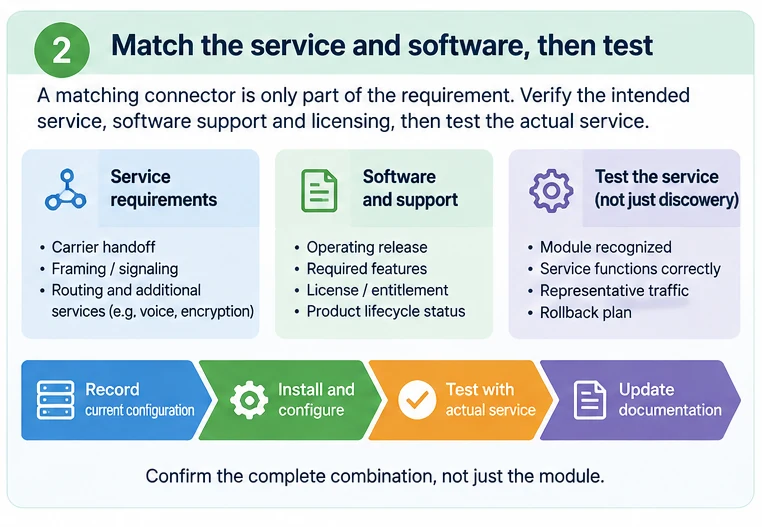
Document the carrier handoff, framing or signaling where applicable, routing requirements and any additional services such as encryption or voice processing. A matching connector only resolves one part of that requirement.
For digital voice interfaces, for example, the intended T1/E1 operating role and supporting resources must be checked against the module’s documentation. A port label does not establish a complete voice-gateway configuration. R21
The evaluation should explain which services must run simultaneously. A platform-level headline throughput figure does not substitute for a supported and tested service configuration.
Software is part of the compatibility record
Record the operating image, release, required features and entitlement assumptions. Distinguish “the hardware is recognized” from “the intended service is supported and authorized in this configuration.” Confirm transfer and support terms separately from the physical sale.
For older equipment, check the exact product’s lifecycle notices and available software path. Cisco’s lifecycle policy explains the framework, but the milestones for one product cannot be assigned to another by age or family name. R19
| Requirement | Evidence that closes it |
|---|---|
| Mechanical and host support | Exact chassis/carrier/module reference |
| Interface behavior | Documented service mode and peer requirements |
| Software support | Applicable release and feature conditions |
| Operational continuity | Configuration backup, replacement procedure and rollback |
Test the service, not just module discovery
An illustrative replacement may pass inventory recognition while failing the carrier service because framing, signaling or configuration differs. The acceptance plan should therefore include the actual handoff and representative traffic, not only a boot log.
Stage the proposed combination where practical. Save the existing configuration, establish recovery access and define a clear rollback condition before work begins. Any change to the module, carrier or release should update the approved configuration record.
A useful enquiry includes the installed inventory and service requirement alongside the desired interface. That gives a supplier or engineer enough information to qualify a specific replacement instead of guessing from “ASR-compatible.”
Engineering illustrations
These figures illustrate the design concepts discussed here. They are not measured results, certified configurations or a supplied-equipment list.
Related reading
- WAN Router Changes: Plan Interfaces, Services and a Recoverable Cutover
- ASR and ISR Selection Checklist: Chassis, Modules, Services and Entitlements