
Cisco · wan
WAN Router Changes: Plan Interfaces, Services and a Recoverable Cutover
Plan ASR and ISR replacement or expansion from carrier handoffs, service features, module dependencies and rollback requirements.
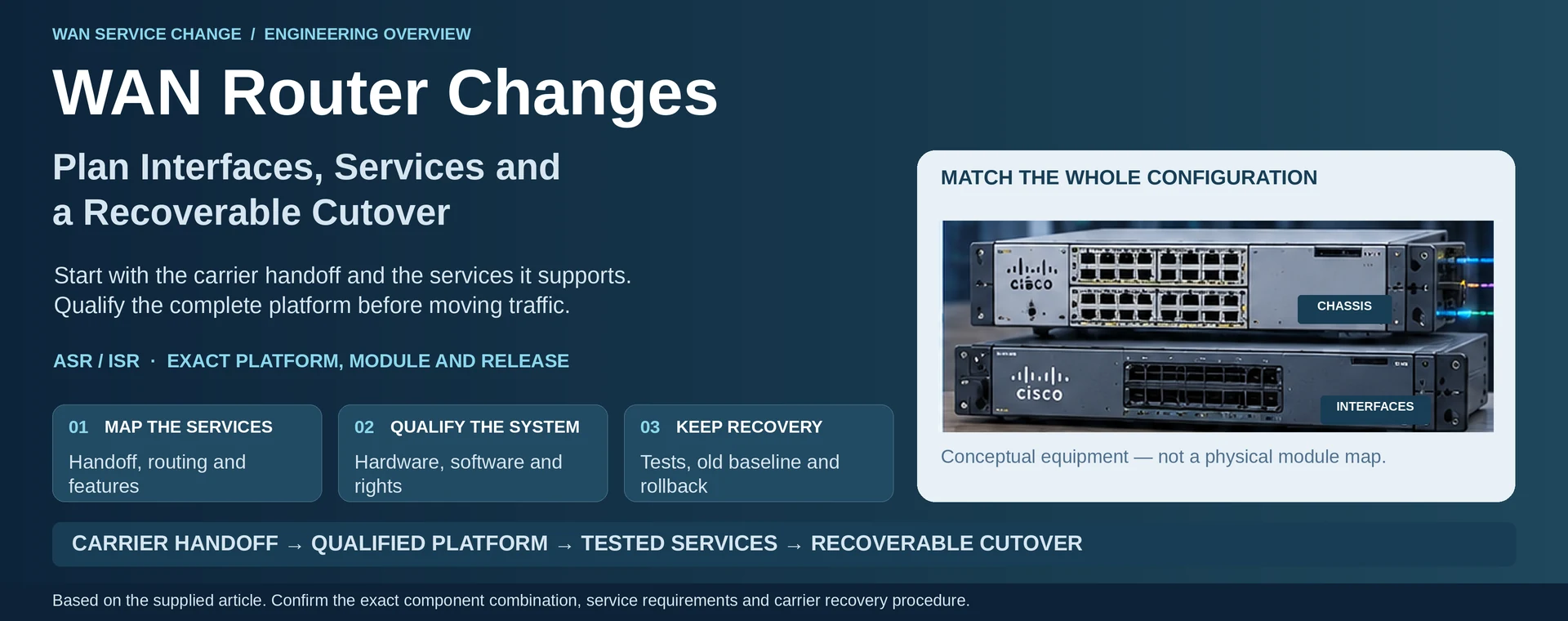
A WAN router change can affect more than the physical circuit. Routing policy, encryption, voice, quality of service, monitoring and management access may all depend on the installed platform. Start with the service contract and actual configuration before selecting a chassis or interface module.
Describe the carrier handoff and the services above it
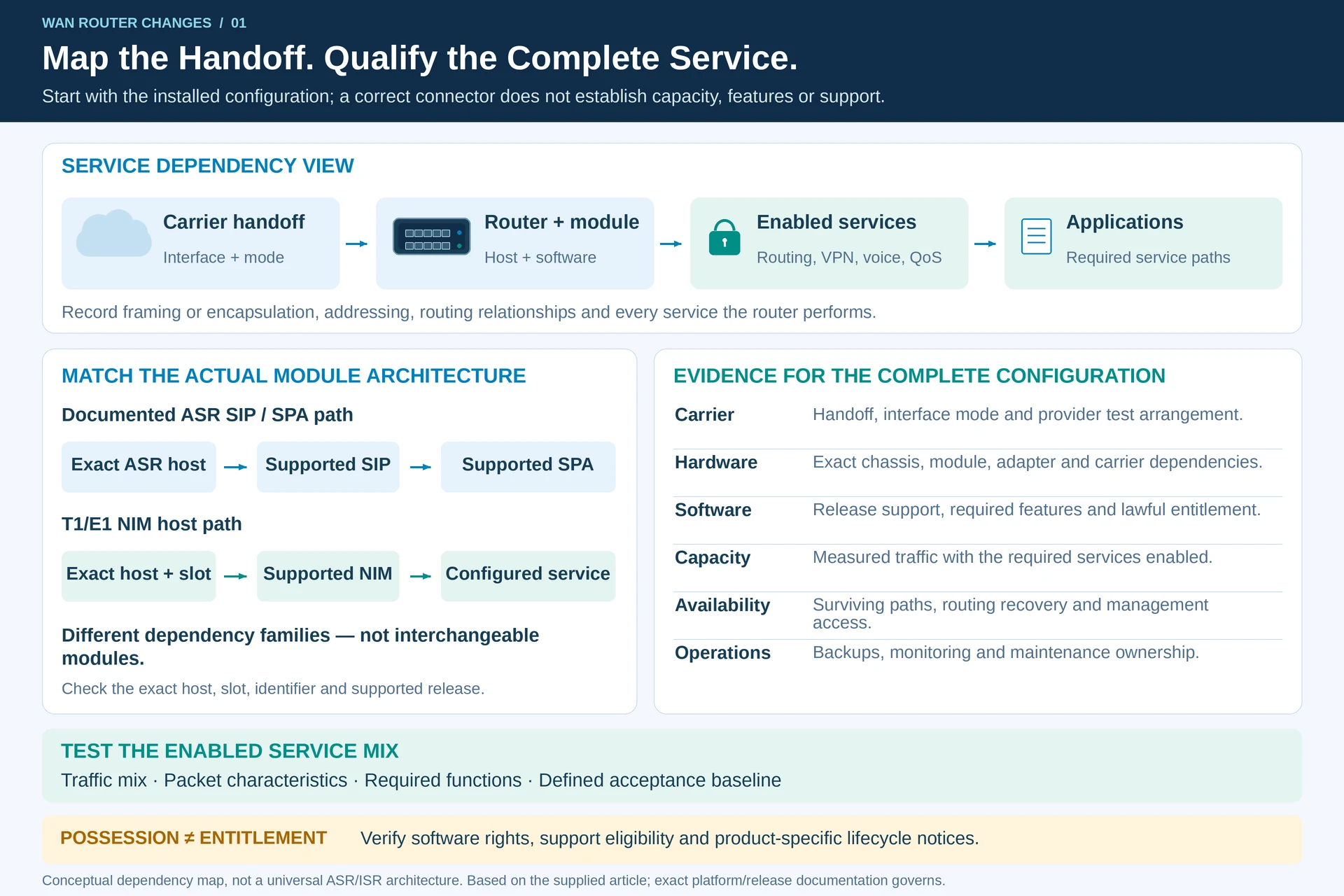
Record the physical interface, framing or encapsulation, addressing and routing relationship. Then identify every service the router performs. A replacement with the correct connector can still lack the required software function, performance profile or operational behavior.
For an expansion, distinguish adding another supported interface from adding a new service class. ASR and ISR family names do not establish module interchangeability. Cisco’s ASR documentation describes specific SIP/SPA architectures, while T1/E1 NIM documentation addresses a different class of interface dependency. R20R21
Build a dependency-based configuration
| Requirement | Evidence to collect |
|---|---|
| Carrier attachment | Handoff specification, interface mode and provider test arrangement |
| Hardware | Exact chassis, module, adapter or carrier dependencies |
| Software | Release support, required features and lawful entitlement |
| Capacity | Measured traffic with the required services enabled |
| Availability | Surviving paths, routing recovery and management access |
| Operations | Configuration backups, monitoring and maintenance ownership |
Do not compare a headline forwarding figure with an encrypted or policy-heavy workload without a relevant test basis. Define the traffic mix, packet characteristics and enabled functions used for acceptance.
Keep entitlement separate from possession
An installed software image, a used hardware purchase and the right to use or obtain particular software are separate matters. Confirm the applicable terms and support eligibility for the actual transaction. Do not promise that a module purchase includes every required feature or software service.
For legacy equipment, check the product-specific lifecycle milestones. The general manufacturer policy explains the process but does not establish dates for the offered device. R19
Rehearse a service-sized cutover
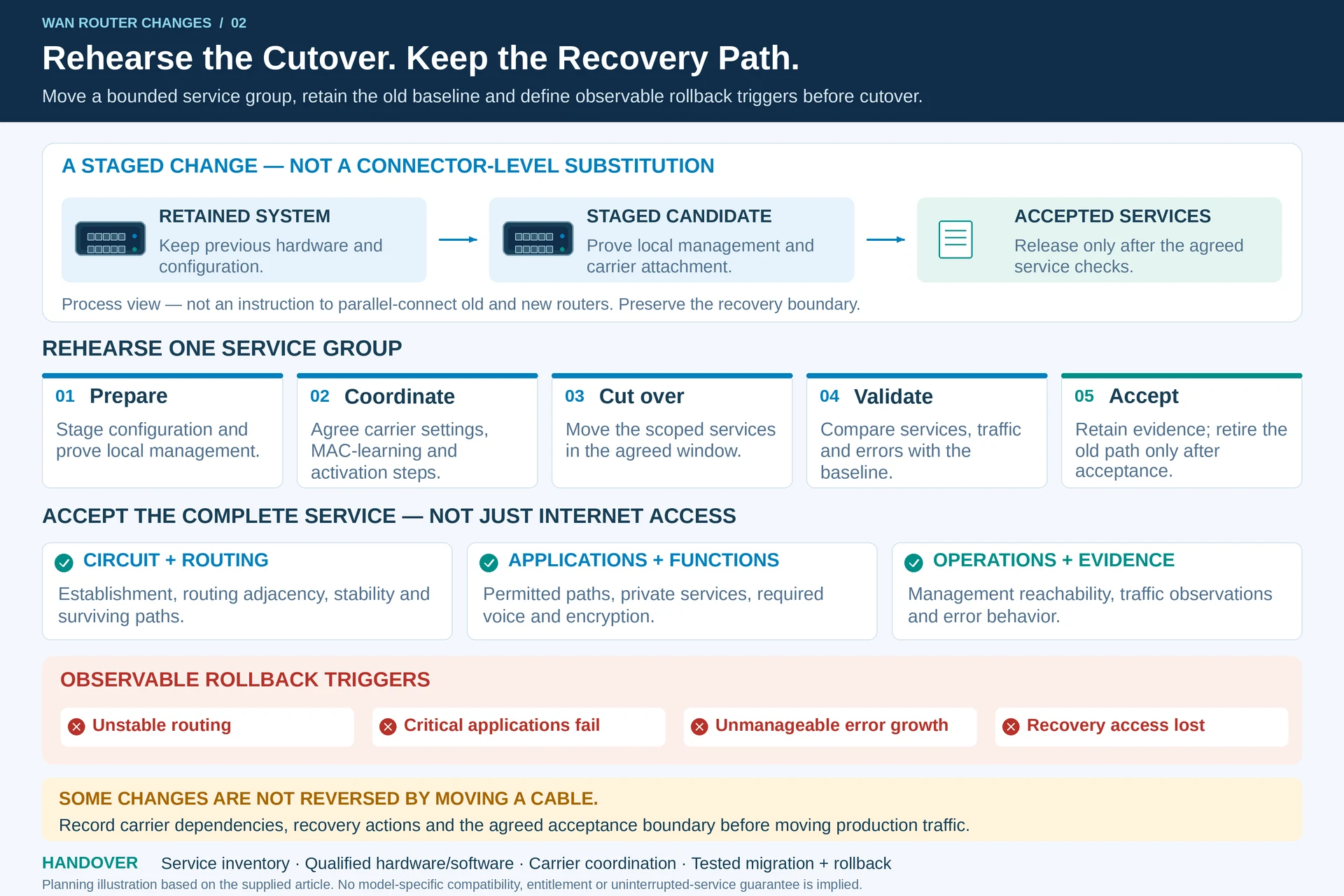
Prepare the new configuration, verify local management and test the carrier interface before moving production traffic. Coordinate with the provider where MAC learning, circuit settings or activation procedures could affect recovery.
An illustrative acceptance sequence checks circuit establishment, routing adjacency, permitted application paths, management reachability and required voice or encrypted services. Then compare traffic and error observations with the defined baseline. “Internet access works” is too narrow when the router also carries private business services.
Define when to return to the old system
Specify observable rollback triggers: unstable routing, failed critical applications, unmanageable error growth or loss of recovery access. Preserve the previous hardware and configuration until the acceptance boundary has been crossed. Account for changes that cannot be reversed merely by moving a cable.
The resulting package should include a service inventory, qualified hardware/software combination, carrier coordination record and tested migration procedure. This turns a router purchase into a controlled service change rather than a connector-level substitution.
Engineering illustrations
These figures illustrate the design concepts discussed here. They are not measured results, certified configurations or a supplied-equipment list.
Related reading
- ASR and ISR Selection Checklist: Chassis, Modules, Services and Entitlements
- Why “ASR-Compatible” Is Not Enough for a Router Module