
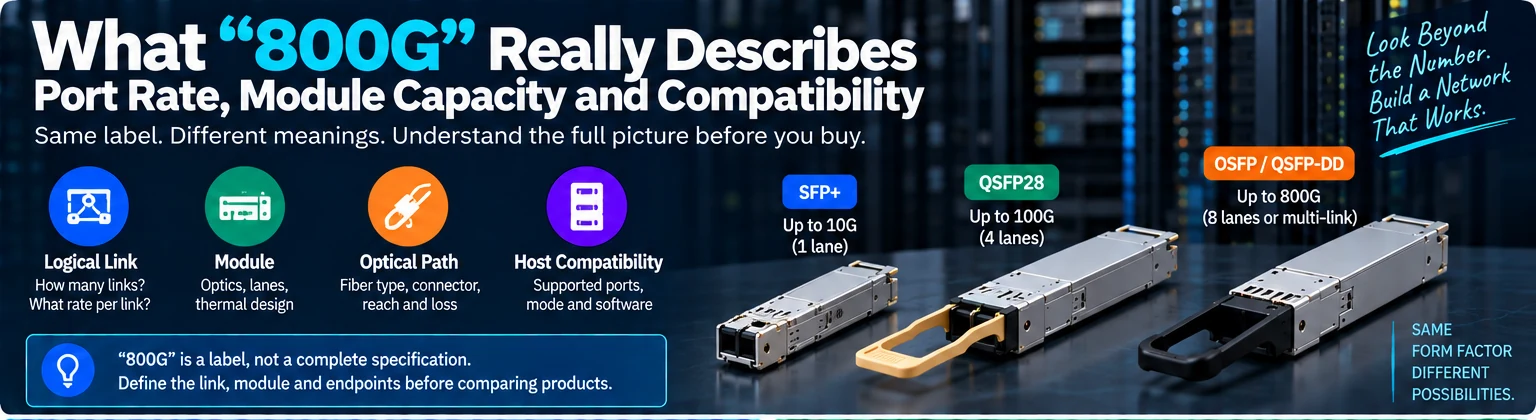
“800G” looks like a complete specification until two products with that label fail to form the intended connection. The problem is often not the number itself. It is that the number describes different parts of the system.
A purchasing comparison must establish the logical link, physical module and supported endpoint configuration separately.
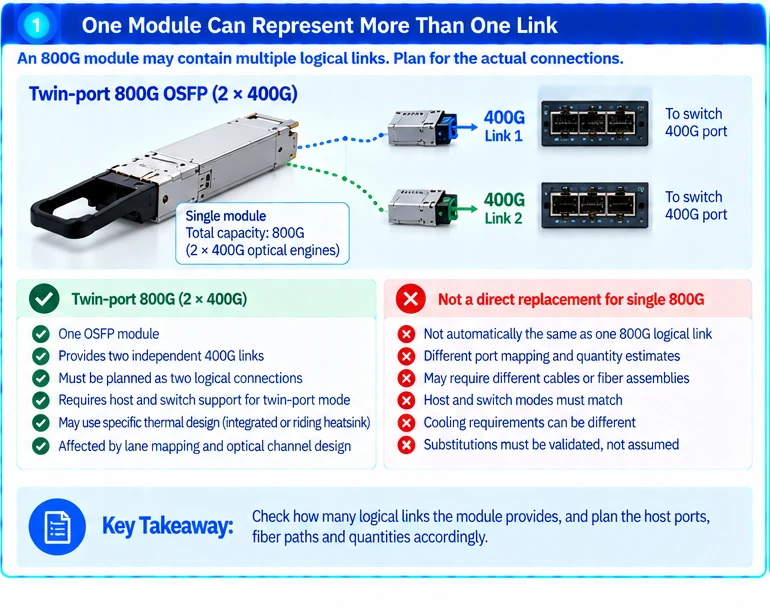
One module can represent more than one link
NVIDIA’s 100G-PAM4 interconnect documentation describes twin-port OSFP products containing two 400Gb/s optical engines. The module’s combined capacity is 800G, but the individual connections must be planned as the documented 400G links. That arrangement is not automatically a substitute for a single logical 800G connection. R01R05
Likewise, an XDR switch’s logical-port specification must be read from that platform’s own documentation. Similar aggregate module capacities do not make different operating protocols or lane implementations interchangeable. R43
This distinction affects both engineering and quantity estimates. Counting one module for each “800G connection” can produce the wrong number of host links, optical channels or fiber assemblies.
A connector name leaves important questions open
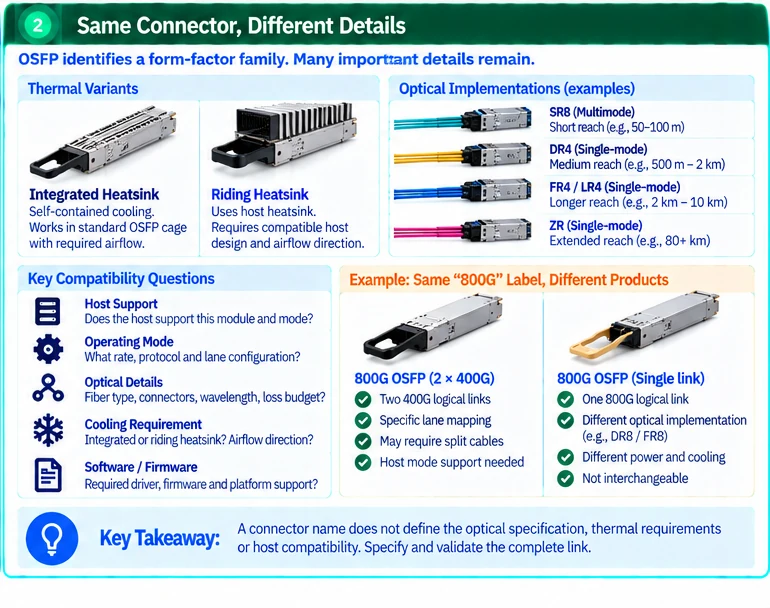
OSFP describes a form-factor family, not a complete end-to-end compatibility guarantee. The host’s electrical interface, operating mode and cooling arrangement remain relevant.
For the documented NVIDIA implementations, integrated-heatsink and riding-heatsink arrangements have different host requirements. A compatible-looking outline is not permission to install one thermal variant in place of another. R01
The same caution applies on the optical side. A module’s total rate does not identify its fiber medium, connector arrangement, wavelength implementation or required channel budget. Both ends must be specified against the same intended optical link.
Ask for a link, not an isolated module
An illustrative comparison shows why a short quote description is insufficient:
| Quotation wording | What is still unresolved |
|---|---|
| “800G OSFP optic” | One logical link or multiple links; host and cooling form |
| “Two 400G host connections” | Switch port map, approved modules and branch arrangement |
| “800G cable, two meters” | Protocol, endpoint support, assembly type and routed length |
A complete request names endpoint A, endpoint B, their exact ports and the target operating mode. It then records both optical modules and the fiber path, or the exact fixed cable assembly. Include the relevant software and firmware conditions.
Substitutions must preserve the design
When a supplier proposes an alternative, compare it against the link record rather than the previous item’s headline speed. A candidate may match the aggregate rate while changing lane mapping, thermal requirements or the number of independent optical paths.
Treat approved substitutions as controlled engineering changes. Update the port map and quantity schedule, then validate the resulting combination before broad deployment. “It fits” and “it linked once” are weaker evidence than documented support plus an appropriate test.
The practical lesson is simple: bandwidth labels are useful only after their scope is clear. Define what 800G means at the logical port, module and application boundary before comparing products or building a BOM.
Engineering illustrations
These figures illustrate the design concepts discussed here. They are not measured results, certified configurations or a supplied-equipment list.
Related reading
- Optics and Cable Selection Checklist: Qualify Both Endpoints and the Channel
- NVIDIA Switch Selection Worksheet: Logical Ports, Cages and Rack Requirements
- XDR 800G Fabric Planning: Port Architecture and Migration Boundaries