
Optics and Cable Selection Checklist: Qualify Both Endpoints and the Channel
Select optical modules, DACs, AOCs and breakout assemblies using a complete endpoint, operating-mode and physical-channel record.
根据现有信息选择下一步核对
| 当前场景 | 先记录 | 选定组件前解决 |
|---|---|---|
| 独立模块加光纤 | 两端模块 OPN、研磨类型、光纤等级、长度及配线点 | 光通道映射、通道限制及主机支持 |
| DAC 或 AOC 整缆 | 完整组件 OPN 与长度、两端端口及模式 | 两端支持列表、走线及弯曲要求 |
| 分支连接 | 父端口、各支路编号、每支速率及通道数 | 端点支持的分支模式与完整组合 |
工程和采购共用一张链路表
空白 CSV · 虚构填写示例 · 项目经理交接包(英文)
同一行保留端点 A/B、OPN、协议、速率、通道模式、固件、研磨类型、光纤、长度、支路、损耗依据、验收依据及下一责任人。原 BOM 行号不变。未知值留空并分派问题,不妨碍先发起讨论。
会改变选择的五个问题
相同速率就能互通吗? 还要核对协议、通道模式、封装、固件和厂商支持的组合。LinkX 概览用于理解产品族,具体部件回到 准确订购料号对应的文档。
APC 和 UPC 能直接配接吗? 应保持连接点规定的研磨类型一致。MMA4Z00-NS400-T 文档明确区分两者;逐点记录,不只根据外壳颜色判断。
分支光纤会转换协议或调制吗? 无源光纤负责通道路由。分支模式由端口及模块支持情况决定。结合原厂拓扑表,对照直连组件与1:2 组件。
“最远 100 m”可以直接写进 BOM 吗? 应附模式、光纤等级和通道条件。例如100G SR4 规格区分 OM3 和 OM4。光缆实际长度与支持距离分别记录。
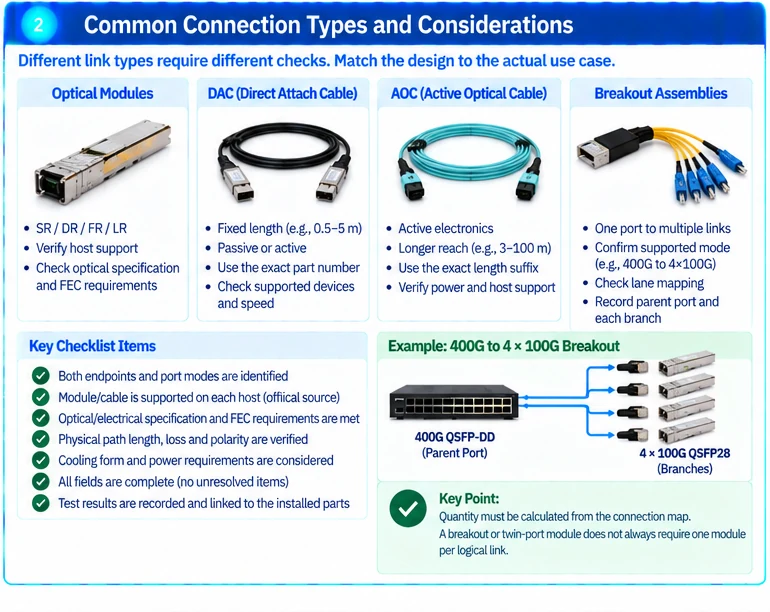
模块数量等于逻辑链路数吗? 分别统计实体模块位置、逻辑链路及光纤支路,再形成采购数量。
容量和验收问题返回AI 以太网方案;也可直接提交现有链路清单。下方保留完整六步方法。
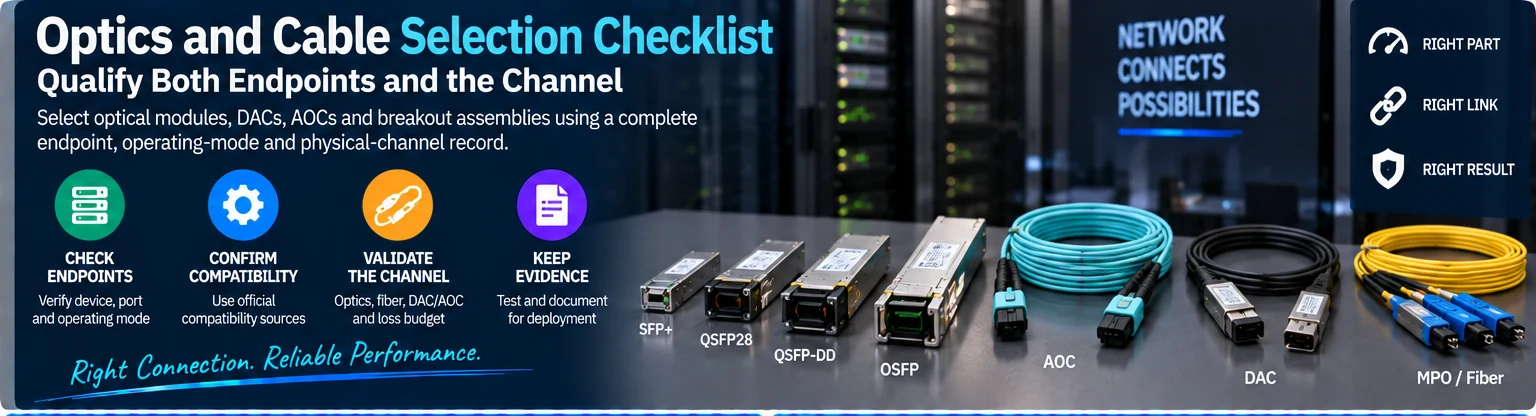
This checklist applies to a proposed connection, not an isolated module. Use it for optical links, direct-attach cables, active optical cables and breakout assemblies. A part is ready for procurement only when the record resolves both host interfaces and the complete physical path.
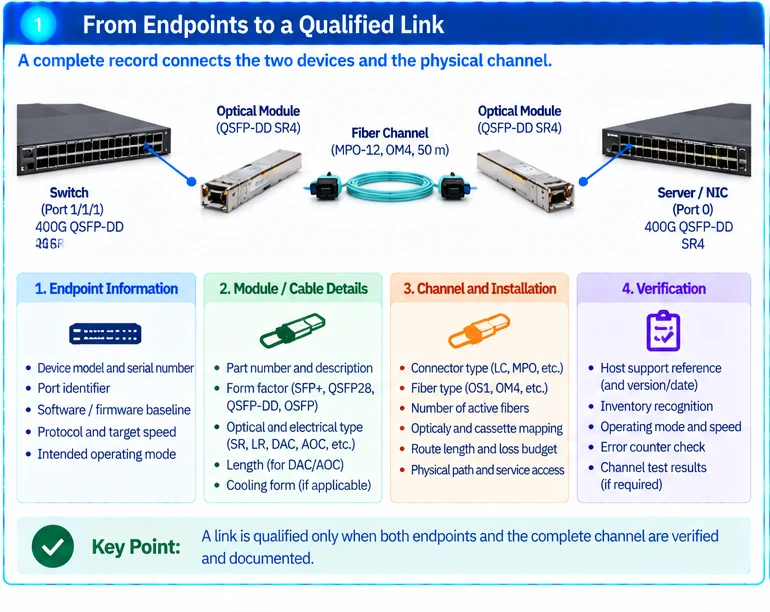
1. Record both hosts and the intended logical links
Capture the device model, port identifier, software or firmware baseline, protocol and target operating mode at each end. For a breakout, create one row per branch while retaining the parent-port identity.
Keep physical cages, logical ports and module aggregate capacity in separate fields. NVIDIA documents twin-port arrangements and platform-specific connections that make these distinctions essential. R01R05
2. Confirm host support independently
Check whether each host supports the proposed module or assembly in the intended mode and release. Save the relevant compatibility reference and its version or access date. A host support entry answers a different question from whether two optical interfaces can communicate. R49
Do not use a marketplace title or a shared connector outline as the support record. For thermal variants, identify the cooling form required by the host. R01
3. Resolve the optical or electrical path
| Field group | Required entries |
|---|---|
| Host support | Device, port mode, module/assembly part number and source |
| Signal compatibility | Protocol, target rate, lane arrangement and applicable FEC requirements |
| Physical installation | Connector, cooling form, routed length and service access |
| Optical channel | Optical specification, fiber, active fibers, polarity and loss constraints |
| Acceptance | Test configuration, observed errors and approved result |
For separate optics, verify the optical implementation at both ends. For DAC/AOC assemblies, retain the complete cable identifier and length. A different length suffix can represent a different qualified assembly rather than a harmless naming change.
For multi-fiber channels, document every cassette and connector mapping. Passive fiber distribution does not convert incompatible endpoint signaling. R42
4. Calculate quantity from the connection map
A conventional separate-optics link generally needs one module at each endpoint and a connecting fiber path. Twin-port modules or breakouts require a channel-level calculation instead. Do not multiply logical links by two modules without checking the implementation.
An illustrative four-link arrangement might use four individual modules at one end and two supported twin-port modules at the other. This example explains the counting method; it is not a qualified BOM for any named platform.
5. Resolve exceptions before release
Mark every missing field. An unknown host release, unidentified peer optic or unmeasured route is an engineering dependency, not an opportunity to assume the most convenient specification.
If a supplier proposes an alternative, repeat the checks affected by that change. Matching rate and connector is not enough to preserve the previous qualification.
6. Commission and retain evidence
Confirm recognition and actual operating mode, inspect relevant diagnostics and record error-counter changes under agreed traffic. For optical channels, retain the applicable inspection and channel-test results. Link those results to the exact installed components and software baseline.
The final output is a qualified link record that can be reused for installation, spares and future troubleshooting. It should distinguish a documented supported combination from an untested candidate rather than describing both simply as compatible.
Engineering illustrations
These figures illustrate the design concepts discussed here. They are not measured results, certified configurations or a supplied-equipment list.
Related reading
- What “800G” Really Describes: Port Rate, Module Capacity and Compatibility
- SFP+, QSFP28 and QSFP-DD Selection: Form Factor Is Only the First Filter
References
可直接使用的项目资料
按当前任务选择资料。可以先提交已有清单,后续再补缺项。下载模板为英文。