Network engineering
Scalable Data Center Cabling: Reserve Paths, Fibers and Service Space Deliberately
Plan cabling growth through named expansion stages, reusable channel evidence and physical capacity beyond spare switch ports.
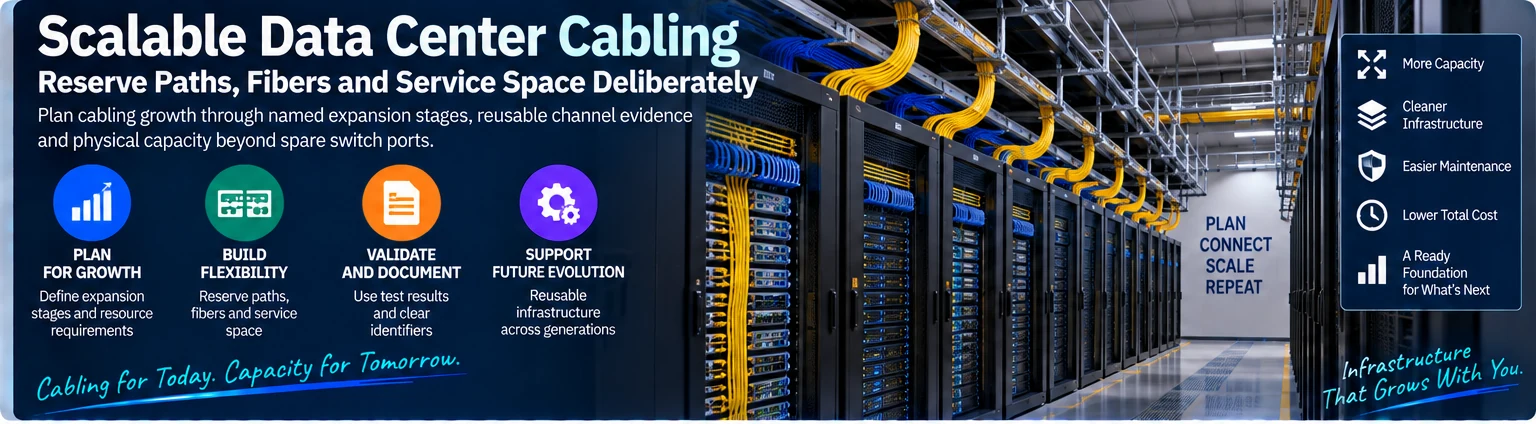
Cabling scalability is the ability to add a defined set of connections without unexpected reconstruction or disruption. It is not established by an empty switch port or a high fiber count alone. Growth consumes pathway space, termination positions, service access and qualified optical channels as well as active interfaces.
Define the next expansion stage
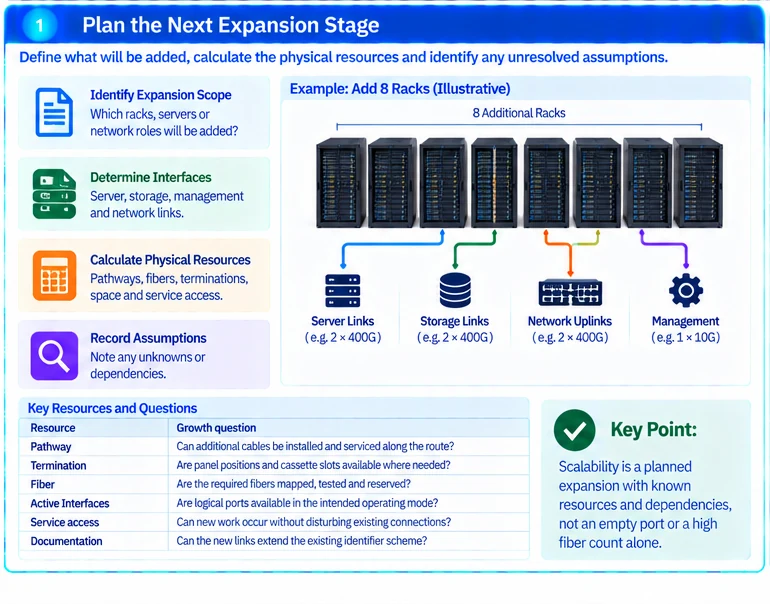
State which racks, servers or network roles will be added. Identify the expected interfaces and any assumptions that remain unresolved. Then calculate the physical resources needed for that stage.
For an illustrative expansion, eight additional racks may each need a defined set of server, storage and management paths. The planning record should identify where those paths terminate and how they reach the racks—not simply add eight racks to an equipment count.
| Resource | Growth question |
|---|---|
| Pathway | Can additional cables be installed and serviced along the route? |
| Termination | Are panel positions and cassette slots available where needed? |
| Fiber | Are the required fibers mapped, tested and reserved? |
| Active interfaces | Are logical ports available in the intended operating mode? |
| Service access | Can new work occur without disturbing existing connections? |
| Documentation | Can the new links extend the existing identifier scheme? |
Separate reusable infrastructure from interface assumptions
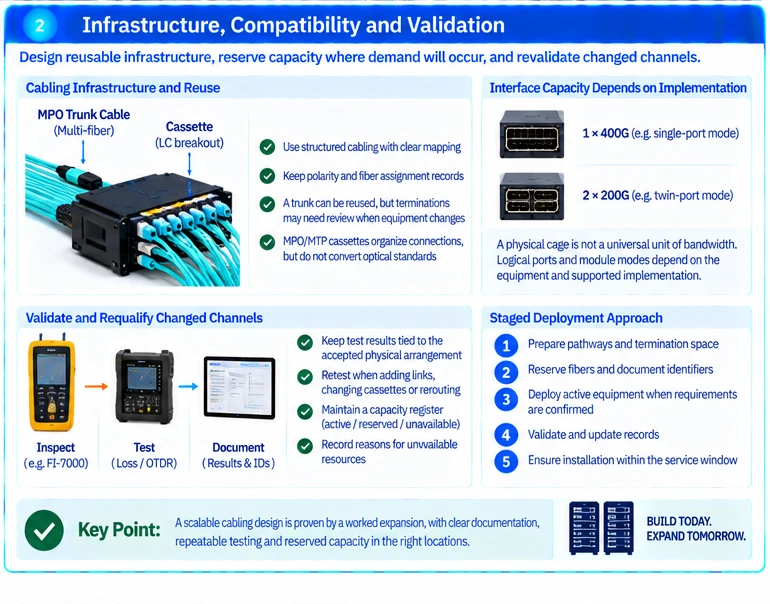
A fiber trunk may remain useful across equipment changes, but its termination and optical-channel qualification may need review. Parallel-optics mapping and cassette arrangements can change even when the route is retained. R42
Similarly, a physical cage is not a universal unit of future bandwidth. Logical-port and module arrangements depend on the equipment and supported mode. NVIDIA’s twin-port examples illustrate why capacity must be counted from the actual implementation. R01
Reserve capacity where demand will occur
A spare panel in one row does not solve a termination shortage in another. Place reserves according to the expansion drawing and maintenance boundaries. Avoid consuming a planned growth path with undocumented temporary links.
Use staged procurement where interface assumptions are not yet firm. It may be reasonable to prepare pathways and termination space before selecting future active optics, rather than buying unqualified components under a vague future-proofing claim.
Requalify changed channels
Keep test results tied to the accepted physical arrangement. Adding a connection, replacing a cassette or rerouting a segment can change the channel and its margin. Determine which inspection and tests must be repeated, rather than reusing an old report automatically. R17
Maintain a capacity register showing active, reserved and unavailable resources. Explain why something is unavailable—for example, an unmapped fiber or an inaccessible route—so that it is not mistakenly counted as ready capacity.
Accept scalability through a worked expansion
Review the next-stage drawing and BOM before declaring the design scalable. Confirm that installation, testing and documentation can be performed within the permitted service window.
The deliverable is a specific growth path with known assumptions and dependencies. It should make the next expansion predictable without claiming that today’s cabling supports every future optical interface.
Engineering illustrations
These figures illustrate the design concepts discussed here. They are not measured results, certified configurations or a supplied-equipment list.