Network engineering
Networking B300 GPU Systems: Match the Exact Server Platform and Fabric
Plan B300-based GPU networking from the server's documented interfaces, host topology, workload and operational requirements.

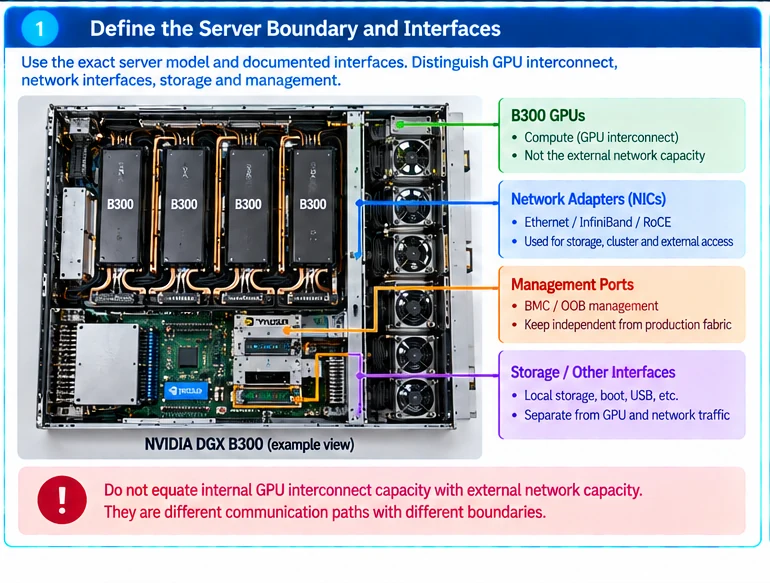
“B300 networking” is not a complete system specification. B300 identifies a GPU generation, while the server platform determines network interfaces, adapter placement, cooling and service connections. An NVIDIA DGX B300 configuration should be read from its own system documentation; it should not be assumed to describe every third-party server using B300 GPUs. R40
Establish the server boundary
Record the exact server model and configuration, compute adapters, service interfaces, management ports and host-interface arrangement. Identify which interfaces are intended for GPU communication and which support storage, external access or administration.
Do not equate internal GPU interconnect capacity with external network capacity. They are different communication paths with different boundaries. A fabric design must work from the external interfaces actually available to the workload.
Map the workload to those interfaces
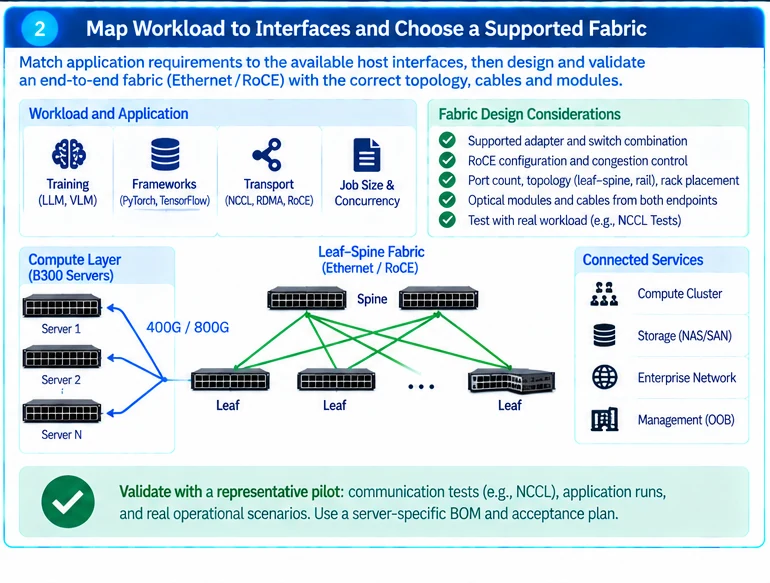
Identify the framework, transport and expected job placement. Count active fabric ports per server and define the intended mapping across racks or rails. A server-count estimate without its adapter topology can misstate both switch-port demand and the interconnect BOM.
| Input | Why it matters |
|---|---|
| Exact server configuration | Establishes real host and network interfaces |
| Application and transport | Determines the communication path to validate |
| Job size and concurrency | Influences cross-rack demand and shared-path pressure |
| Rack placement | Determines topology and cable routes |
| Failure objective | Defines surviving paths and acceptable job interruption |
Select a supported fabric combination
For an Ethernet/RoCE design, coordinate host software, adapter capabilities, switch functions and congestion policy. Do not describe an arbitrary group of compatible-looking components as a validated platform solution. Use the relevant deployment baseline and test the integrated path. R08
Choose interconnects from both endpoints. Logical-port rate, physical cage, lane arrangement and module cooling form are separate properties. A high aggregate module capacity does not establish a single link of the same rate. R01
Include the installation and recovery layer
Account for management connectivity, console access, power feeds, cooling, mounting and qualified spares. These requirements come from the complete server and switch configuration, not the GPU name.
Keep compute-fabric expansion independent of management reachability. Operators should not need a healthy production fabric to diagnose why that fabric has failed.
Validate communication and useful work
Use a representative pilot with the actual server configuration. Run host and fabric checks, collective tests where applicable and the intended application. Retain command settings, placement, versions and observed congestion or error behavior. NCCL Tests can provide useful communication evidence, but its results should not be presented as performance of every B300 workload. R11
The deliverable is a server-specific network design with a qualified BOM and acceptance plan. For a meaningful enquiry, provide the complete server configuration and workload—not only the number of B300 GPUs.
Engineering illustrations
These figures illustrate the design concepts discussed here. They are not measured results, certified configurations or a supplied-equipment list.