Network engineering
Long-Reach PoE Design: Separate the Data Path from the Power Problem
Connect distant powered endpoints by evaluating data reach, delivered power, environmental conditions and maintainable alternatives.
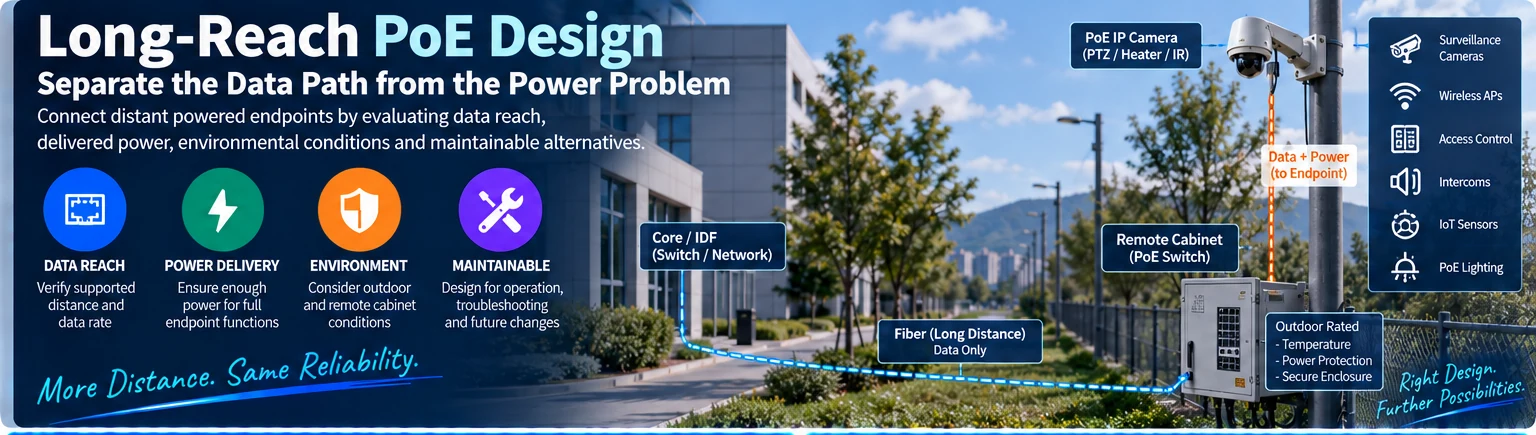
A distant camera or access point creates two requirements: a supported data connection and enough delivered power for the endpoint’s operating mode. Solving one does not solve the other. A link can pass traffic while the device loses functions under an insufficient power allocation, or provide power while failing the required data-rate target.
Describe the endpoint and the route
Record the endpoint’s data rate, power mode, environmental requirements and local installation conditions. Measure the actual route, including intermediate cabinets and available power sources. Identify whether maintenance personnel can access those locations safely and reliably.
Do not assume that an ordinary copper Ethernet channel can be extended indefinitely without changing its supported application. Any extender or proprietary long-reach mode must be evaluated against its documented rate, distance and power conditions.
Compare complete architectures
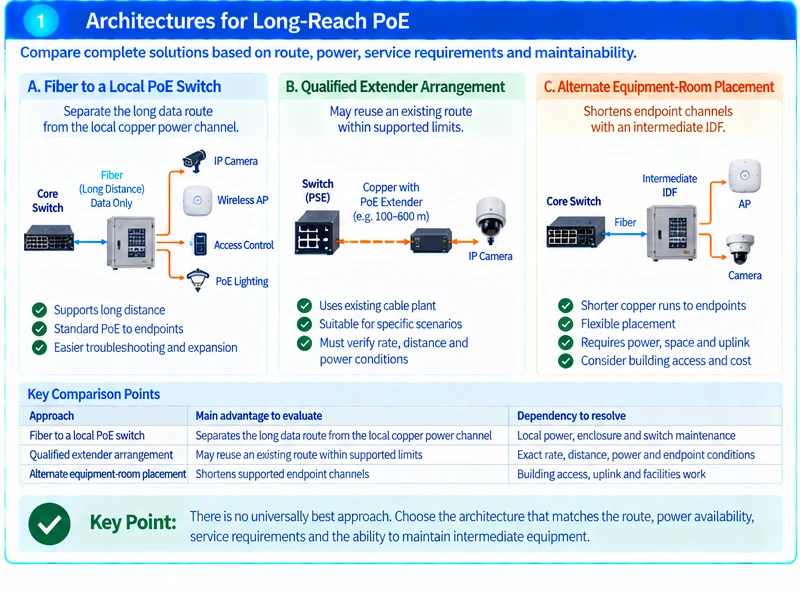
| Approach | Main advantage to evaluate | Dependency to resolve |
|---|---|---|
| Fiber to a local PoE switch | Separates the long data route from the local copper power channel | Local power, enclosure and switch maintenance |
| Qualified extender arrangement | May reuse an existing route within supported limits | Exact rate, distance, power and endpoint conditions |
| Alternate equipment-room placement | Shortens supported endpoint channels | Building access, uplink and facilities work |
No approach is universally preferable. The decision depends on the route, power availability, service requirements and the ability to maintain intermediate equipment.
Calculate delivered power separately
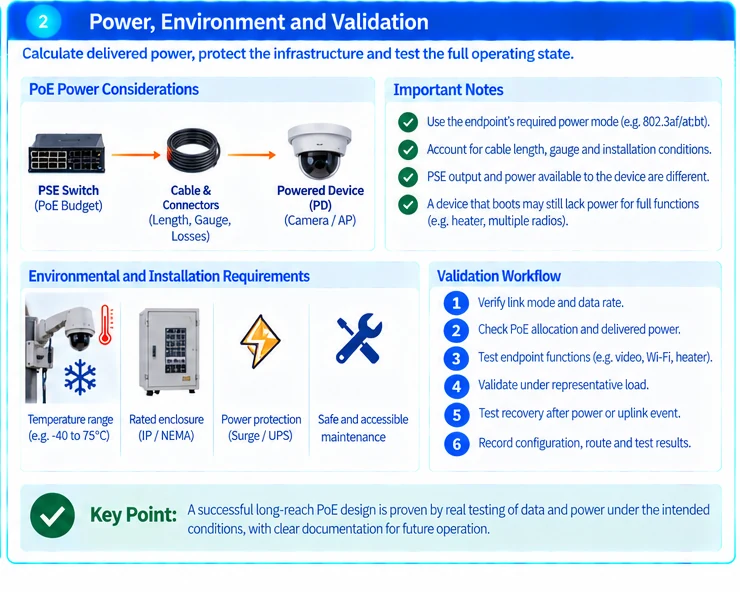
Use the endpoint’s documented requirement and the source equipment’s available PoE allocation. Account for losses and operating conditions using the approved system guidance. PSE output and power available to the powered device are different quantities; a PSU’s total rating should not be treated as the endpoint budget. R32
An illustrative endpoint may need a higher power mode to operate a heater, multiple radios or another optional function. A test showing only that it boots is insufficient if the service depends on those functions.
Protect the supporting infrastructure
A remote cabinet can introduce a new failure point through power loss, temperature or inaccessible components. Specify equipment and installation conditions for the actual location and involve qualified personnel for electrical and environmental work.
Maintain the management and uplink design alongside the endpoint link. Campus network patterns can inform these boundaries, but the remote installation needs its own recovery plan. R45
Accept the full operating state
Test the endpoint under its required functions and representative load, not only at startup. Verify the intended link mode, power allocation, application traffic and recovery after the agreed power or uplink event.
Retain the exact equipment combination, route, configuration and environmental assumptions. For an enquiry, provide endpoint model, required functions, route length, existing cable and available local power. These details support a deployable long-reach solution rather than an unsupported promise attached to the word PoE.
Engineering illustrations
These figures illustrate the design concepts discussed here. They are not measured results, certified configurations or a supplied-equipment list.