Network engineering
Small-Business Video Networks: Size Camera Traffic, PoE and Recording Storage
Design a small surveillance network with separate traffic, power, storage and access-control calculations plus practical acceptance tests.

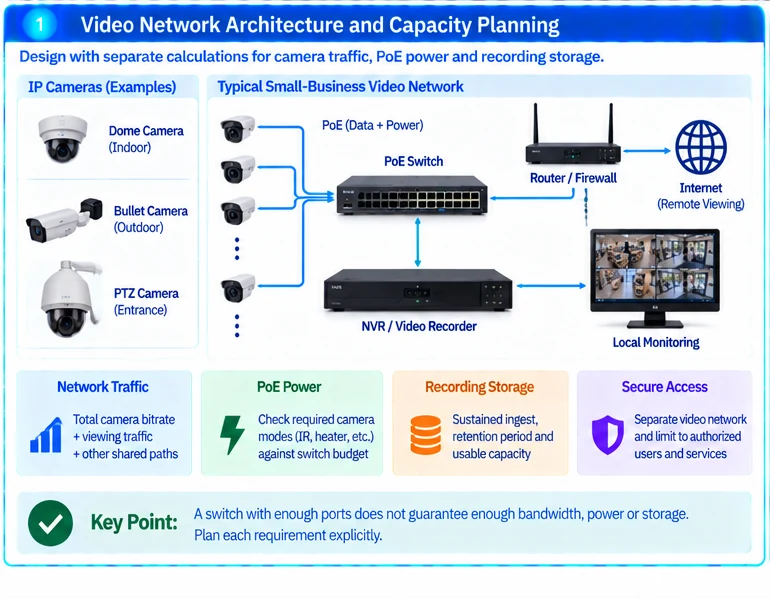
A small video-surveillance network still has several independent capacity requirements. Camera traffic consumes network bandwidth, cameras may consume PoE, and recorded streams consume storage. A switch with enough ports does not establish that the recording system can ingest, retain and retrieve the required video.
Inventory the actual video streams
Record camera models, configured streams, expected bit rates, recording schedule and retention requirement. Include live viewing, remote viewing and playback where they share the same network or recorder resources. Use measured or vendor-qualified stream behavior rather than assuming every camera produces a fixed rate in all scenes.
Calculate a transparent storage baseline
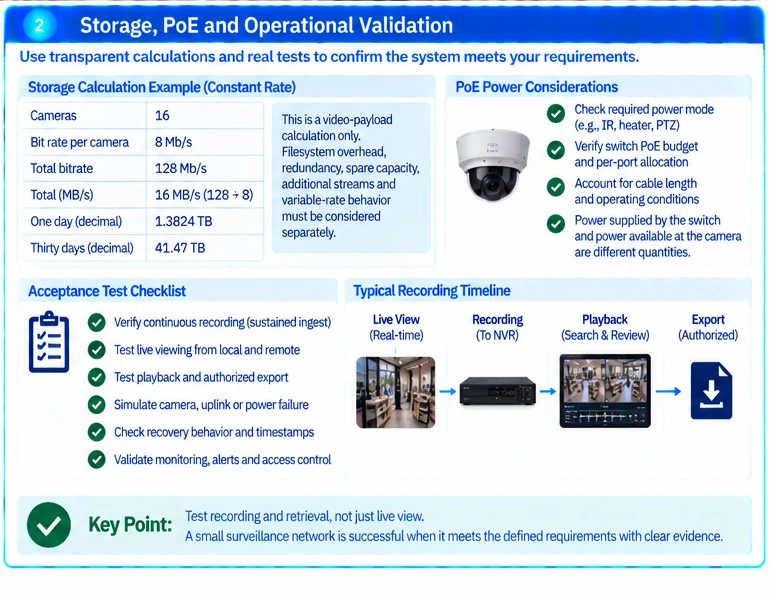
For an illustrative constant-rate example, sixteen cameras at 8 Mb/s each produce 128 Mb/s. Dividing by eight gives 16 MB/s. Continuous recording for one day produces approximately 1.3824 TB, and thirty days approximately 41.47 TB, using decimal units.
This is a video-payload calculation only. Filesystem overhead, redundancy, spare capacity, additional streams and variable-rate behavior must be considered separately. Usable recording capacity is not the sum of drive nameplate capacities.
| Design area | Calculation or evidence |
|---|---|
| Network | Aggregate camera traffic plus viewing and other shared paths |
| Recording | Sustained ingest, concurrent retrieval and retention |
| PoE | Required camera modes within the available switch budget |
| Recovery | Recorder, uplink and power-failure behavior |
| Access | Authorized viewing, administration and export paths |
Budget power for the required camera functions
Check whether infrared illumination, heaters or other functions change the required power mode. Compare endpoint needs with the switch’s documented available PoE budget, including the intended power-failure condition. Power supplied by the switch and power available at the camera are different quantities. R32
A camera booting during installation is not proof that it will remain fully functional under every required operating condition.
Keep the video network controlled
Limit access to cameras and recorders to approved services and administrators. Separate ordinary guest traffic from video infrastructure and avoid exposing management interfaces for convenience. Network segmentation and application authentication should reinforce each other rather than assuming internal location equals authorization. R35
Retention, privacy and viewing permissions must follow the organization’s applicable requirements. This network design does not determine the legal basis for recording.
Test recording and retrieval, not just live view
Verify sustained recording, representative live viewing, playback and authorized export. Test an agreed camera, uplink or power interruption and confirm the recovery behavior. Check timestamps and monitoring so that missing recordings can be identified.
The handover should include stream settings, port and power allocation, storage assumptions and recovery instructions. This makes a small surveillance deployment measurable and maintainable without promising a universal retention period or loss-free operation.
Engineering illustrations
These figures illustrate the design concepts discussed here. They are not measured results, certified configurations or a supplied-equipment list.