Network engineering
Small-Business Network Security: A Maintainable Set of Controls
Build a practical small-business security baseline around access separation, privileged accounts, updates, backups and recovery tests.
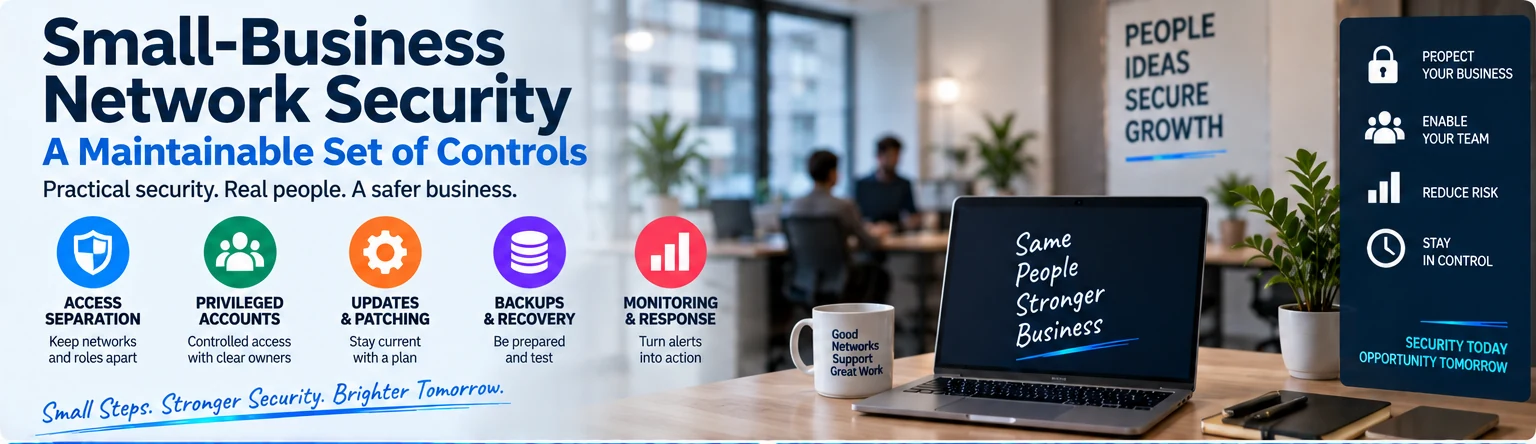
A small organization benefits from security controls that are understood, maintained and tested. An elaborate design without an owner can be less useful than a simpler set of controls applied consistently. Start with the services the business depends on and the access that each role actually needs.
Identify a small number of clear boundaries
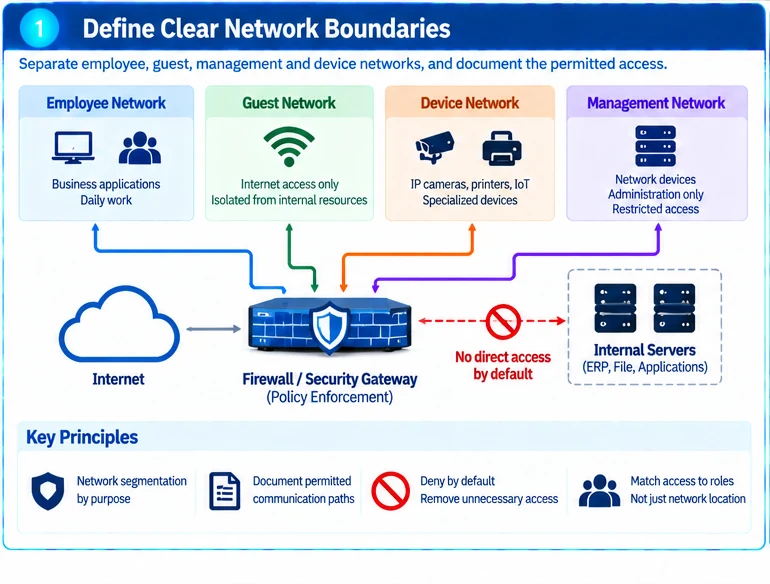
Separate employee access, guest connectivity, infrastructure management and specialized devices where their requirements differ. Document the permitted paths between them. Avoid allowing a guest network or camera segment to reach administrative interfaces by default.
Network location should not automatically authorize access to business applications. NIST’s zero-trust guidance provides a useful principle for this distinction, but a small network should implement it through concrete access decisions rather than adopting a label. R35
Assign an owner to every control
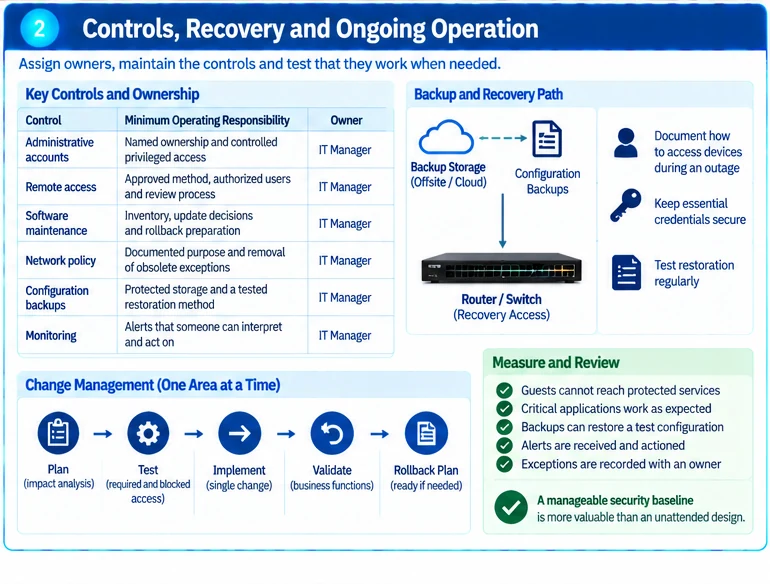
| Control | Minimum operating responsibility |
|---|---|
| Administrative accounts | Named ownership and controlled privileged access |
| Remote access | Approved method, authorized users and review process |
| Software maintenance | Inventory, update decisions and rollback preparation |
| Network policy | Documented purpose and removal of obsolete exceptions |
| Configuration backups | Protected storage and a tested restoration method |
| Monitoring | Alerts that someone can interpret and act on |
A firewall rule that nobody can explain should be reviewed. An alert that nobody receives is not an operational control.
Protect the recovery path
Store configuration backups and support information where they remain accessible during a network outage. Document how to reach the router or switch when normal remote access is unavailable. Preserve essential credentials through an appropriate secure process rather than placing them in a public installation document.
Do not solve remote-support convenience by broadly exposing management services. Keep administrative access limited to the approved path.
Change one bounded area at a time
Before enforcing a new policy, identify the business transactions it may affect. Test required access and blocked access separately. Preserve a rollback procedure and avoid changing routing, authentication and firewall policy simultaneously without a clear test plan.
For any production or operational equipment, consult its owner before applying ordinary office-IT update or scanning practices. OT systems can have distinct availability and safety constraints. R34
Measure whether the baseline works
Confirm that guests cannot reach protected services, administrators can recover devices, critical applications function and backups can restore a test configuration. Record exceptions with an owner and review condition.
The output is not a guarantee against incidents or a claim of regulatory compliance. It is a manageable security baseline with a documented recovery capability. For project scoping, provide the service inventory, current remote-access method, available support staff and the business impact of downtime. Product selection should follow those requirements rather than define them.
Engineering illustrations
These figures illustrate the design concepts discussed here. They are not measured results, certified configurations or a supplied-equipment list.