Network engineering
Small-Office Wi-Fi: Reliable Coverage with a Supportable Wired Foundation
Design small-office wireless around actual rooms, clients, application use, PoE and a simple recovery model.
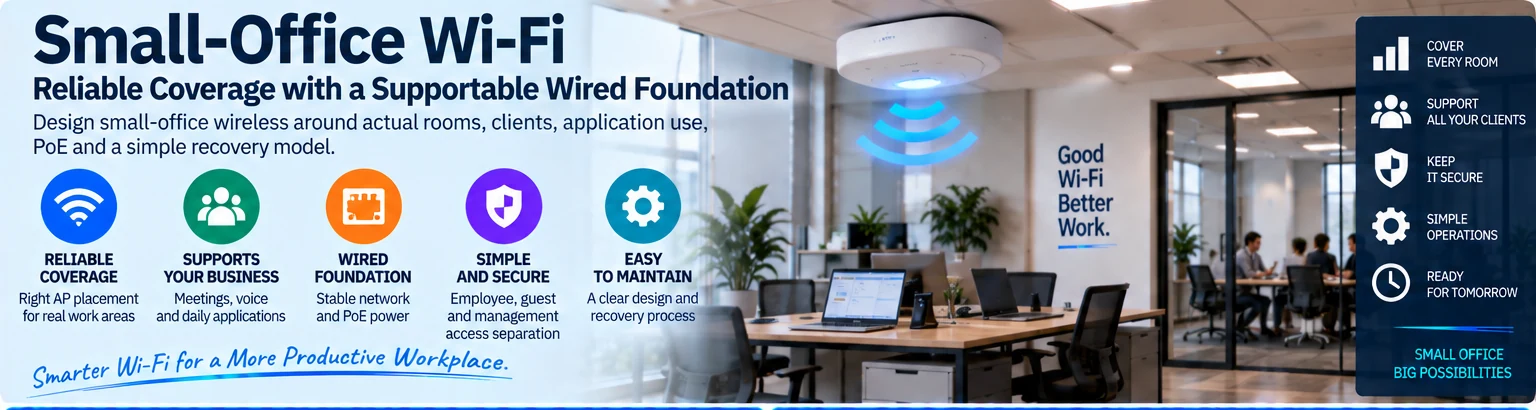
A small office does not need a complicated wireless architecture to have a reliable service. It needs appropriate AP placement, suitable wired and power connections, clear access rules and a recovery method the support team can use. Buying the highest advertised radio rate does not establish those conditions.
Describe the space and the clients
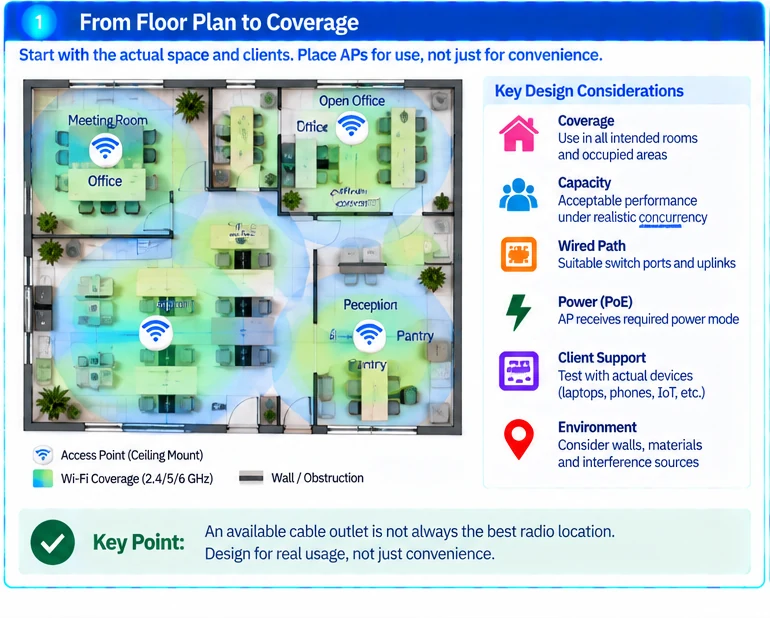
Record room layout, construction materials, occupied areas and expected concurrent users. Identify applications that are sensitive to interruption, such as voice or interactive meetings, and distinguish them from ordinary background transfers.
Use actual client devices in assessment. Their supported bands and behavior affect the result, so a test with one new laptop should not represent every older phone or specialist device. Site-survey guidance supports this environment- and client-aware approach. R37
Place APs for use, not only for convenience
An available cable outlet is not always the best radio location. Evaluate coverage and interference in the areas where work occurs. Avoid placing an AP inside an equipment cabinet solely because power is nearby.
| Design area | Practical check |
|---|---|
| Coverage | Can intended clients use required applications in occupied areas? |
| Capacity | Does service remain acceptable under realistic concurrency? |
| Wired path | Are AP ports and uplinks suitable for expected demand? |
| Power | Does each AP receive its required operating allocation? |
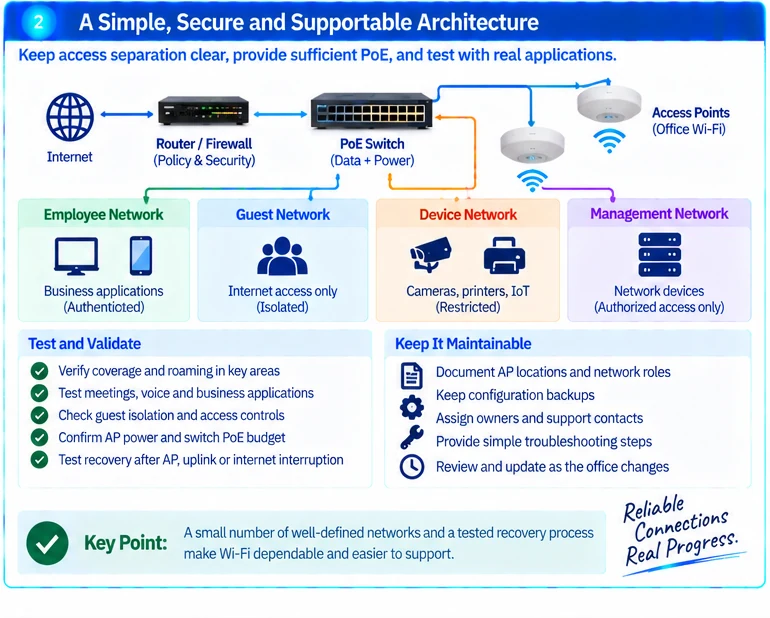
| Access | Are employee, guest and administrative paths appropriately controlled? |
Verify the AP’s documented behavior under the available PoE mode. A powered AP may operate with reduced functions, so startup alone is not a complete acceptance test. R32
Keep access separation simple
Provide guest access without exposing business or management services. Use appropriate authentication for employee access and restrict administrative interfaces. Internal wireless association should not itself be treated as application authorization. R35
Avoid unnecessary networks and exceptions that the support team cannot explain. A small number of well-defined roles is usually easier to maintain than a growing collection of undocumented SSIDs and rules.
Test the actual office workload
Check representative meetings, business applications and movement between rooms where relevant. Repeat tests with realistic occupancy and multiple clients. Record device type and conditions so that a later complaint can be compared with the accepted baseline.
Test recovery after the agreed AP, uplink or internet interruption. Explain which functions depend on external management or authentication services and what remains available during an outage.
The handover should include AP locations, network roles, administrative ownership, configuration backups and basic fault-isolation steps. For an initial design, provide the floor plan, client inventory, applications and current coverage problems. Those inputs lead to a supportable service rather than an AP-count guess.
Engineering illustrations
These figures illustrate the design concepts discussed here. They are not measured results, certified configurations or a supplied-equipment list.