Network engineering
Horizontal Cabling for Enterprise Endpoints: Data, Power and Maintainability
Plan work-area copper cabling from endpoint applications, complete channel requirements, PoE conditions and testable handover records.
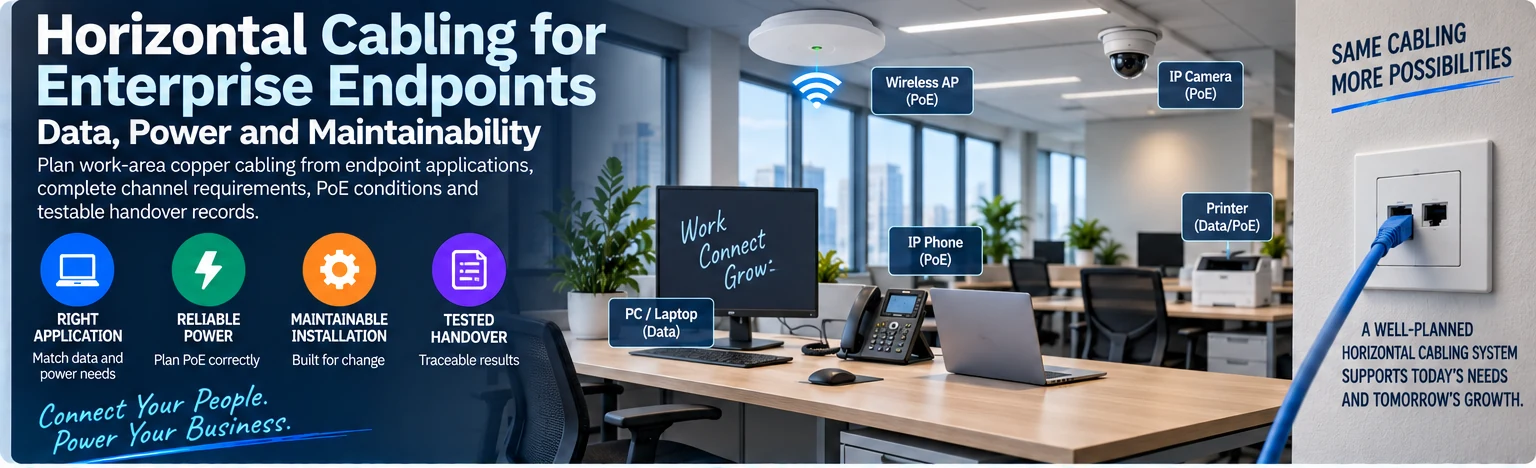
Horizontal cabling connects local endpoints to the access network. Its suitability depends on the completed channel—including patching and termination—not only the category printed on the permanent cable. Plan the channel around the endpoint’s data and power requirements and the environment in which it will operate.
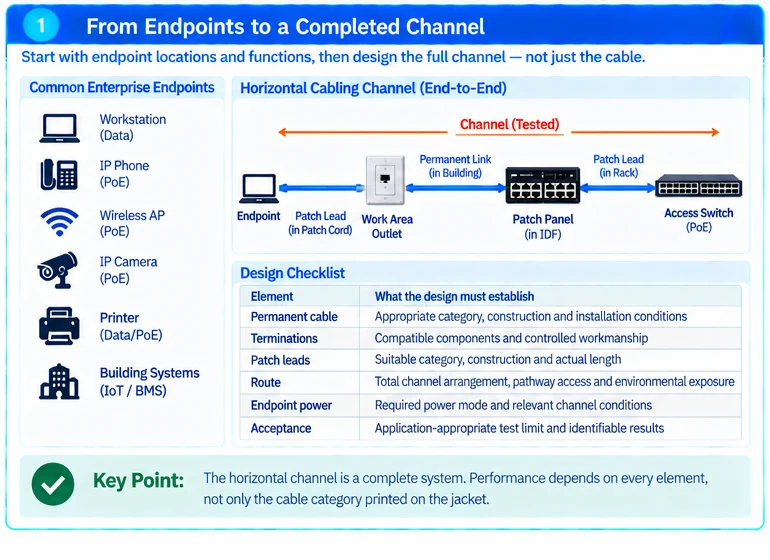
Start with endpoint locations and functions
Map desks, wireless APs, phones, cameras and shared devices. Identify locations likely to change and areas where later access is difficult. Record the target Ethernet application and whether the endpoint receives power through the channel.
Do not place every outlet according to today’s desk layout if the space is expected to be reconfigured. Equally, avoid unexplained overprovisioning. Reserve connections for a defined growth or relocation scenario.
Specify the completed channel
| Element | What the design must establish |
|---|---|
| Permanent cable | Appropriate category, construction and installation conditions |
| Terminations | Compatible components and controlled workmanship |
| Patch leads | Suitable category, construction and actual length |
| Route | Total channel arrangement, pathway access and environmental exposure |
| Endpoint power | Required power mode and relevant channel conditions |
| Acceptance | Application-appropriate test limit and identifiable results |
Permanent-link and channel tests cover different arrangements. State which one is being accepted and what patching remains outside that test. A report for one arrangement should not be treated as evidence for a materially different installation.
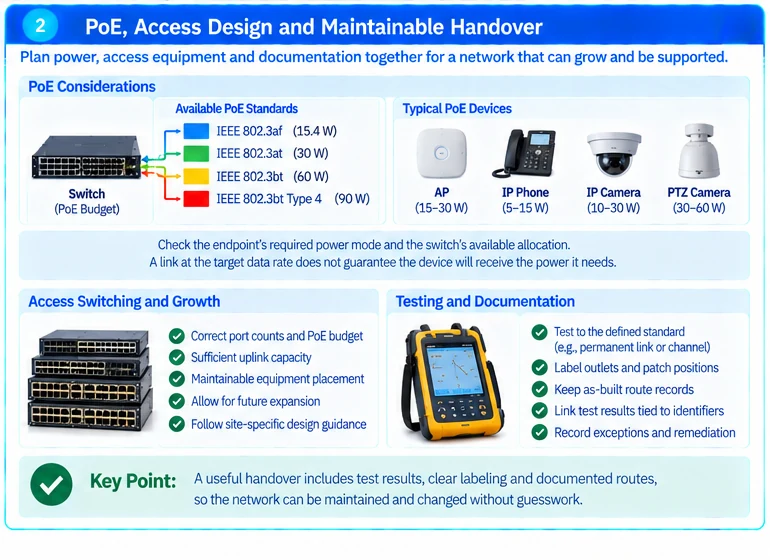
Treat PoE as a separate design requirement
Power available at the switch and power delivered to the endpoint are not identical. Check the endpoint’s required power class or mode and the switch’s supported allocation. Consider the actual cable construction, bundling and installation conditions through the appropriate qualified cabling review. R32
A device linking at the target data rate does not prove that it can receive the power needed for all functions. Conversely, a powered device may still have an unsuitable data channel.
Align access switching with the physical plan
Locate access equipment so that the channel meets the intended application and remains maintainable. Include switch port counts, uplink requirements, power budget and equipment-room access in the same project plan. Campus design guidance can inform access placement and service boundaries, but does not replace installation-specific qualification. R45
Where a route exceeds the supported copper application or presents unsuitable environmental conditions, redesign the path or use an appropriate alternative architecture. Do not assume an extender preserves every data-rate and power requirement.
Make the handover useful for troubleshooting
Label outlets and patch positions with stable identifiers, retain as-built routes and link test results to those identifiers. Record exceptions and remediation rather than reporting only an overall pass percentage.
Keep documentation for any fiber-fed access areas consistent with the wider channel register; optical inspection and copper certification are different tasks and should not be combined into one generic “cabling tested” claim. R17
The result is an endpoint channel that can be located, tested and changed without reconstructing the installation. A useful project brief includes the floor plan, endpoint roles, target applications, power needs and expected layout changes.
Engineering illustrations
These figures illustrate the design concepts discussed here. They are not measured results, certified configurations or a supplied-equipment list.