
Data centers
How should a global network program standardize its BOM without accepting incompatible substitutions?
Standardize service requirements while retaining local channel and host configurations.
A common global BOM can simplify purchasing while hiding important local differences. Preserve the technical identity of every service when substituting assemblies, optics or delivery batches.
The short answer
Standardize functional channel requirements and approved configurations, then retain site-specific host, route and compliance information. Approve substitutions against the whole configuration rather than a matching connector or nominal rate.
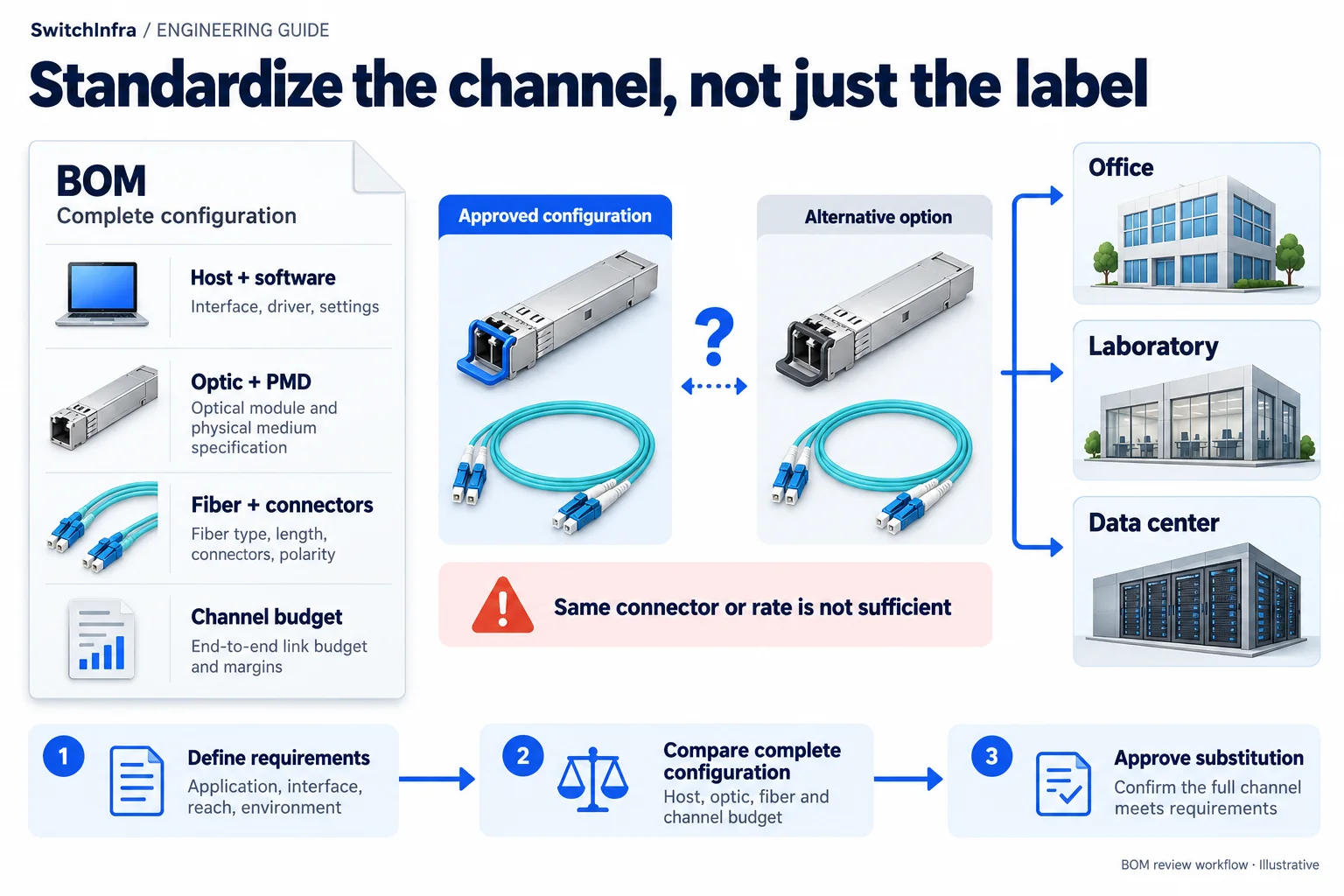
Review host software, optical PMD, fiber mapping and channel budget together when evaluating a BOM substitution. Conceptual illustration; equipment shapes are illustrative.
Third-party project account · Independent analysis by SwitchInfra
Not a SwitchInfra deployment. Candidate equipment is proposed for comparable requirements.
Global — reported program scope
3 settings — offices, laboratories and data centers
Copper + fiber — reported passive supply
Anonymous — customer not named
What the documented project tells us
Leviton describes an unnamed technology company seeking common cabling standards for offices, laboratories and data centers. Its account emphasizes global delivery coordination and reports supplying passive copper and optical connectivity.
That situation creates a specific selection challenge: a part may be commercially available in one region while failing the host, channel or facility requirements of another. Repeatable buying needs an approved configuration, not simply a globally repeated part description.
Settings — The program covers offices, laboratories and data centers.
Objective — The account describes a single-source cabling-standard initiative.
Delivery — Supply-chain redundancy and coordinated schedules are identified needs.
Scope — Leviton reports passive copper and fiber supply.
Scope of the analysis: Public project analysis of a third-party supplier account. Not a SwitchInfra deployment or independent acceptance report. Every proposed rate and model below is a separate design exercise.
Work through the engineering choices
Start with the documented constraint, then state the conditions for the proposed equipment role.
Define a global service specification with local inputs
The source spans several facility types and regions.
Design exercise: Design exercise: standardize a 10G optical service across three sites.
Write the service requirement separately from the purchase item: endpoint role, rate, media, connector interface, loss limit and acceptance method. Then attach each site’s host configuration and channel record. This keeps the common specification useful without pretending that all sites have identical networks.
For example, SFP-10G-SR and SFP-10G-LR both represent 10G optical functions but use different media. A regional supplier cannot substitute one for the other merely because both use LC. Treat a change of media, optical standard or equipment interface as a configuration change requiring review.
Cisco 10G optical module data sheet
Approve alternatives as complete configurations
The account emphasizes meeting coordinated project schedules.
Design exercise: Design exercise: review a proposed alternative when the preferred part is delayed.
Record the exact PID and offered unit condition, then check both endpoints, software and the installed optical channel. Include connector finish and any required adapter or cassette. Keep a record of the configuration that was approved; a verbal description such as equivalent 100G optic is too imprecise for repeat orders.
QSFP-100G-CWDM4-S is an optional single-mode 100G example, not a universal alternative to every 100G model. Review host and FEC requirements as well as optical limits. Lead time may justify evaluating another configuration, but it does not demonstrate that the alternative is compatible.
Cisco 100G optical module data sheet · Cisco optics compatibility matrix
Preserve configuration identity through delivery batches
The supplier reports a continuing global infrastructure relationship.
Design exercise: Design exercise: receive phased shipments for the same multi-site program.
Separate requested quantities, allocated stock, shipped items and accepted configurations. Record substitutions against the affected site and service rather than editing the master description silently. An acceptable laboratory pilot does not automatically validate all other host software releases or installed channels.
For each shipment, reconcile the delivered identifiers with the approved BOM and intended site. SFP-10G-SR-S illustrates why suffixes matter: its application limitations must be reviewed for the actual service, not assumed from similarity to a base-model name. Keep spares aligned with the configuration they are intended to replace.
Cisco 10G optical module data sheet · Cisco optics compatibility matrix
Ask for a configuration and delivery matrix
The RFQ should allow a commercial team to compare options without losing the technical reasons behind the original selection. Request alternatives explicitly, with the affected configurations and confirmation status clearly stated.
Cisco optics compatibility matrix
Identity
Exact PIDs, offered condition, quantities and site allocations.
Compatibility
Host/software combinations, media, channel loss and supported application.
Delivery
Approved substitutions, batch traceability, acceptance and spare assignment.
Candidate models and selection boundaries
These are illustrative model inquiries, not the equipment installed in the source project. Confirm the required rate and complete channel before finalizing any line.
| Model / family and status | Role and condition |
|---|---|
| SFP-10G-SR Conditional model inquiry | Conditional global 10G MMF standard Site host and channel must match the approved configuration. Cisco 10G optical module data sheet |
| SFP-10G-LR Conditional model inquiry | Separate 10G SMF standard Not an interchangeable regional replacement for SR. Cisco 10G optical module data sheet |
| SFP-10G-SR-S Conditional model inquiry | Suffix-specific 10G MMF alternative Review actual application; S-class does not support FCoE. Cisco 10G optical module data sheet |
| QSFP-100G-CWDM4-S Conditional model inquiry | Separate 100G SMF configuration Requires explicit host, FEC and channel review. Cisco 100G optical module data sheet |
Listed models are independent design candidates, not equipment identified in this project. IDs are supplied only for previously verified exact catalog matches. Other PIDs are model inquiries; supply and platform compatibility are unconfirmed.
Continue in the relevant product family
Use the analysis to define the role before comparing catalog options.
Discuss this project
Carry the route, media, endpoint and loss requirements into the inquiry. Leave unknown quantities blank; source-project fiber counts are not an equipment BOM.
Follow the next selection question.
Compare related decisions while keeping each source’s scope, hardware and link conditions separate.
Browse more engineering analyses →
Single-mode university data center: 100G / 40G selection
A G.657.A2 fiber plant makes the complete optical channel central to the equipment choice.
Read the engineering analysis · Original project account
Expand mixed OM4 and single-mode cabling
A public Xi’an expansion account becomes a practical guide to channel allocation, 1U fiber density and patching-loss budgets.
Read the engineering analysis · Original project account
Building interconnect: pretermination or splicing?
Compare complete installation, mapping and acceptance packages at high fiber counts.
Read the engineering analysis · Original project account
Before you finalize the channel
Does one global standard require identical equipment everywhere?
No. It can define common service and acceptance requirements while retaining approved site-specific configurations.
Can a matching rate justify a substitution?
No. Media, optical PMD, host support, software, application limits and channel budget remain material.
Is the anonymous customer identifiable from its industry?
The source does not name it. Industry descriptions are insufficient evidence for assigning a customer identity.
What should the RFQ ask suppliers to return?
A site and configuration matrix, exact offered PIDs and condition, quantities, delivery assumptions and separately identified alternatives.
Trace the project facts and technical limits
- Leviton project account
- Cisco 10G optical module data sheet
- Cisco 100G optical module data sheet
- Cisco optics compatibility matrix
Source check: 19 October 2026. Catalog status is stated per candidate.
Sources checked 19 October 2026. Source-page metadata dates publication to 17 September 2025. Customer identity and deployed active models are undisclosed; delivery claims remain supplier statements.