
Network engineering
HPC Networking Solutions: From Job Communication to a Qualified Fabric
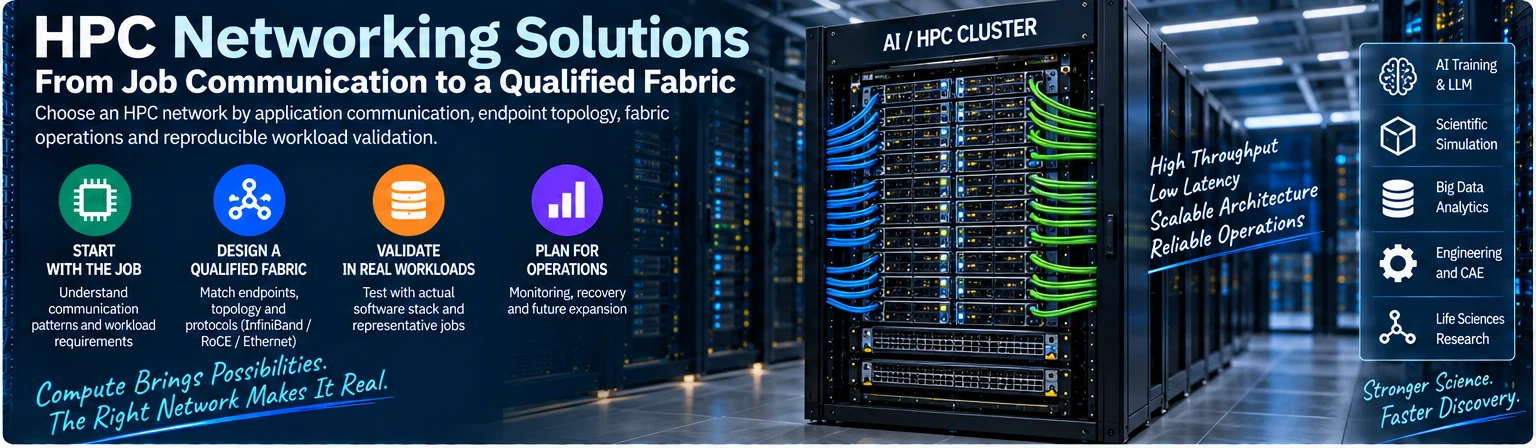
Choose an HPC network by application communication, endpoint topology, fabric operations and reproducible workload validation.
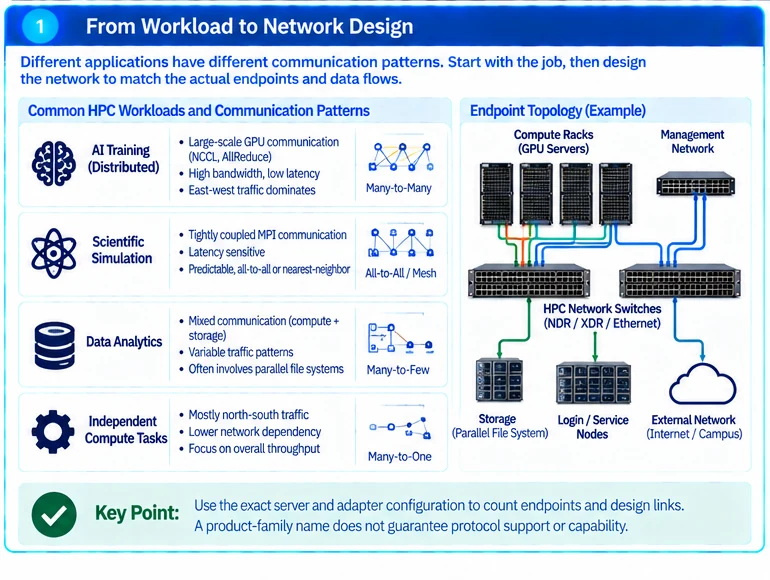
High-performance computing networks serve workloads with very different communication patterns. A tightly coupled simulation, a distributed training job and a collection of independent compute tasks may use the same number of servers yet require different network behavior. The starting point is the job, not the switch generation.
Identify the communication requirement
Record process or GPU placement, job size, message behavior, concurrency and storage interaction. Determine which communication crosses nodes and which remains inside the server. Separate compute, storage, external-service and management paths before deciding where they share infrastructure.
Count active network endpoints from the actual server and adapter configuration. Exact adapter variants and supported modes matter; a product-family name is not a universal protocol entitlement. R51
Follow the appropriate design path
| Project question | Relevant solution scope |
|---|---|
| Choosing the overall compute network | AI compute fabric planning |
| Building or expanding an NDR environment | NDR endpoint, topology and interconnect design |
| Planning an XDR transition | XDR port architecture and migration boundaries |
| Using Ethernet RDMA for AI | RoCE architecture and separate commissioning workflow |
| Making the cluster operable | Management, power, recovery and spare infrastructure |
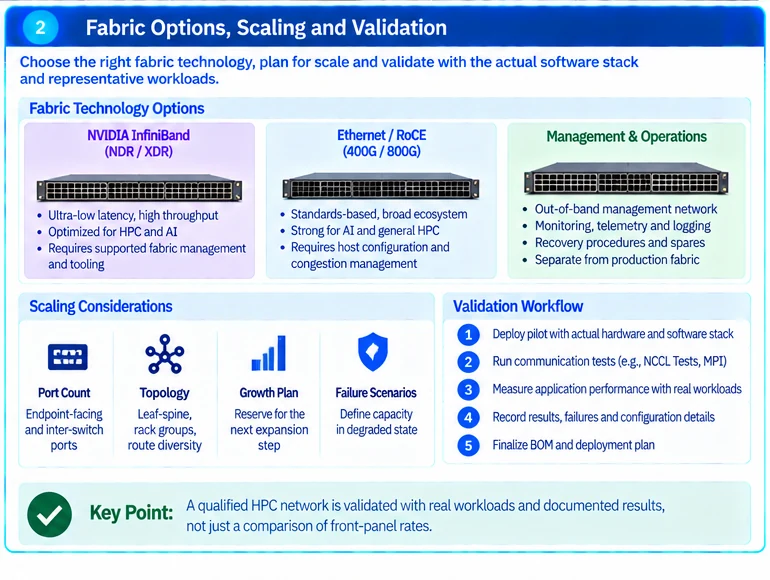
These scopes should be evaluated as complete systems. Ethernet/RoCE requires coordinated host and congestion behavior; InfiniBand requires its own supported fabric-control and management arrangements. Neither can be reduced to a front-panel rate comparison. R08R52
Define scale and failure explicitly
Calculate endpoint-facing ports, inter-switch ports and expansion reservations. State normal and degraded-state capacity assumptions. A topology sized for one large job can behave differently when several jobs compete for shared links.
Reserve growth for a named next step, such as an additional rack group. Include the interconnects and management resources that step consumes. An unused cage is not necessarily available capacity in every operating mode.
Validate with the actual software stack
A pilot should include the real host architecture, drivers, firmware, fabric software and representative cabling. Use communication tests to diagnose the path, then measure the application’s relevant outcome. NCCL Tests can support GPU-collective evaluation, but its results need configuration and placement context and are not a universal HPC benchmark. R11
Retain failures and exceptions as well as successful runs. They identify the operating boundaries that a procurement specification should preserve.
For an initial design discussion, provide the server inventory, applications, job sizes, rack layout and operating team’s constraints. The resulting fabric proposal should explain what it is designed to achieve, how that will be demonstrated and which assumptions limit its future expansion.
Engineering illustrations
These figures illustrate the design concepts discussed here. They are not measured results, certified configurations or a supplied-equipment list.
Related reading
- AI Compute Fabric Planning: Choose the Network Around the Workload
- 800G RoCE Fabric Architecture for AI Clusters
- NVIDIA Switch Selection Worksheet: Logical Ports, Cages and Rack Requirements