
Network engineering
Internet Data Center Networking: Separate Edge, Service and Compute Responsibilities
Plan an internet data-center network around traffic roles, service boundaries, capacity, observability and controlled growth.
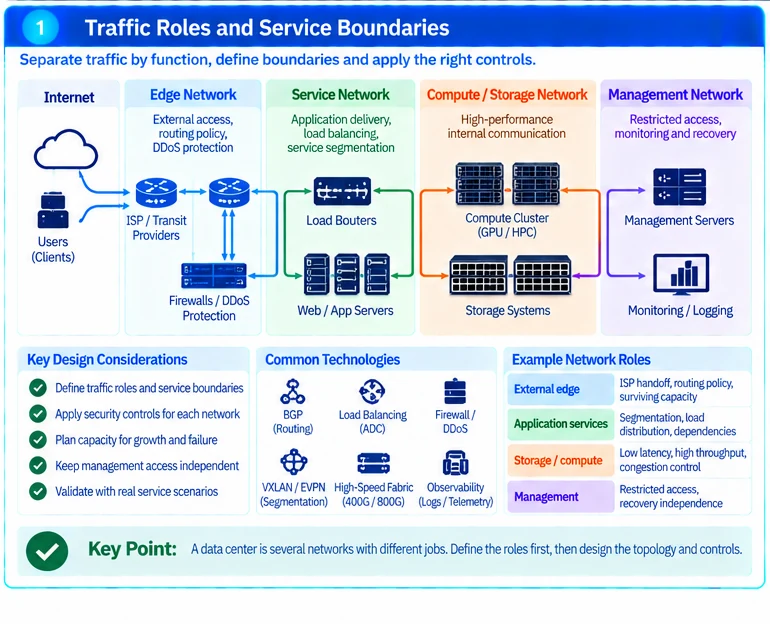
An internet data center contains several networks with different jobs. External traffic delivery, application services, storage, compute communication and management should not be treated as one undifferentiated bandwidth requirement. Define those responsibilities first, then select the appropriate topology and controls.
Build a traffic-role map
Identify which systems receive client traffic, which communicate internally and which must remain reachable during recovery. Record expected traffic direction and concurrency at each boundary. A large aggregate switch capacity does not guarantee that a constrained service path has enough capacity.
| Network role | Main design concern |
|---|---|
| External edge | Provider handoff, routing policy and surviving service capacity |
| Application services | Segmentation, load distribution and dependency visibility |
| Storage or compute fabric | Workload-specific latency, throughput and congestion behavior |
| Management | Restricted administrative access and recovery independence |
Network location should not automatically establish application trust. Define access controls around actual service requirements and keep their ownership clear. R35
Choose the relevant detailed solution
Use the 400G interconnect architecture and deployment pages when the problem is a high-capacity handoff or site connection. Use the CDN solution when cache behavior changes client and origin traffic requirements. Use the compute-fabric solutions when tightly coupled jobs dominate internal communication.
For CDN services, cache policy and freshness behavior affect what can be served locally; a network plan cannot assume every object is safely reusable. R33
Keep overlays tied to an operating requirement
VXLAN and EVPN can support particular virtualization and segmentation designs, but they add control-plane and operational responsibilities. Define endpoint attachment, routing boundaries, underlay reachability and failure behavior before adopting an overlay. R30R31
A smaller service network may not need the same architecture as a large multitenant facility. The design should justify complexity through an actual requirement.
Size growth and failure together
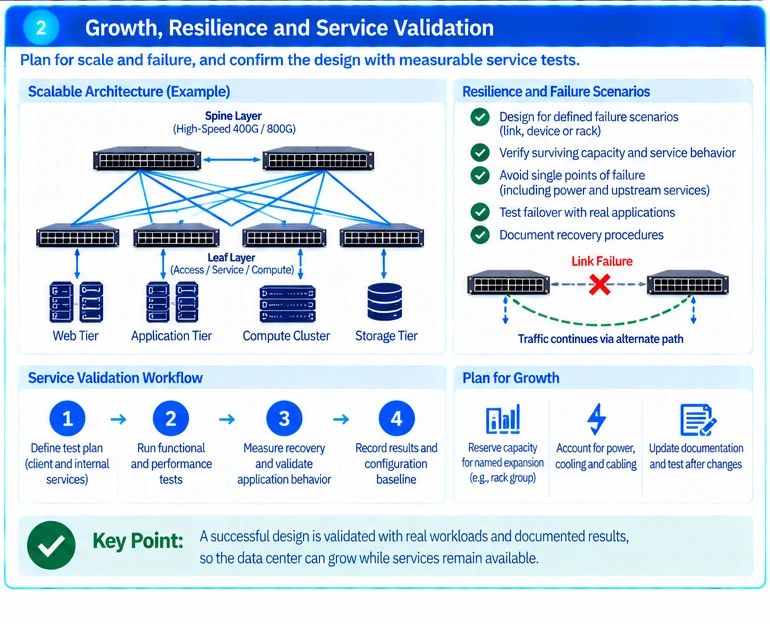
Calculate capacity at each shared path and under the agreed equipment or route failure. Include the behavior of surviving servers and upstream services. Adding interfaces without accounting for application or storage limits may move the bottleneck rather than remove it.
Reserve expansion capacity for named service groups or rack additions. Record the physical cabling, power and management resources that the next phase consumes.
Make acceptance service-oriented
Test representative client transactions and internal dependencies alongside forwarding, errors and recovery. Link results to a fixed configuration baseline so that later changes can be compared meaningfully.
For an initial project brief, provide the service map, provider handoffs, rack layout, workload profiles and required failure tolerance. The resulting design should explain how external delivery and internal operation remain coordinated as the data center grows.
Engineering illustrations
These figures illustrate the design concepts discussed here. They are not measured results, certified configurations or a supplied-equipment list.
Related reading
- 400G Cloud Interconnect Architecture: Define the Service Before the Optic
- CDN Network Design: Model Cache Hits, Origin Traffic and Failure Capacity