
Network engineering
400G Cloud Interconnect Architecture: Define the Service Before the Optic
Design a 400G cloud or data-center interconnect around service handoffs, route diversity, capacity and the correct optical architecture.
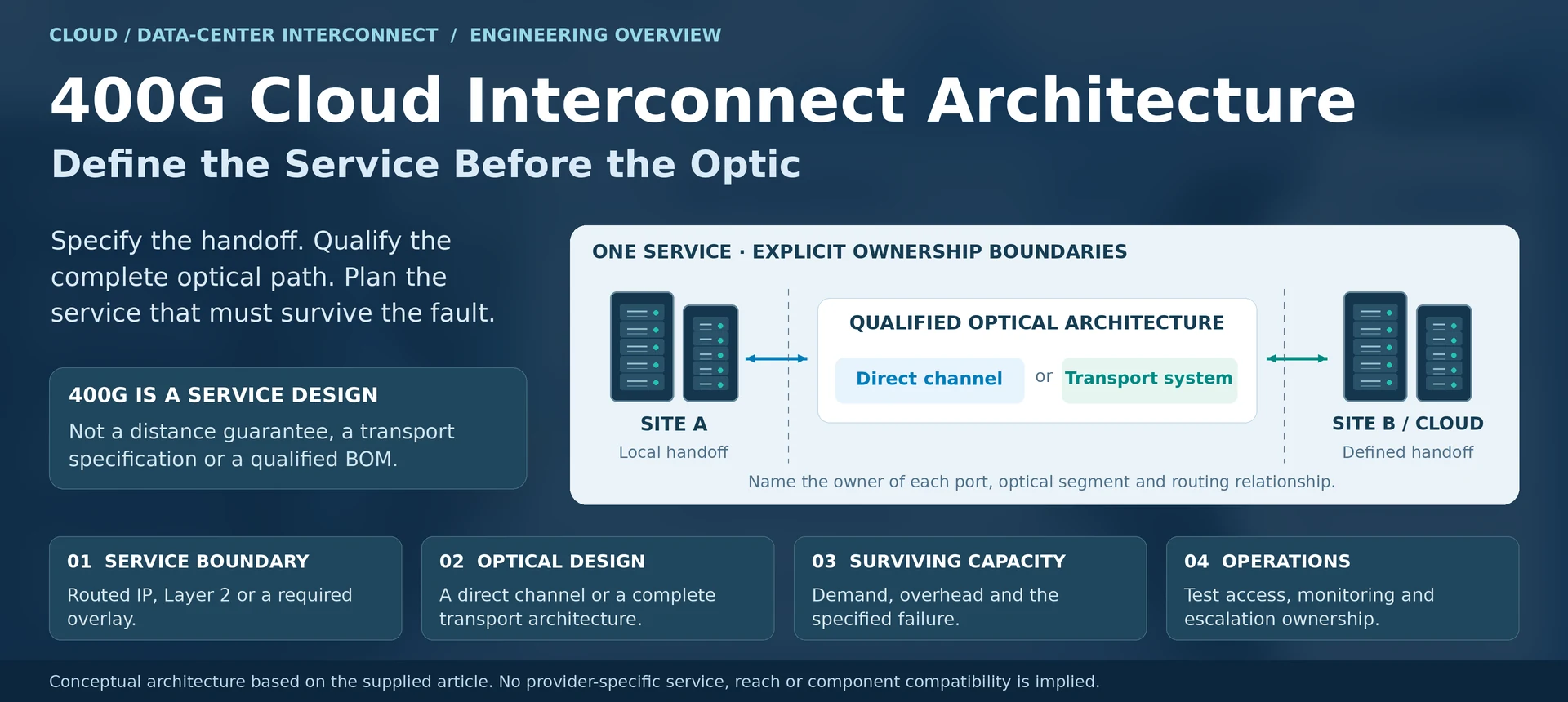
A 400G interconnect can describe a connection inside a data center, a leased service between sites or a client interface into an optical transport system. These arrangements have different responsibilities and engineering limits. Define the service and ownership boundary before selecting transceivers or drawing a redundant pair of lines.
Identify what crosses the boundary
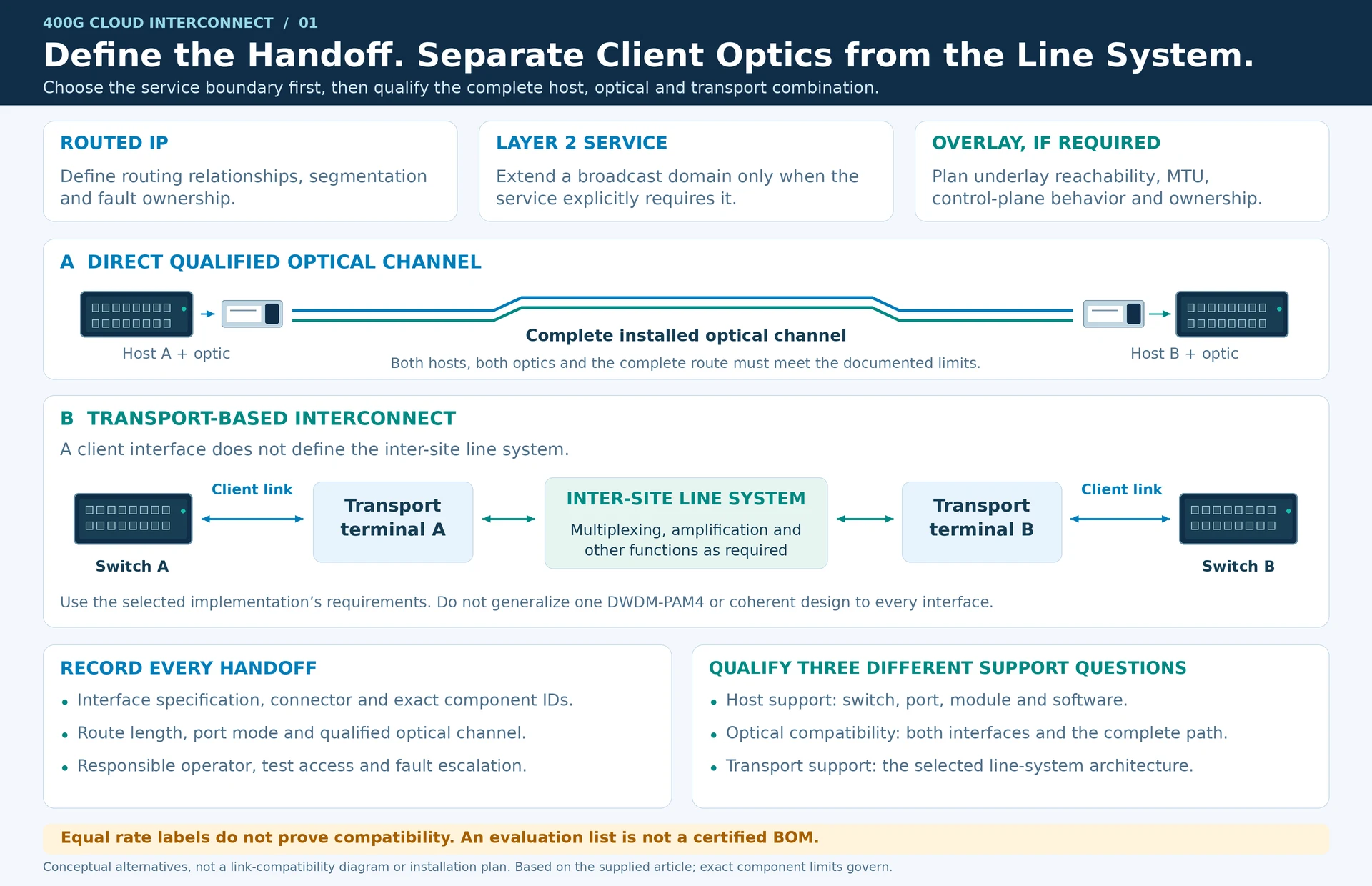
Document the applications, endpoints and traffic direction. Determine whether the required handoff is routed IP, a Layer 2 service or a specific overlay arrangement. Decide where routing, segmentation and fault isolation belong. Extending a broadcast domain between sites should be an explicit service requirement, not an accidental consequence of a high-bandwidth link.
VXLAN and EVPN can support particular overlay designs, but their availability does not remove the need to plan underlay reachability, MTU, failure behavior and operating ownership. R30R31
Separate client optics from the line system
The optic that connects a switch to nearby transport equipment is not necessarily the optic or system that carries the inter-site route. Identify whether the channel is a direct supported optical link or includes wavelength multiplexers, amplification, dispersion treatment or other line-system functions.
Some DWDM-PAM4 implementations specify associated transport requirements; those conditions cannot be generalized to every PAM4 or coherent interface. Select a complete supported optical architecture instead of combining components because their rate labels match. R41
Define capacity and availability together
| Design dimension | Required decision |
|---|---|
| Service boundary | Who owns each port, optical segment and routing relationship? |
| Capacity | Busy-hour demand, growth and allowed congestion |
| Resilience | Link, route, equipment and site failures to tolerate |
| Optical path | Direct channel or transport system with documented limits |
| Operations | Monitoring, escalation and maintenance coordination |
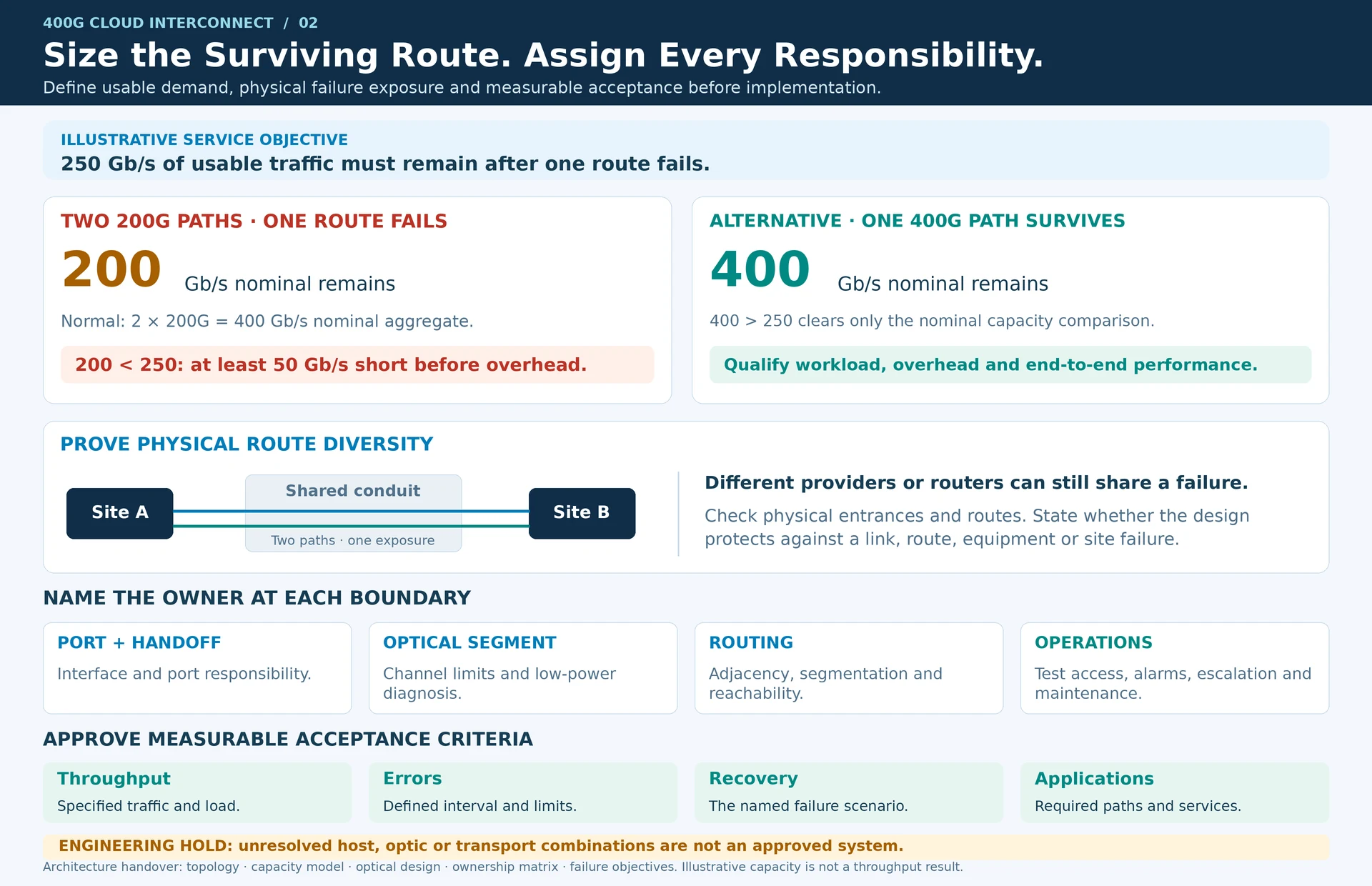
An illustrative requirement for 250 Gb/s of usable traffic after one route fails cannot be justified by two 200G paths: only 200 Gb/s of nominal link capacity remains. A single surviving 400G path may satisfy the arithmetic, but the design still needs workload and overhead allowances plus end-to-end validation.
Route diversity must be demonstrated physically. Two services entering the same building conduit can share a failure even when they use different providers or routers.
Keep procurement aligned with ownership
For every handoff, record interface specification, supported modules, connector, route length and responsible operator. Define who provides test access and who diagnoses a low-power or error condition. The module catalogue supports product identification; it does not replace a channel design or service agreement. R25
Do not represent an evaluation list as a certified BOM. Hold unresolved host, optical or transport combinations for engineering confirmation.
Release an architecture that can be operated
Before implementation, approve the topology, capacity model, optical design, responsibility matrix and failure objectives. Establish measurable acceptance criteria covering throughput, errors, recovery and application reachability.
Use the companion implementation workflow for staging and cutover. This architecture document should answer a different question: why this service boundary and physical design meet the project’s requirements, and what assumptions must remain true as the interconnect grows.
Engineering illustrations
These figures illustrate the design concepts discussed here. They are not measured results, certified configurations or a supplied-equipment list.
Related reading
- Deploying a 400G Interconnect: Staging, Cutover and Acceptance
- 400G Data Center Design Guide: Ports, Capacity, Optics and Acceptance
- High-Density 400G Is a Rack Design Problem, Not Just a Port Count