
Enterprise & facilities
What must a manufacturing fiber mesh prove before it counts as service resilience?
Connect route diversity, equipment environment and failure testing before ordering duplicate optics.
A mesh adds potential paths, but resilient service also requires suitable equipment, independent failure domains and a defined restoration behavior. Specify those requirements before duplicating optical parts.
The short answer
Map physical routes and common dependencies, define service restoration requirements, and verify equipment placement. Count working and protection channels only after the active topology and host interfaces are agreed.
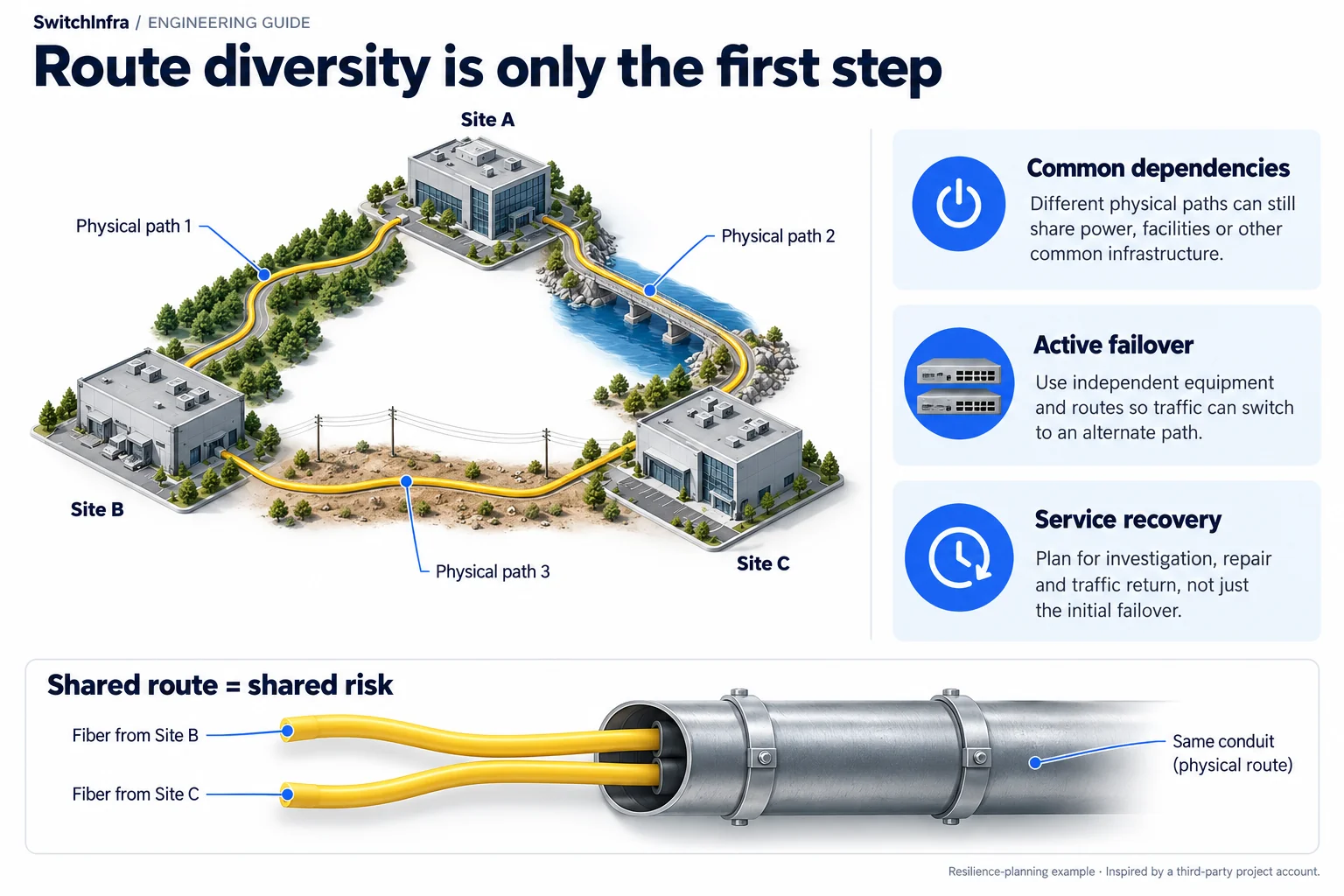
Physical route diversity should be assessed together with common dependencies, active failover and service recovery. Conceptual illustration; equipment shapes are illustrative.
Third-party project account · Independent analysis by SwitchInfra
Not a SwitchInfra deployment. Candidate equipment is proposed for comparable requirements.
Italy — reported facility location
30,000+ — reported components deployed
Copper + fiber — reported connectivity scope
Mesh — supplier-described backbone
What the documented project tells us
Leviton describes an unnamed tire manufacturer’s new Italian facility using copper and fiber connectivity. It reports more than 30,000 components and a meshed fiber backbone, working with A.Erre Telecomunicazioni and distributor ASIT.
The selection question is how a comparable plant turns that physical mesh into maintainable service resilience. Component totals and a supplier’s continuity statement do not reveal failure domains, active protocols or recovery-test results.
Facility — The account concerns a new manufacturing site in Italy.
Scale — More than 30,000 connectivity components are reported.
Media — Copper and fiber products are included.
Backbone — The supplier describes a meshed fiber arrangement.
Scope of the analysis: Public project analysis of a third-party supplier account. Not a SwitchInfra deployment or independent acceptance report. Every proposed rate and model below is a separate design exercise.
Work through the engineering choices
Start with the documented constraint, then state the conditions for the proposed equipment role.
Draw shared failures before counting spare paths
The source describes the backbone as meshed and redundant.
Design exercise: Design exercise: protect a production-support service during maintenance.
Trace each proposed path through ducts, entrances, racks and power dependencies. Two fiber routes that meet at the same unprotected enclosure may still share a consequential failure point. Record what must remain available during a single maintenance activity or equipment outage.
Then define the active network’s expected response and the acceptable service interruption. Physical alternatives alone do not establish routing convergence, loop prevention or application recovery. Quote optics for the agreed topology, with working and protection roles explicit, rather than multiplying all channel quantities by two without a failure analysis.
Leviton Italian manufacturing account
Match equipment placement to the actual environment
The project concerns a manufacturing facility with copper and fiber systems.
Design exercise: Design exercise: distinguish a conditioned communications room from a production-floor cabinet.
Record temperature range, contaminants, power quality and maintenance access at each equipment position. A manufacturing address does not mean every switch requires the same environmental design, but ordinary enterprise equipment cannot be assumed suitable for an exposed industrial location.
C9200L-24T-4G-E is a conditional ordinary 1G data-only example, subject to its operating requirements. It is not presented as an industrial switch or a PoE solution. Keep powered devices and any environmentally demanding endpoint role separate, rather than using a familiar port count as the entire specification.
Cisco Catalyst 9200 series data sheet
Select the optical channel for each protection role
The source does not disclose fiber grade, rate or optical models.
Design exercise: Conditional examples: 10G backbone channels on verified media.
SFP-10G-LR can be assessed for a suitable single-mode path, while SFP-10G-SR requires verified multimode media. Check the entire route and supported endpoint configuration independently for each path. Unequal route lengths or patching can produce different optical margins even when two links serve the same application.
Keep spares assigned to exact approved configurations and test the intended failure transition before accepting a resilience claim. Fiber removes the conductive data path between optical endpoints; it does not by itself supply power, qualify the switch environment or validate the service’s recovery behavior.
Cisco 10G optical module data sheet · Cisco optics compatibility matrix
Quote a maintainable failure scenario
Tell the supplier which service must survive which failure, and provide the actual installation environment. A useful proposal identifies working paths, alternate paths, common dependencies and the evidence required at handover.
Cisco optics compatibility matrix
Failures
Shared ducts, racks, entrances, power dependencies and maintenance events.
Environment
Equipment-position conditions, power needs and service access.
Recovery
Host configuration, channel margins, restoration objective and observed test result.
Candidate models and selection boundaries
These are illustrative model inquiries, not the equipment installed in the source project. Confirm the required rate and complete channel before finalizing any line.
| Model / family and status | Role and condition |
|---|---|
| C9200L-24T-4G-E Conditional catalog candidate | Conditional ordinary data-room access Not an industrial or PoE claim; verify operating environment. Cisco Catalyst 9200 series data sheet |
| SFP-10G-LR Conditional model inquiry | Independent 10G SMF protection-path example Assess each route and both hosts separately. Cisco 10G optical module data sheet |
| SFP-10G-SR Conditional model inquiry | Alternative 10G MMF example Requires verified MMF and its own path budget. Cisco 10G optical module data sheet |
Listed models are independent design candidates, not equipment identified in this project. IDs are supplied only for previously verified exact catalog matches. Other PIDs are model inquiries; supply and platform compatibility are unconfirmed.
Continue in the relevant product family
Use the analysis to define the role before comparing catalog options.
Discuss this project
Carry the route, media, endpoint and loss requirements into the inquiry. Leave unknown quantities blank; source-project fiber counts are not an equipment BOM.
Follow the next selection question.
Compare related decisions while keeping each source’s scope, hardware and link conditions separate.
Browse more engineering analyses →
100G single-mode: select with a budget
Use distance, loss, receive power and FEC to distinguish two duplex-LC candidates.
Read the engineering analysisOfficial technical source
25G migration: select the operating mode
Match NIC capability, optical media and FEC before changing server link rates.
Read the engineering analysisOfficial technical source
40G breakout: a suffix can change the design
Check the host configuration and exact optical model before buying four 10G paths.
Read the engineering analysisOfficial technical source
Before you finalize the channel
Does a fiber mesh guarantee uninterrupted production?
No. Common dependencies, active topology and application behavior determine the actual outcome. Define and test the required failure scenarios.
Does every plant connection need an industrial switch?
Determine requirements at the actual equipment position. The supplier account does not disclose environmental ratings or installed switches.
Can one spare optic serve both SR and LR paths?
No. They use different optical media and PMDs. Assign spares to the exact approved configuration.
What belongs in a resilience RFQ?
The service failure objective, route and power dependencies, equipment environments, host configurations, measured channel budgets and acceptance checks.
Trace the project facts and technical limits
- Leviton project account
- Cisco Catalyst 9200 series data sheet
- Cisco 10G optical module data sheet
- Cisco optics compatibility matrix
Source check: 19 October 2026. Catalog status is stated per candidate.
Sources checked 19 October 2026. Source-page metadata dates publication to 10 December 2025. Customer identity, active topology and independent recovery tests remain undisclosed.