
Campus networks
How should a university separate research traffic and campus services over shared cabling?
Choose the fabric from application needs, then map the reported MPO cabling to each service.
A university can use the same cabling program for scientific computing and ordinary campus systems while needing very different active-network designs. Workload requirements must precede a switch or optical BOM.
The short answer
Write separate service profiles for research, campus applications and management. Verify the media and mapping of every MPO channel before assigning Ethernet rates, optics or an HPC fabric.
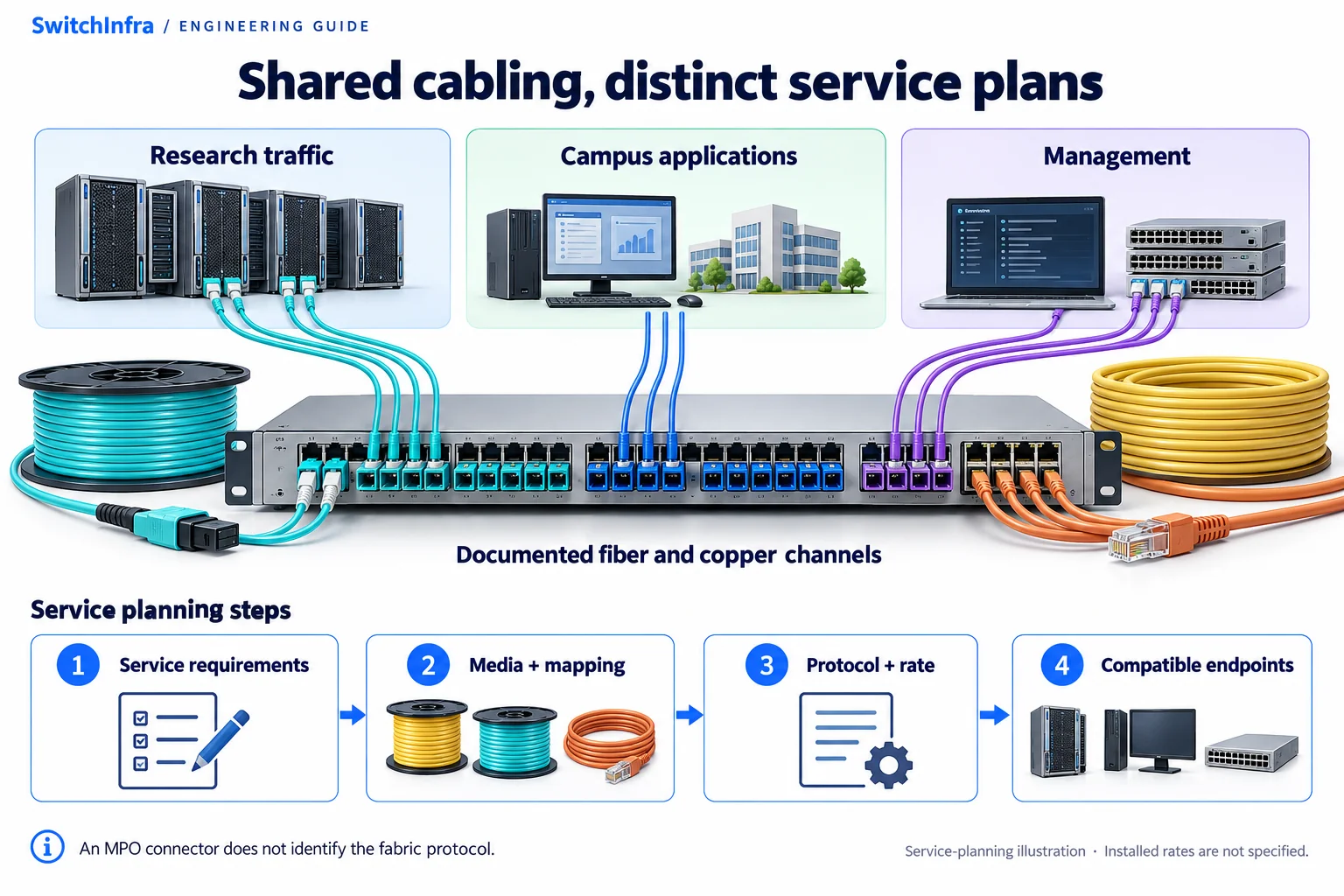
Document the media and channel mapping for research, campus applications and management before selecting protocol and rate. Conceptual illustration; equipment shapes are illustrative.
Third-party project account · Independent analysis by SwitchInfra
Not a SwitchInfra deployment. Candidate equipment is proposed for comparable requirements.
2 roles — data-center and supercomputing context
Cat 6 — reported copper system
MPO–MPO — reported preterminated cabling
Unknown — rates and fabric protocol
What the documented project tells us
ENJOYLink describes Cat 6 unshielded cabling and MPO–MPO preterminated fiber for Lanzhou University, linking its account to campus information systems and scientific computing. It does not publish a port-level network design.
That limited disclosure still raises a useful engineering question: which connections need ordinary application access, and which need a workload-specific research fabric? Calling both a data-center link would hide important purchasing differences.
ENJOYLink, republished by Qianjia project account
Workloads — The account discusses research and campus information services.
Facilities — It names the Yuzhong data center and supercomputing center.
Copper — A Cat 6 unshielded system is reported.
Fiber — MPO–MPO preterminated optical cabling is reported.
Scope of the analysis: Public project analysis of a third-party supplier account. Not a SwitchInfra deployment or independent acceptance report. Every proposed rate and model below is a separate design exercise.
Work through the engineering choices
Start with the documented constraint, then state the conditions for the proposed equipment role.
Define services before selecting a fabric
The supplier associates the facilities with both research and campus operations.
Design exercise: Design exercise: classify a new research cluster and its campus-facing services.
List application traffic separately from cluster interconnect, storage access and administration. Record endpoint interfaces, concurrent flows, latency requirements and recovery expectations for each. A scientific workload might justify a specialized fabric, but its building address does not prove that requirement.
For a small departmental expansion, ordinary Ethernet may meet the actual task. For a tightly coupled workload, collect application and server requirements before deciding between Ethernet and another fabric. Do not convert the supplier’s mention of supercomputing into a claim that this case deployed InfiniBand, RoCE or a particular speed.
ENJOYLink supplier project collection
Establish what each MPO assembly actually connects
The source identifies preterminated MPO–MPO cabling.
Design exercise: Design exercise: map a proposed rack connection through the existing trunk.
Request the installed fiber grade, connector fiber count, pinning, polarity and cassette or harness part numbers. Determine whether the equipment sees a parallel multifiber interface or duplex ports. MPO names the connector arrangement; it does not identify the optical standard or even the fiber medium.
If a native 40G SR4 path is proposed independently, QSFP-40G-SR4-S can be assessed on a verified multimode channel. It does not support four-way 10G breakout. A different port arrangement needs its own host and cabling review rather than a silent substitution.
Cisco 40G optical module data sheet · CommScope cassette and distribution reference
Keep data access and management quantities separate
The account also lists copper cabling.
Design exercise: Design exercise: prepare separate rows for management, server access and aggregation.
Count server data interfaces from the actual NIC schedule. Then count management interfaces separately, including the switches that remain reachable during fabric maintenance. A copper management port does not establish the bandwidth or medium required by the server’s application connection.
SFP-10G-SR and SFP-10G-LR illustrate alternative 10G Ethernet optical paths after media verification. Neither is a general research-fabric recommendation. Quote each complete channel with its host software, endpoint rate and loss result so a technically valid management choice cannot be mistaken for a suitable compute interconnect.
Cisco 10G optical module data sheet · Cisco optics compatibility matrix
Build a workload-aware RFQ
Include the application owner’s service profile alongside the cable inventory. The useful deliverable is a role-specific BOM with explicit assumptions and a test plan for the actual workload.
Cisco optics compatibility matrix
Service
Compute, storage, campus applications and management identified separately.
Channel
Fiber grade, MPO mapping, loss and equipment-facing interface.
Endpoints
NICs, host ports, protocol, software and concurrent traffic target.
Candidate models and selection boundaries
These are illustrative model inquiries, not the equipment installed in the source project. Confirm the required rate and complete channel before finalizing any line.
| Model / family and status | Role and condition |
|---|---|
| QSFP-40G-SR4-S Conditional model inquiry | Independent native 40G MMF example Requires verified MMF; no 4 × 10G breakout. Cisco 40G optical module data sheet |
| SFP-10G-SR Conditional model inquiry | Conditional 10G Ethernet MMF access Not proof of a research-fabric design. Cisco 10G optical module data sheet |
| SFP-10G-LR Conditional model inquiry | Alternative 10G Ethernet SMF path Requires a separately verified single-mode channel. Cisco 10G optical module data sheet |
Listed models are independent design candidates, not equipment identified in this project. IDs are supplied only for previously verified exact catalog matches. Other PIDs are model inquiries; supply and platform compatibility are unconfirmed.
Continue in the relevant product family
Use the analysis to define the role before comparing catalog options.
Network Modules and Line Cards
Discuss this project
Carry the route, media, endpoint and loss requirements into the inquiry. Leave unknown quantities blank; source-project fiber counts are not an equipment BOM.
Follow the next selection question.
Compare related decisions while keeping each source’s scope, hardware and link conditions separate.
Browse more engineering analyses →
24-fiber MTP: one allocation, different optical choices
Map custom cassettes before selecting native 40G, duplex 10G or an independently proposed breakout design.
Read the engineering analysis · Original project account
Campus OS2: qualify both routes before choosing optics
Use Newcastle’s Catalyst Building account to examine per-route channel budgets and protection requirements. The installed link rates remain undisclosed.
Read the engineering analysis · Original project account
Campus ring: count channels across the ODF
Translate a university distribution project into route, pair and protection requirements before choosing optics.
Read the engineering analysis · Original project account
Before you finalize the channel
Does a supercomputing center imply InfiniBand?
No. The account does not disclose its fabric protocol. Obtain workload and endpoint requirements before making that choice.
Does MPO mean a 40G or 100G link?
No. Fiber grade, mapping, PMD and supported endpoint modes determine the usable connection.
Can one BOM cover management and compute traffic?
It can contain both, but each row must retain its service role, bandwidth and failure requirements.
What information turns this into a purchasable project?
Provide the workload profile, endpoint inventory, channel map, current host software and quantities by service role.
Trace the project facts and technical limits
- ENJOYLink, republished by Qianjia project account
- Cisco 40G optical module data sheet
- CommScope cassette and distribution reference
- Cisco 10G optical module data sheet
- Cisco optics compatibility matrix
Source check: 19 October 2026. Catalog status is stated per candidate.
Sources checked 19 October 2026. Rates, media grade, fabric protocol and installed optics remain undisclosed. Cisco models are separate compatibility-unconfirmed examples.