
Campus networks
How should network ports and fiber capacity be planned around preformed building pathways?
Reconcile cable pulling, room demand and individual optical paths before finalizing the BOM.
When cable penetrations are formed before the network is installed, the physical route becomes a purchasing constraint. Copper bundles, fiber assemblies and future access all need room in the same plan.
The short answer
Validate the pathway and room-level port schedule before ordering cable assemblies or switches. Treat total installed fiber length separately from the distance of any one optical channel.
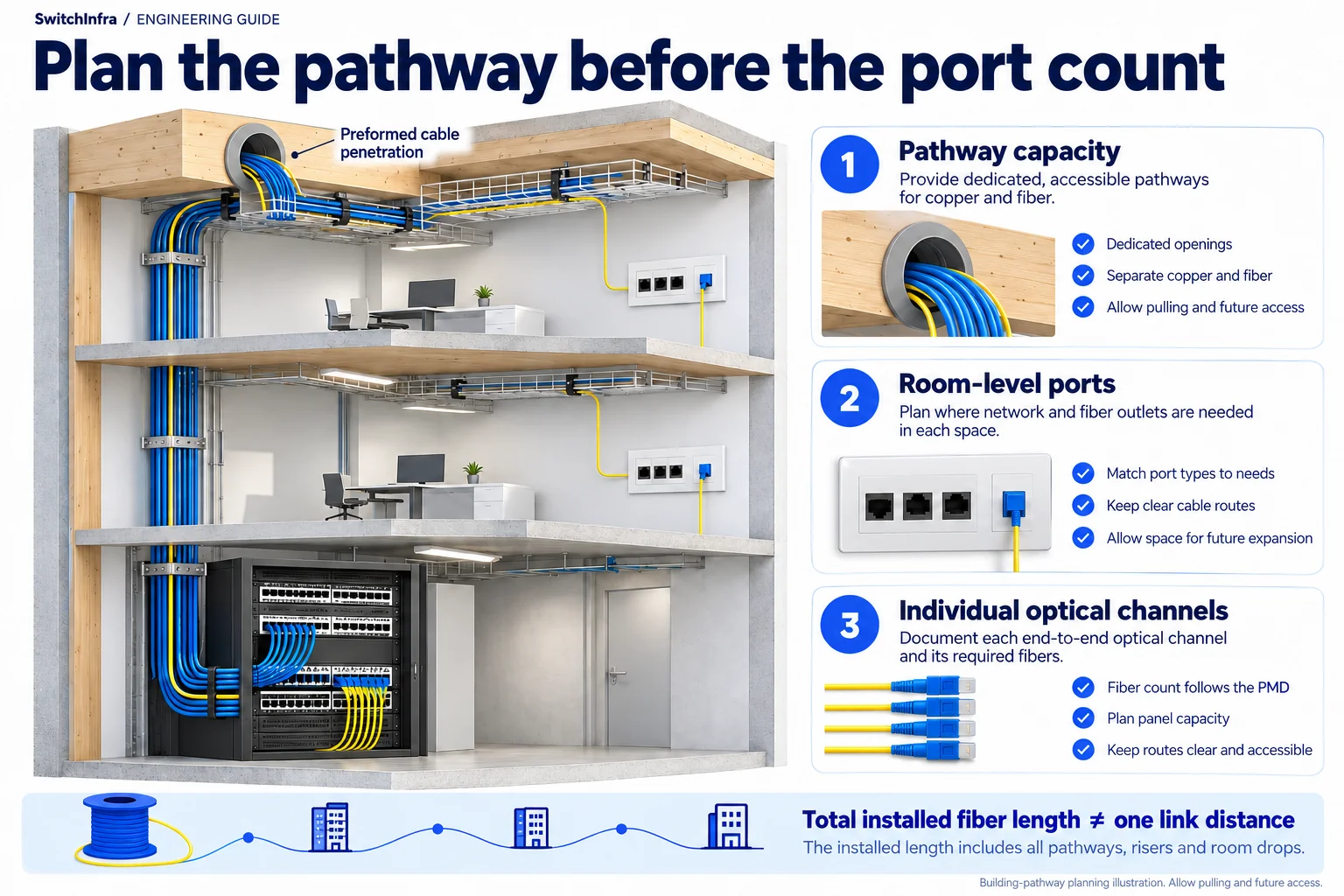
Plan building pathways and room-level ports before allocating individual channels. Total installed fiber length is not one link’s reach. Conceptual illustration; equipment shapes are illustrative.
Third-party project account · Independent analysis by SwitchInfra
Not a SwitchInfra deployment. Candidate equipment is proposed for comparable requirements.
1,500 approx. — reported outlets
Cat 6A UTP — reported copper solution
700 m — reported total fiber cable
Preformed — building cable penetrations
What the documented project tells us
CommScope describes a law-building refurbishment using approximately 1,500 outlets, Cat 6A UTP and single-mode fiber. The timber structure used factory-formed cable penetrations, making pathway planning a material part of the project.
The reported 700 metres of fiber is an installation total, not a disclosed end-to-end optical reach. A comparable design must reconcile physical pathway capacity with the actual room and aggregation requirements.
Structure — The account describes preformed penetrations in a timber structure.
Copper — A Cat 6A UTP solution is reported.
Outlets — Approximately 1,500 outlets are reported.
Fiber — The account reports 700 metres of single-mode fiber cable.
Scope of the analysis: Public project analysis of a third-party supplier account. Not a SwitchInfra deployment or independent acceptance report. Every proposed rate and model below is a separate design exercise.
Work through the engineering choices
Start with the documented constraint, then state the conditions for the proposed equipment role.
Reserve a usable installation route, not only cable area
The source highlights factory-formed pathway penetrations.
Design exercise: Design exercise: schedule cable pulls through a fixed floor penetration.
Survey the route through every transition, including bend space, supports, accessible pull points and the space needed by preterminated connector protection. A cable can fit geometrically while the assembly or pulling method cannot pass safely through the complete route.
Separate initial occupancy from future spare capacity. Coordinate the chosen installation sequence with the building team before fixing assembly lengths. Avoid relying on an unverified last-minute penetration or an assumption that another trade’s clearance will remain available during the network installation.
CommScope Macquarie project account
Translate room needs into access and aggregation roles
The project account links the refurbishment to teaching and audiovisual connectivity.
Design exercise: Design exercise: compare ordinary desk ports with higher-demand teaching-room connections.
Create a room schedule that records endpoint rate, power requirements and the expected number of simultaneous users or streams. Installed outlets are not the same as active switch ports. Keep spare outlets and dedicated audiovisual connections visible so a capacity review can distinguish present demand from expansion allowance.
C9200L-24T-4G-E can be assessed for a limited 1G data-only role. It supplies neither a PoE role nor 10G uplinks. If optical 10G aggregation is needed in an existing compatible Catalyst 9400 system, assess C9400-LC-48XS as a line card, not a standalone switch.
Cisco Catalyst 9200 series data sheet · Cisco Catalyst 9400 line-card installation guide
Select fiber optics from individual channel records
The source gives a total fiber quantity, without individual link distances.
Design exercise: a 10G single-mode building connection.
Measure the actual routed channel between the intended equipment ports and include jumpers, adapters, cassettes and splices. Identify the installed fiber grade and connector finish. Total cable used throughout a building cannot substitute for this path-specific information.
SFP-10G-LR is a model to evaluate with suitable single-mode channels and supported hosts. Its reach specification does not validate every 700-metre route automatically. Where a chassis line card is proposed, confirm supervisor, software, power and available system bandwidth as well as the transceiver matrix.
Cisco 10G optical module data sheet · Cisco Catalyst 9400 line-card installation guide · Cisco optics compatibility matrix
Connect pathway approval to the optical quotation
The RFQ should retain the building route constraints alongside the active equipment requirements. Ask for complete assemblies and an installation method that can be reviewed against the surveyed penetrations.
Cisco optics compatibility matrix
Physical fit
Pulling arrangement, bends, assembly protection, route access and spare space.
Port role
Room demand, power needs, simultaneous traffic and aggregation rate.
Platform
Chassis and supervisor if applicable, software, optics and channel measurements.
Candidate models and selection boundaries
These are illustrative model inquiries, not the equipment installed in the source project. Confirm the required rate and complete channel before finalizing any line.
| Model / family and status | Role and condition |
|---|---|
| C9200L-24T-4G-E Conditional catalog candidate | Conditional ordinary 1G desk access Data-only platform; not a powered-device or 10G-uplink choice. Cisco Catalyst 9200 series data sheet |
| C9400-LC-48XS Conditional catalog candidate | Conditional 10G optical system component Needs compatible C9400 chassis, SUP-2/2XL and IOS XE 17.8.1+. Cisco Catalyst 9400 line-card installation guide |
| SFP-10G-LR Conditional model inquiry | Independent 10G SMF channel Installed fiber, loss and endpoint compatibility require review. Cisco 10G optical module data sheet |
Listed models are independent design candidates, not equipment identified in this project. IDs are supplied only for previously verified exact catalog matches. Other PIDs are model inquiries; supply and platform compatibility are unconfirmed.
Continue in the relevant product family
Use the analysis to define the role before comparing catalog options.
Network Modules and Line Cards
Discuss this project
Carry the route, media, endpoint and loss requirements into the inquiry. Leave unknown quantities blank; source-project fiber counts are not an equipment BOM.
Follow the next selection question.
Compare related decisions while keeping each source’s scope, hardware and link conditions separate.
Browse more engineering analyses →
24-fiber MTP: one allocation, different optical choices
Map custom cassettes before selecting native 40G, duplex 10G or an independently proposed breakout design.
Read the engineering analysis · Original project account
Campus OS2: qualify both routes before choosing optics
Use Newcastle’s Catalyst Building account to examine per-route channel budgets and protection requirements. The installed link rates remain undisclosed.
Read the engineering analysis · Original project account
Campus ring: count channels across the ODF
Translate a university distribution project into route, pair and protection requirements before choosing optics.
Read the engineering analysis · Original project account
Before you finalize the channel
Is 700 metres the distance between switches?
No. The account states an installation quantity. Individual routed channel lengths are not disclosed.
Can outlet count determine switch quantity?
Only after distinguishing active devices, spare outlets, power needs and the chosen distribution arrangement.
Can the line card operate by itself?
No. C9400-LC-48XS is a chassis component with specific supervisor and software requirements.
What would make an assembly quotation reliable?
A surveyed route, approved installation sequence, endpoint and port schedule, measured channels and confirmed platform configuration.
Trace the project facts and technical limits
- CommScope project account
- Cisco Catalyst 9200 series data sheet
- Cisco Catalyst 9400 line-card installation guide
- Cisco 10G optical module data sheet
- Cisco optics compatibility matrix
Source check: 19 October 2026. Catalog status is stated per candidate.
Sources checked 19 October 2026. Publication date, installed switch models, individual distances and optical test results are undisclosed. Proposed models are independent examples.