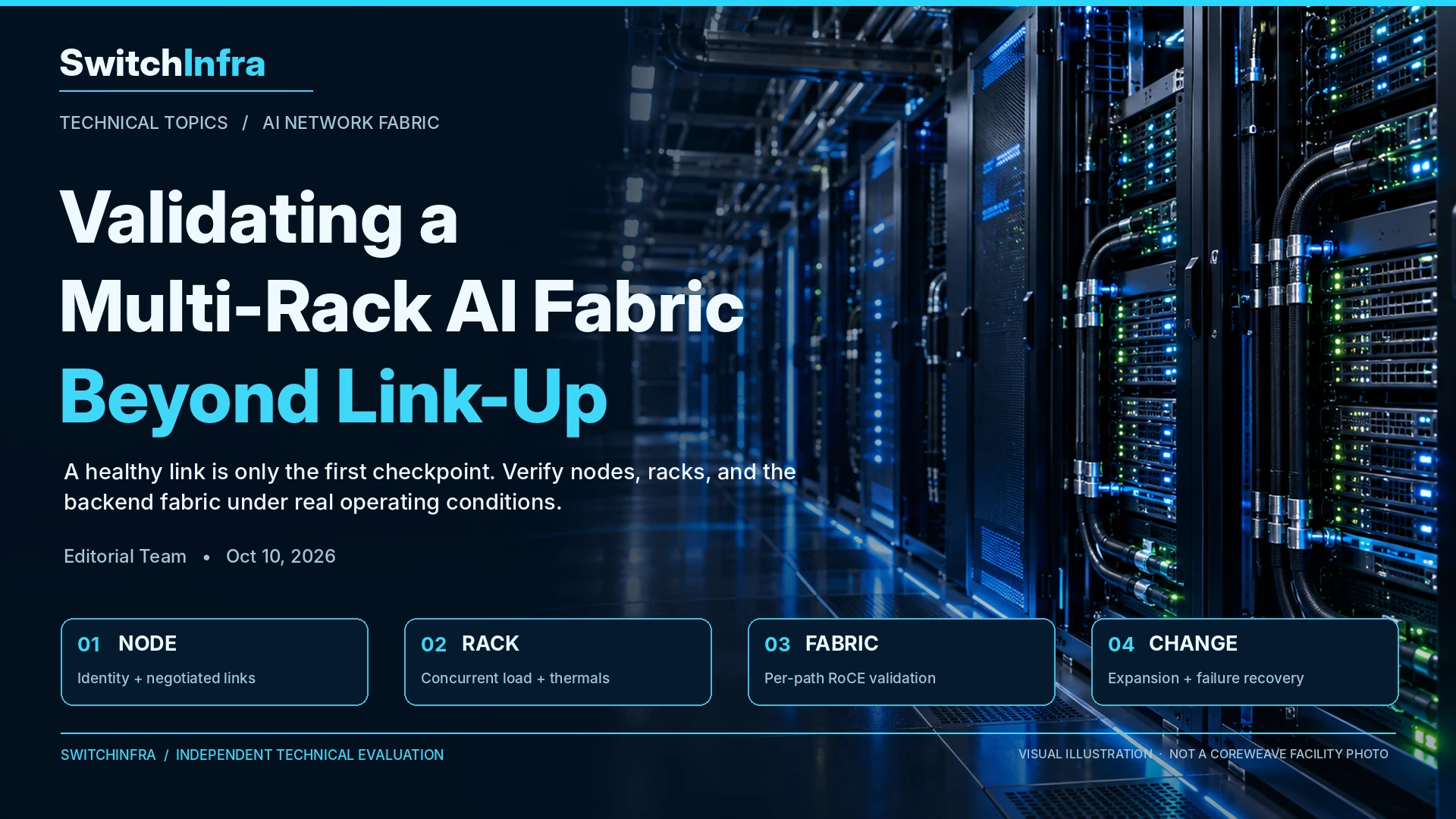
A successful link negotiation confirms only part of an AI network. Cluster readiness also depends on how the links behave together when workers communicate simultaneously, the system gets hot and a path becomes unavailable.
A real multi-rack example
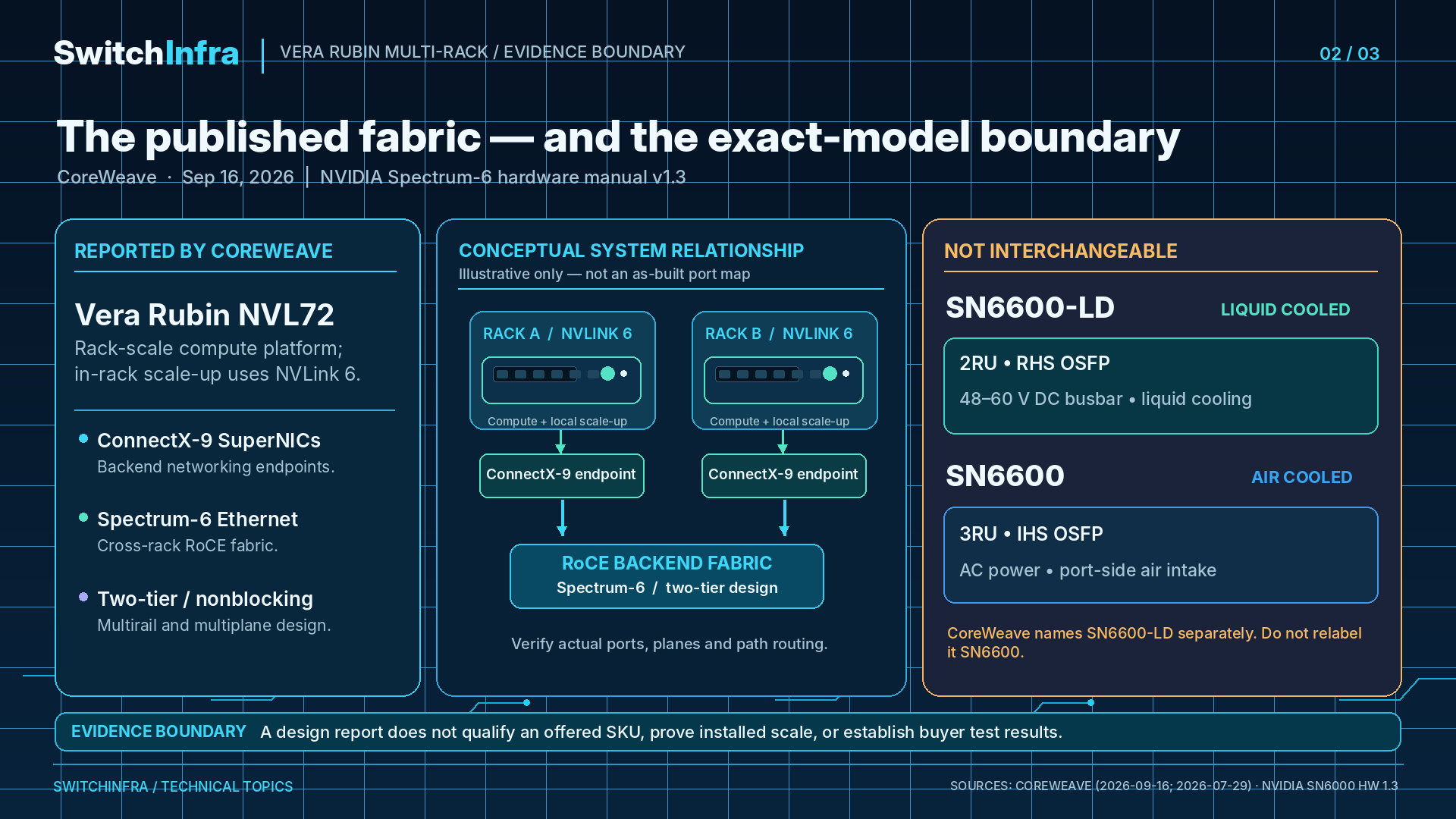
CoreWeave’s September 2026 report describes multi-rack Vera Rubin bring-up using ConnectX-9 and Spectrum-6. Its validation progresses from nodes to racks and then to the backend fabric. The described RoCE design is multirail, multiplane and nonblocking. CoreWeave’s bring-up report
A separate CoreWeave article identifies SN6600-LD. That liquid-cooled model must not be silently relabeled as the air-cooled SN6600. Deployment identification
Give every validation stage a purpose
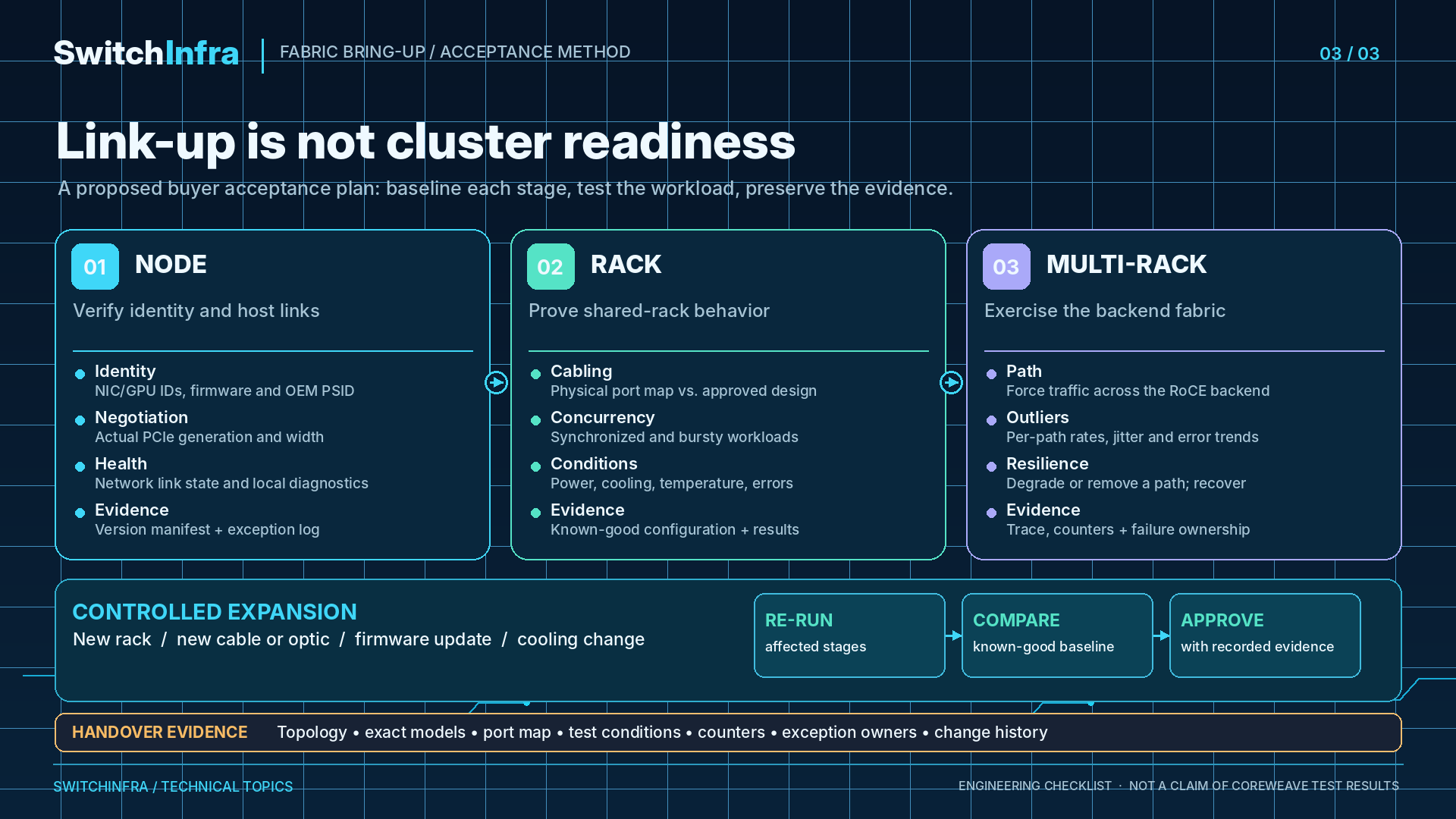
For a new project, organize acceptance into three stages.
First, verify the node. Record the expected devices, firmware, negotiated host links and network links. An unexpected lane width or device identity belongs in the exception report even if the server appears healthy.
Second, verify the rack. Confirm the physical port map against the design. Run concurrent workloads and inspect thermal behavior, power delivery and error counters. Preserve a record of the known-good configuration.
Third, verify the multi-rack path. Use tests that demonstrably traverse the backend fabric. Compare per-path results rather than accepting only an aggregate average. Include synchronized communication and less regular service traffic if both will share the environment.
These steps are proposed acceptance practices. They are not a claim that another installation will reproduce CoreWeave’s results.
Treat expansion as a controlled change
When adding racks, repeat the relevant tests and compare against the baseline. Confirm that a new cable, software version or cooling arrangement has not created an outlier. Define who owns a failure that crosses the boundaries between server, network and facilities teams.
Keep topology capacity separate from installed scale. A published design limit describes how an architecture may expand; it does not establish that a cluster of that size exists or has been benchmarked.
Select the physical platform carefully
The SN6000 documentation distinguishes air-cooled and liquid-cooled systems. A buyer must verify power, cooling, rack integration and interconnect details for the exact offered model. NVIDIA hardware introduction
Public architecture evidence supports planning, but it cannot clear an unpublished, prototype or differently cooled order code for procurement. Request the current hardware and compatibility documentation, and keep unresolved details out of the final installation plan.
Sources checked: 10 October 2026. This article discusses third-party evidence or an explicitly labeled engineering scenario; it does not establish a reseller’s delivery history, current stock or exact-SKU deployment.
Technical illustrations