
Campus networks
How should a campus specify optics for diverse OS2 fiber routes?
Use Newcastle’s Catalyst Building account to examine per-route channel budgets and protection requirements. The installed link rates remain undisclosed.
The Catalyst Building account raises a practical campus question: how should two diverse fiber paths become a specified, testable service? Separate channel qualification from equipment protection before requesting parts.
The short answer
Document each route’s distance, termination and loss independently. Select the service rate and compatible optics, then define the equipment and failover design. Spare fibers and a second cable route solve different problems.
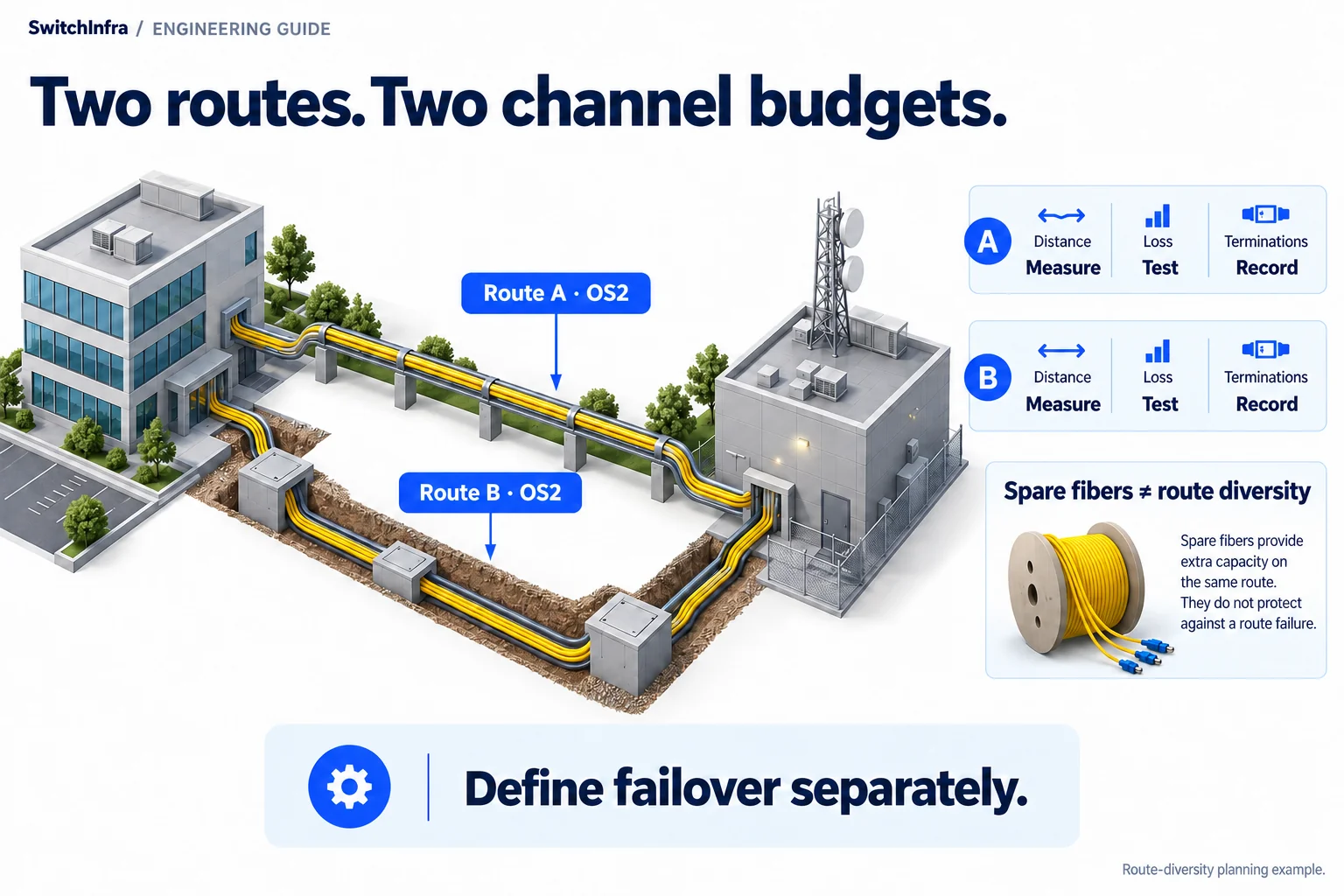
Measure and test each OS2 route independently. Spare fibers in one route do not provide physical route diversity. Conceptual illustration; equipment shapes are illustrative.
Third-party project account · Independent analysis by SwitchInfra
Not a SwitchInfra deployment. Candidate equipment is proposed for comparable requirements.
48-core — OS2 backbone specification
Dual — diverse backbone routes
6 — communication rooms
Not stated — deployed link rate
What the documented project tells us
Installer UCS Technologies reports internal and external 48-core OS2 backbones, diverse dual backbone routes and external connections from two existing campus buildings. Its account does not identify link rates, optics or measured channel losses.
For a comparable project, the useful purchasing unit is a documented end-to-end channel. Buying identical modules for two routes is premature when their lengths, patching and equipment may differ.
Installer-published project account
Fiber category — OS2 single-mode is listed for internal and external backbones.
Internal distribution — Six communication rooms are described with diverse dual fiber backbones.
Campus connections — External single-mode links arrive from two existing campus buildings.
Disclosure boundary — Port models, PMDs and service rates are not disclosed.
Scope of the analysis: Third-party installer account. Independent analysis for a comparable project; not a SwitchInfra deployment. UCS Technologies is the installer, not Cisco UCS.
Work through the engineering choices
Start with the documented constraint, then state the conditions for the proposed equipment role.
Qualify each physical channel separately
The account specifies OS2 backbones and route diversity.
Design exercise: Proposed planning record: channel A and channel B, each with its own endpoint and route schedule.
Record routed length rather than the straight-line distance between buildings. Trace patch cords, panels, splices and equipment-facing connectors. Obtain loss measurements for each proposed service path at the relevant wavelength; a trunk’s fiber category alone does not qualify the complete channel.
Reserve fibers for growth and repairs in each route schedule. Forty-eight cores are a cable capacity, not forty-eight duplex Ethernet ports. Fibers in one sheath share its physical exposure, so allocating spare pairs there does not create an independent route.
UCS Technologies: Catalyst Building case account
Choose the PMD after specifying the service rate
The installed service rates are not reported.
Design exercise: if a new service requires 10G Ethernet, assess a 10GBASE-LR pair.
SFP-10G-LR is a conditional example: Cisco specifies duplex LC and up to 10 km over G.652 single-mode fiber. Verify the actual OS2 cable, both host ports, software and peer module. Check the complete loss and receive-power limits rather than treating the reach rating as acceptance.
SFP-10G-SR is a multimode optic and is excluded from this OS2 role, even if the patch panel presents LC. If the requirement changes to another rate, reopen the PMD and host selection; this case supplies no basis for assigning 40G or 100G.
Cisco 10GBASE SFP+ modules data sheet · Cisco optics compatibility matrix
SFP-10G-LR
Conditional 10G OS2 example
Model inquiry; exact public catalog listing and supply not verified.
Specify what the second path must protect
Diverse cable routes are described; failover results are not.
Design exercise: Proposed acceptance objective: maintain the agreed service after losing either selected path.
Define the failure domain before counting equipment. Two cables terminating on one switch still share that switch. Review building entries, panels, endpoint devices and power arrangements, then select a supported network protection design around the actual platforms and application tolerance.
Write the expected interruption and test method into the project brief. Test path loss and the agreed equipment failures independently, recording traffic impact and recovery. A route drawing or healthy optical reading cannot demonstrate protocol convergence or application continuity.
UCS Technologies: Catalyst Building case account
Prepare the BOM around services and failure domains
If a new design chooses two duplex 10G circuits, one per qualified route, the optical starting point is four modules and four endpoint ports. This is an example quantity, not the Newcastle installation. Add patching, spares and equipment only after the design is agreed.
Cisco 10GBASE SFP+ modules data sheet · Cisco optics compatibility matrix
Channel schedule
Route identifier, endpoints, fiber pairs, termination, length and measured loss.
Equipment schedule
Exact hosts, software, supported optic PIDs and available ports.
Acceptance schedule
Failure scenarios, permitted interruption, test traffic and recorded results.
Candidate models and selection boundaries
These are illustrative model inquiries, not the equipment installed in the source project. Confirm the required rate and complete channel before finalizing any line.
| Model / family and status | Role and condition |
|---|---|
| SFP-10G-LR Conditional model inquiry | Conditional 10G OS2 link Only if 10G is required and both hosts and channels qualify. Model inquiry; listing and supply unverified. Cisco 10GBASE SFP+ modules data sheet · Cisco optics compatibility matrix |
| SFP-10G-SR Excluded for this link role | Excluded from OS2 channel Multimode PMD; an LC connector does not make it suitable for OS2. Cisco 10GBASE SFP+ modules data sheet |
Linked product IDs identify verified catalog listings. Unlinked entries remain model or family inquiries; their listings have not been verified. Availability, unit condition and platform compatibility need confirmation for every line.
Continue in the relevant product family
Use the analysis to define the role before comparing catalog options.
Network Modules and Line Cards
Discuss this project
Carry the route, media, endpoint and loss requirements into the inquiry. Leave unknown quantities blank; source-project fiber counts are not an equipment BOM.
Follow the next selection question.
Compare related decisions while keeping each source’s scope, hardware and link conditions separate.
Browse more engineering analyses →
24-fiber MTP: one allocation, different optical choices
Map custom cassettes before selecting native 40G, duplex 10G or an independently proposed breakout design.
Read the engineering analysis · Original project account
Single-mode university data center: 100G / 40G selection
A G.657.A2 fiber plant makes the complete optical channel central to the equipment choice.
Read the engineering analysis · Original project account
Expand mixed OM4 and single-mode cabling
A public Xi’an expansion account becomes a practical guide to channel allocation, 1U fiber density and patching-loss budgets.
Read the engineering analysis · Original project account
Before you finalize the channel
Does OS2 guarantee a 10G link?
No. Qualify the actual channel and compatible endpoint equipment.
Do dual routes prove complete redundancy?
No. Shared equipment, power or building entries can remain failure points.
Were Cisco optics installed at Newcastle?
The account does not identify installed optics. These are independent conditional examples.
Can spare cores replace a second route?
No. Spare cores within the same cable share its physical route and exposure.
Trace the project facts and technical limits
- Installer-published project account
- Cisco 10GBASE SFP+ modules data sheet
- Cisco optics compatibility matrix
Source check: 19 October 2026. Catalog status is stated per candidate.
Source and catalog checked 19 October 2026. Project-specific engineering review, equipment compatibility, supply and acceptance criteria remain to be confirmed.