
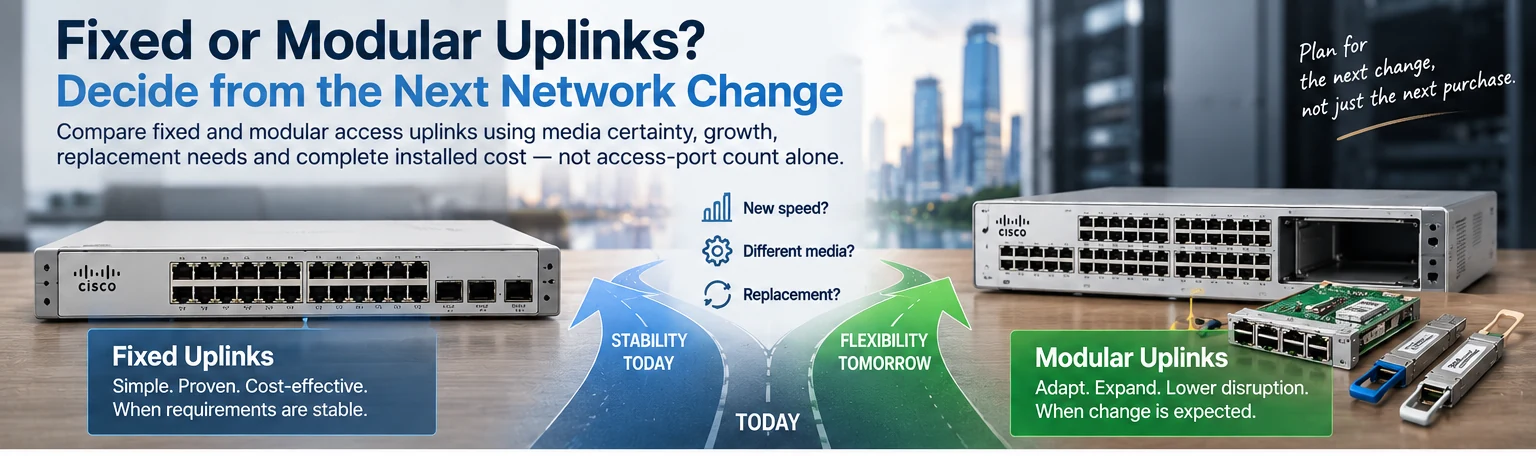
Two access switches can offer the same number of user ports and lead to very different upgrade paths. One has fixed uplinks; the other accepts a supported network module. The better fit depends on how certain the uplink requirement is and what is expected to change.
This is not a simple choice between “basic” and “future-proof.” Modularity has value only when its supported options match a plausible requirement.
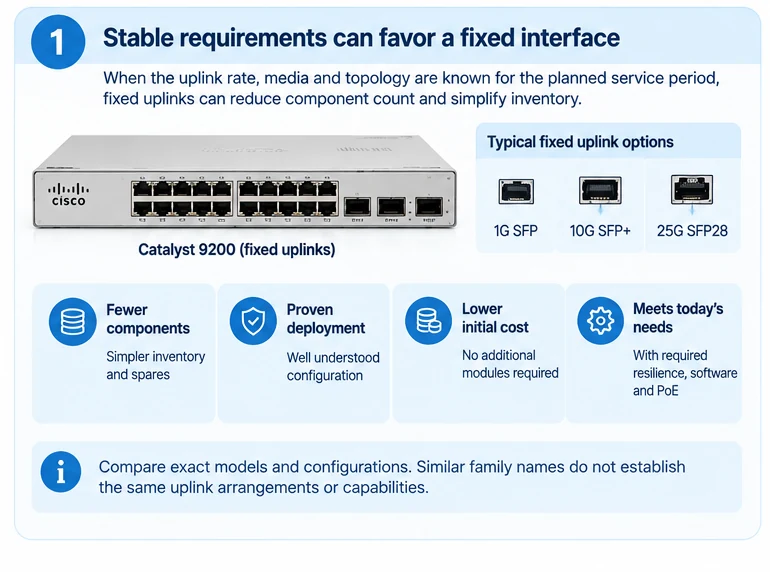
Stable requirements can favor a fixed interface
When the uplink rate, media and topology are known for the planned service period, fixed uplinks can reduce component count and simplify inventory. The proposed platform must still meet the required resilience, software and endpoint-power conditions.
Cisco’s Catalyst 9200 and 9300 documentation distinguishes model-specific uplink arrangements. Similar family names or access-port counts do not establish the same expansion and stacking options. R14R12
The relevant comparison is therefore between exact configurations, not broad series labels.
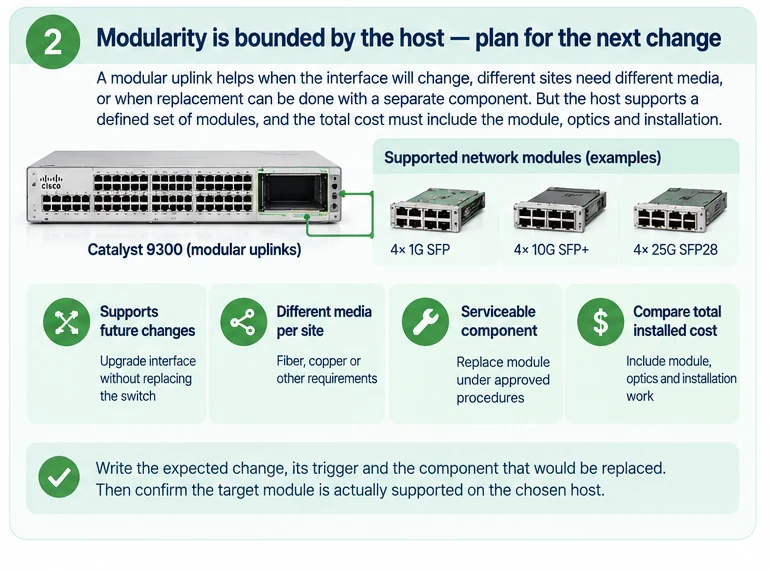
Modularity is bounded by the host
A modular uplink may help when the required interface will change, when different sites need different media or when replacement procedures benefit from a separately serviceable component. But the host supports a defined set of modules—not every interface that might exist later.
The Catalyst network-module guide is an example of why the supported host/module relationship must be checked explicitly. An expansion slot is not a promise of unlimited future upgrades. R13
Include the module, optics, peer requirements and any installation work in the cost comparison. Comparing a populated fixed-uplink switch with an unpopulated modular chassis produces a misleading price difference.
Put a date and a condition on the next change
An illustrative evaluation might compare a branch with a stable pair of fiber uplinks against a campus closet expected to change aggregation interfaces during a scheduled refresh. The first requirement may not benefit from unused module flexibility; the second may justify it if the required future option is already supported or explicitly qualified.
Avoid paying for an undefined possibility. Write the expected change, its trigger and the component that would be replaced.
| Evaluation point | Fixed-uplink question | Modular-uplink question |
|---|---|---|
| Present requirement | Are the installed interfaces sufficient? | Is the correct module included? |
| Planned change | Would it require replacing the switch? | Is the target module actually supported? |
| Maintenance | What is the replacement boundary? | Can the module be replaced under approved conditions? |
| Cost | Is the whole configuration included? | Are modules and related optics included? |
Keep architecture ahead of procurement
The uplinks must support the traffic and failure assumptions of the campus design. A module choice does not compensate for an inadequate aggregation path or poorly defined redundancy. R45
Request quotes against the same complete topology and software scope. Then compare the cost and operational effect of the identified next change. This produces a useful decision: not which switch looks more expandable, but which configuration meets today’s requirement and a specific, defensible upgrade path.
Engineering illustrations
These figures illustrate the design concepts discussed here. They are not measured results, certified configurations or a supplied-equipment list.
Related reading
- Catalyst Campus Access Design: Ports, PoE and Uplink Capacity
- Catalyst Access Switch Selection: Compare Exact C9200, C9200L and C9300 Variants