
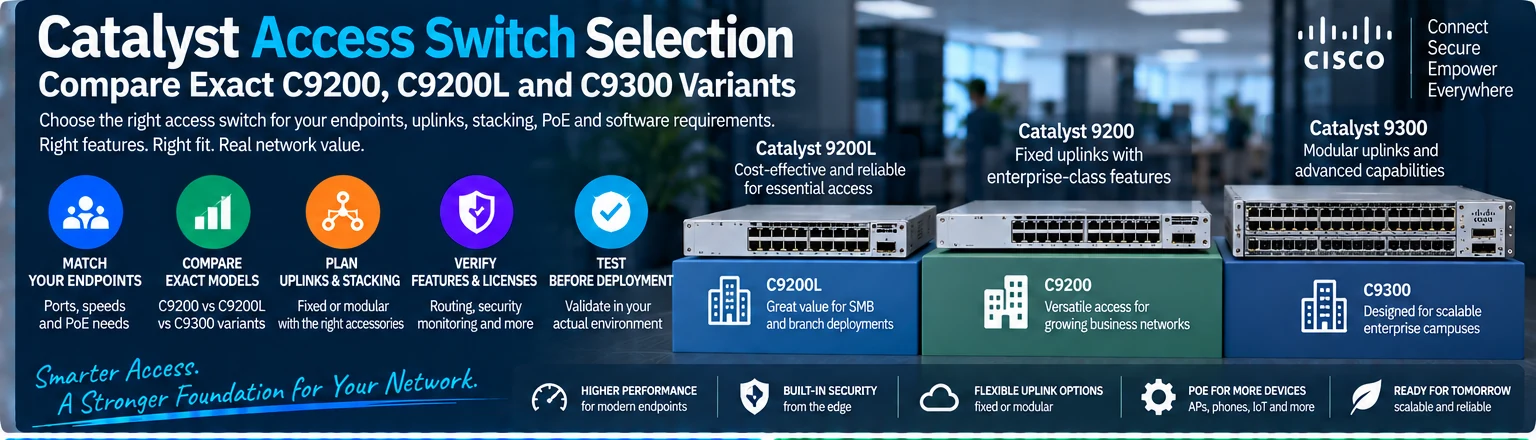
Catalyst Access Switch Selection: Compare Exact C9200, C9200L and C9300 Variants
Select Catalyst access switches by endpoint mix, uplink design, stacking, PoE and current software requirements rather than family-level assumptions.
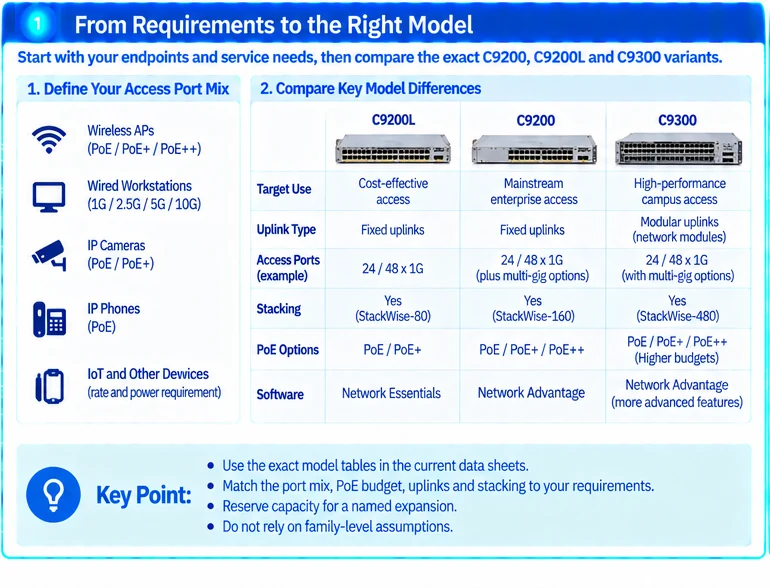
A Catalyst access-switch comparison should begin with endpoint and service requirements. C9200, C9200L and C9300-family variants differ in uplink arrangements, stacking, power and feature scope. The right candidate is the one whose exact configuration meets the requirement, not the one with the most impressive family description.
1. Define the access-port mix
List endpoint quantities, interface types, target rates and required PoE modes. Separate the endpoint count from uplink and management interfaces. Reserve capacity for a named expansion rather than an unexplained percentage.
Use the exact model tables in the current data sheets. The same family can include different access-port and power arrangements. R14R12
2. Decide fixed or modular uplinks
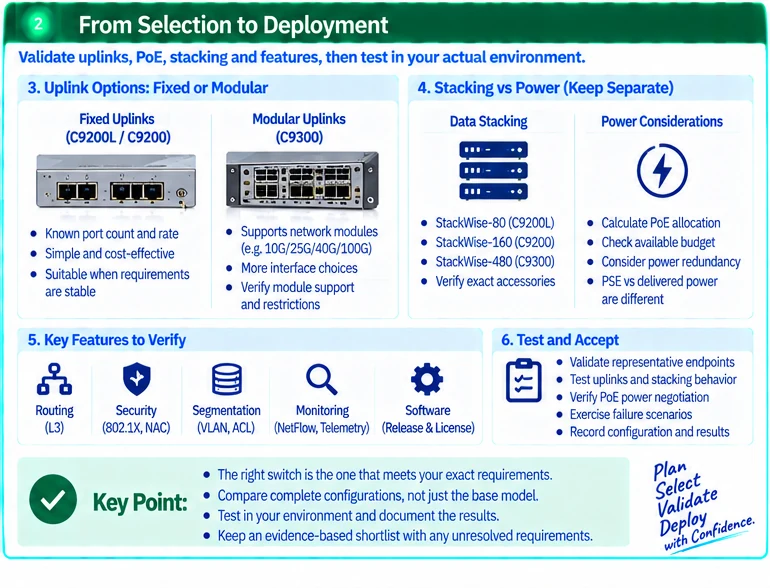
A fixed uplink can be appropriate when the required number, rate and media are known and supported. A modular design can accommodate certain documented interface choices, but the network module and interconnects must be included in the configuration and cost.
Modularity does not establish unlimited future compatibility. Host-specific module restrictions remain part of the selection record. R13
| Dimension | Requirement to record |
|---|---|
| Access interfaces | Quantity, rate, media and endpoint functions |
| Uplinks | Logical connection count, rate and failure-state capacity |
| Stacking | Required behavior and exact supported accessories |
| PoE | Endpoint allocation and available system budget |
| Software | Required features, release and applicable entitlements |
| Operations | Recovery access, configuration management and support ownership |
3. Keep data stacking and power separate
Confirm stacking support and accessory identity for the exact platform. Do not assume that data-stack capability implies power-sharing capability or interchangeable stack adapters. Manufacturer data sheets distinguish these system properties. R12R14
For PoE, calculate the allocation required by the intended endpoint functions. Compare it with the available budget under the chosen supply arrangement and failure objective. PSE capacity and delivered endpoint power are different quantities. R32
4. Qualify required features
Write a short requirement list before comparing software packages: routing, authentication, segmentation, monitoring and any specialized functions. Verify support and entitlement for the intended release and transaction. Do not rely on historical licensing shorthand as a substitute for the current offer.
A feature name alone is insufficient where scale or topology limits affect the deployment. Record the intended use and the evidence supporting it.
5. Test the candidate as an access block
Validate representative endpoints, uplinks, power behavior and required services. Exercise the agreed link, stack or supply-failure scenario where supported and approved. Record application impact rather than assuming a redundancy feature means no interruption.
The output should be an evidence-based shortlist with explicit unmet or unresolved requirements. This makes two offers comparable even when one includes the necessary module, power arrangement and accessories and the other lists only the base switch.
Engineering illustrations
These figures illustrate the design concepts discussed here. They are not measured results, certified configurations or a supplied-equipment list.
Related reading
- Catalyst Campus Access Design: Ports, PoE and Uplink Capacity
- Fixed or Modular Uplinks? Decide from the Next Network Change
References
可直接使用的项目资料
按当前任务选择资料。可以先提交已有清单,后续再补缺项。下载模板为英文。