
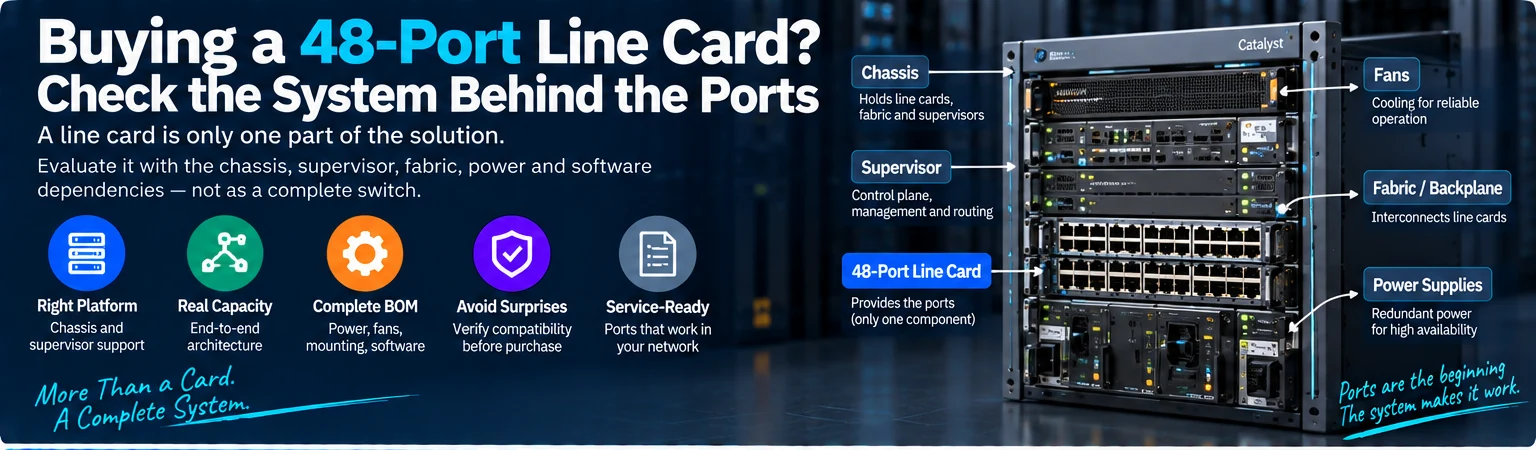
A listing for a 48-port line card can look like a complete switching solution. The port count is easy to compare, the front panel is familiar and the price may be attractive. Yet the item may be only one component of a modular system.
The important procurement question is not “does it have enough ports?” It is “what must be present for these ports to deliver the required service?”
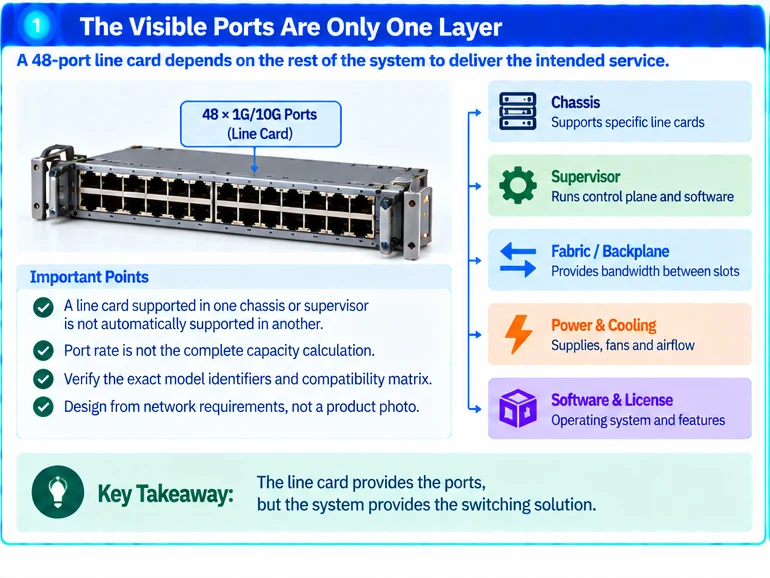
The visible ports are only one layer
A modular design can depend on a particular chassis, supervisor, fabric connection, power arrangement and software release. These relationships are platform-specific. Cisco’s Catalyst 6500/6800 supervisor documentation, for example, describes system combinations and constraints that cannot be established from a line-card photograph. R26
A card supported in one chassis or supervisor configuration should not be assumed to work in another merely because the product-family names are similar. The exact identifier and supported combination belong in the purchase record.
Port rate is not the complete capacity calculation
Adding all front-panel rates produces a nominal interface sum. It does not establish the usable capacity of a slot or the entire system under the selected configuration. The architecture must explain where traffic goes: within a card, across the fabric, to uplinks or through a service boundary.
For an illustrative requirement, 48 endpoint-facing 1Gb/s ports represent 48Gb/s of nominal access capacity in one direction. Whether the design can serve the required simultaneous traffic depends on the rest of the path and its operating assumptions. This arithmetic is not a specification for any particular line card.
Campus design guidance starts from network roles and service requirements; the equipment list should follow that architecture rather than define it accidentally. R45
A populated photograph is not a packing list
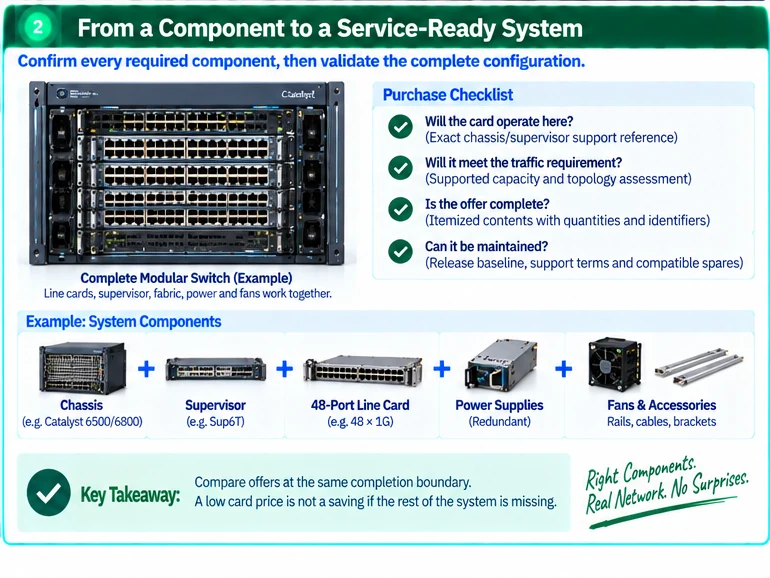
Request a component-level inventory. It should identify the chassis, supervisors, line cards, any required fabric components, approved power supplies, fans and mounting hardware. Record whether each item is included, separately priced or already installed.
Software and support require their own confirmation. A physically complete system is not evidence that the required operating image, feature entitlement or support agreement transfers with it.
| Purchase question | Useful evidence |
|---|---|
| Will the card operate here? | Exact chassis/supervisor/card support reference |
| Will it meet the traffic requirement? | Supported capacity and topology assessment |
| Is the offer complete? | Itemized contents with quantities and identifiers |
| Can it be maintained? | Release baseline, support terms and compatible spares |
Price the service-ready system
Compare offers at the same completion boundary. A low component price is not a saving when the missing supervisor, power supplies or unsupported configuration forces redesign.
Before ordering, have the proposed combination reviewed as a system and define an acceptance test for the required interfaces and services. The final decision should explain both why the card is appropriate and why its supporting configuration is complete. That is the difference between purchasing ports on paper and receiving usable network capacity.
Engineering illustrations
These figures illustrate the design concepts discussed here. They are not measured results, certified configurations or a supplied-equipment list.
Related reading
- Campus Core Design: Chassis Dependencies, Capacity and Resilience
- Modular Campus Core Selection: Verify Chassis, Supervisor and Line-Card Dependencies