

A modular chassis can appear inexpensive until the missing dependencies are priced. Supervisors, fabric components, line cards, power supplies, fans and software requirements may turn a low entry price into a much larger project.
The right comparison is the cost and risk of a service-ready configuration—not the price of the empty enclosure.
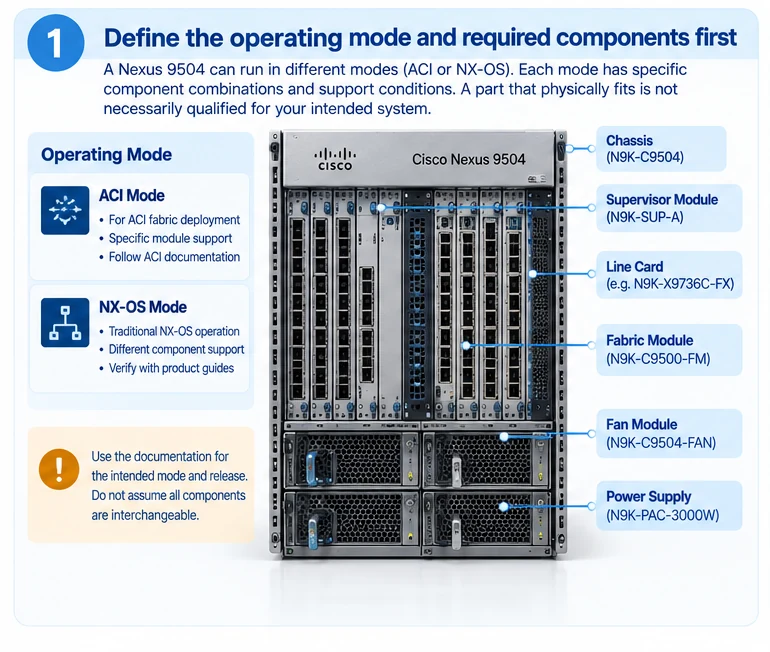
Define the operating mode first
Before choosing components, establish the intended software and control model. For a Nexus 9504 evaluation, ACI-mode hardware documentation supports the combinations and conditions within its stated scope. It should not be used as blanket evidence for every NX-OS configuration or every line-card/fabric pairing. R16
Record the exact identifiers and use the documentation appropriate to the intended mode and release. A component that physically fits is not necessarily qualified for the proposed system.
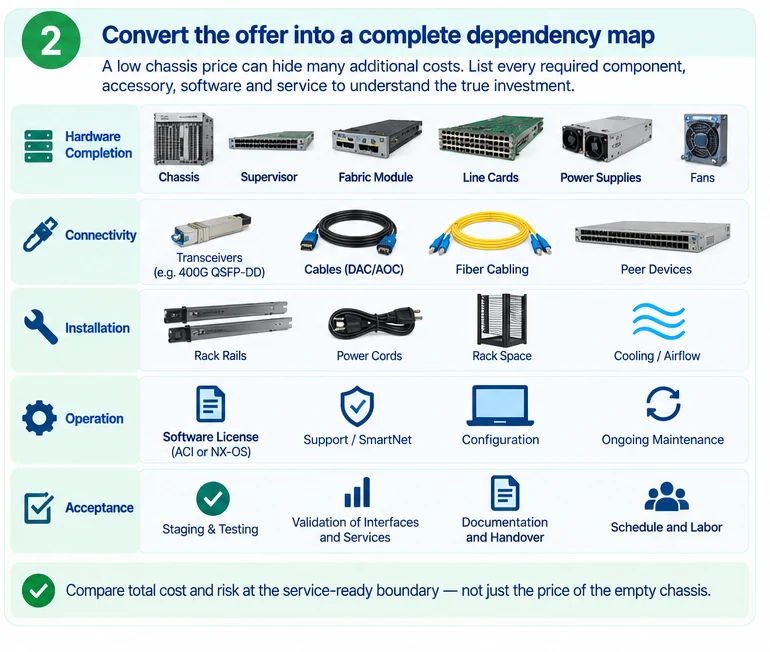
Convert the offer into a dependency map
Ask what each quoted item requires in order to operate. Identify which dependencies are included, separately purchased, already installed or still unresolved.
A useful review starts from the required service ports and works backward through line cards, fabric, control components and chassis resources. It then adds the installation and operating dependencies.
| Cost boundary | Items that must be explicit |
|---|---|
| Hardware completion | Chassis, control/fabric components, cards, fans and supplies |
| Connectivity | Modules, fixed assemblies, fiber paths and peer requirements |
| Installation | Rails, cords, rack fit and thermal conditions |
| Operation | Required software, entitlement and support responsibilities |
| Acceptance | Staging, configuration, testing and handover effort |
This table is a review structure, not a universal bill of materials. The actual platform determines which components exist and which combinations are supported.
Include the cost of uncertainty
A missing compatibility record can create work even when every physical component is present. Engineers may need to reconstruct the configuration, find an applicable image or replace an unsupported part. Schedule risk should be visible alongside price.
For older systems, check lifecycle milestones and software availability for exact identifiers. Cisco’s lifecycle policy describes the general framework; it does not establish the status of an unspecified chassis or component. R19
Commercial condition, seller warranty and manufacturer support eligibility also need separate confirmation. None should be inferred from the word “refurbished” or from a successful boot photograph.
Compare completed alternatives
An illustrative procurement review might find that one offer includes a complete qualified configuration while another includes only chassis and cards. The second is not necessarily worse, but its completion cost and engineering responsibilities must be added before comparison.
Require an itemized inventory and a proposed acceptance method. Verify the intended interfaces, software mode and representative services in a controlled environment before relying on the system for production.
A low chassis price can be useful when the buyer already owns the required compatible components. Without that context, it is simply an incomplete number. Purchase the supported system the network needs, and make every missing dependency visible before committing.
Engineering illustrations
These figures illustrate the design concepts discussed here. They are not measured results, certified configurations or a supplied-equipment list.
Related reading
- Nexus 9504 System Design: Line Cards, Fabric, Power and Operating Mode
- Nexus 9504 Configuration Review: Complete the System Before Deployment