
Cisco · dc-modular
Nexus 9504 System Design: Line Cards, Fabric, Power and Operating Mode
Plan a complete Nexus 9504 system by resolving operating mode, supported modules, fabric dependencies and migration requirements.
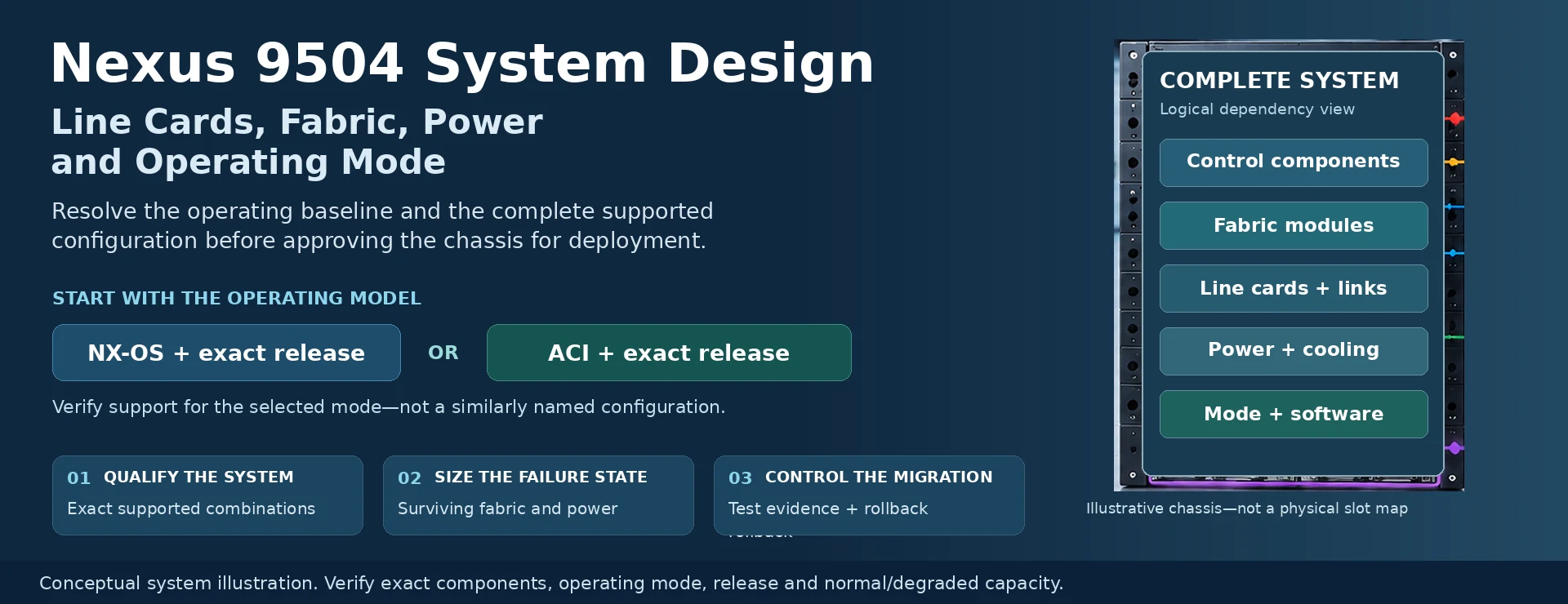
A Nexus 9504 configuration is a system specification, not a list of available line cards. The intended operating mode, supervisor and control components, fabric modules, line cards, software, cooling and power arrangement must form a supported combination. This design workflow prevents a partially specified chassis from being described as deployment-ready.
Choose the operating model first
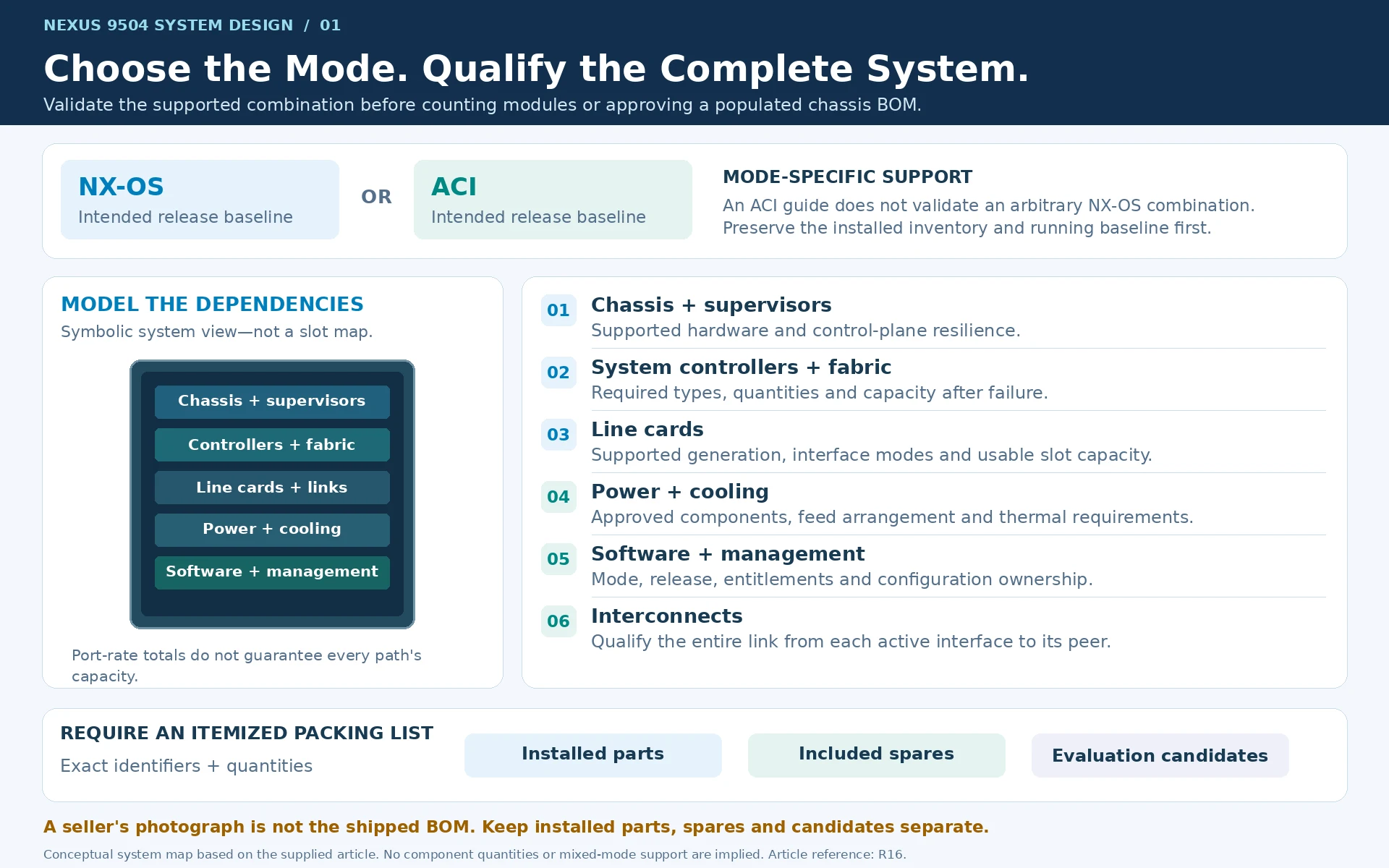
State whether the deployment uses NX-OS or ACI and identify the intended release baseline. The operational requirements and supported combinations must be checked against documentation for that mode. An ACI hardware installation guide is useful for its documented configuration, but it is not evidence that any similarly named NX-OS combination is supported. R16
For an existing installation, record what is actually installed and running. Preserve that baseline before comparing a proposed replacement or expansion.
Model dependencies before quantities
| System element | Design decision |
|---|---|
| Chassis and supervisors | Supported hardware combination and control-plane resilience |
| System controllers and fabric modules | Required types, quantities and remaining capacity after failure |
| Line cards | Supported generation, interface modes and usable slot capacity |
| Power and cooling | Approved components, feed arrangement and thermal requirements |
| Software and management | Operating mode, release, entitlements and configuration ownership |
| Interconnects | Complete qualified links from each active interface to its peer |
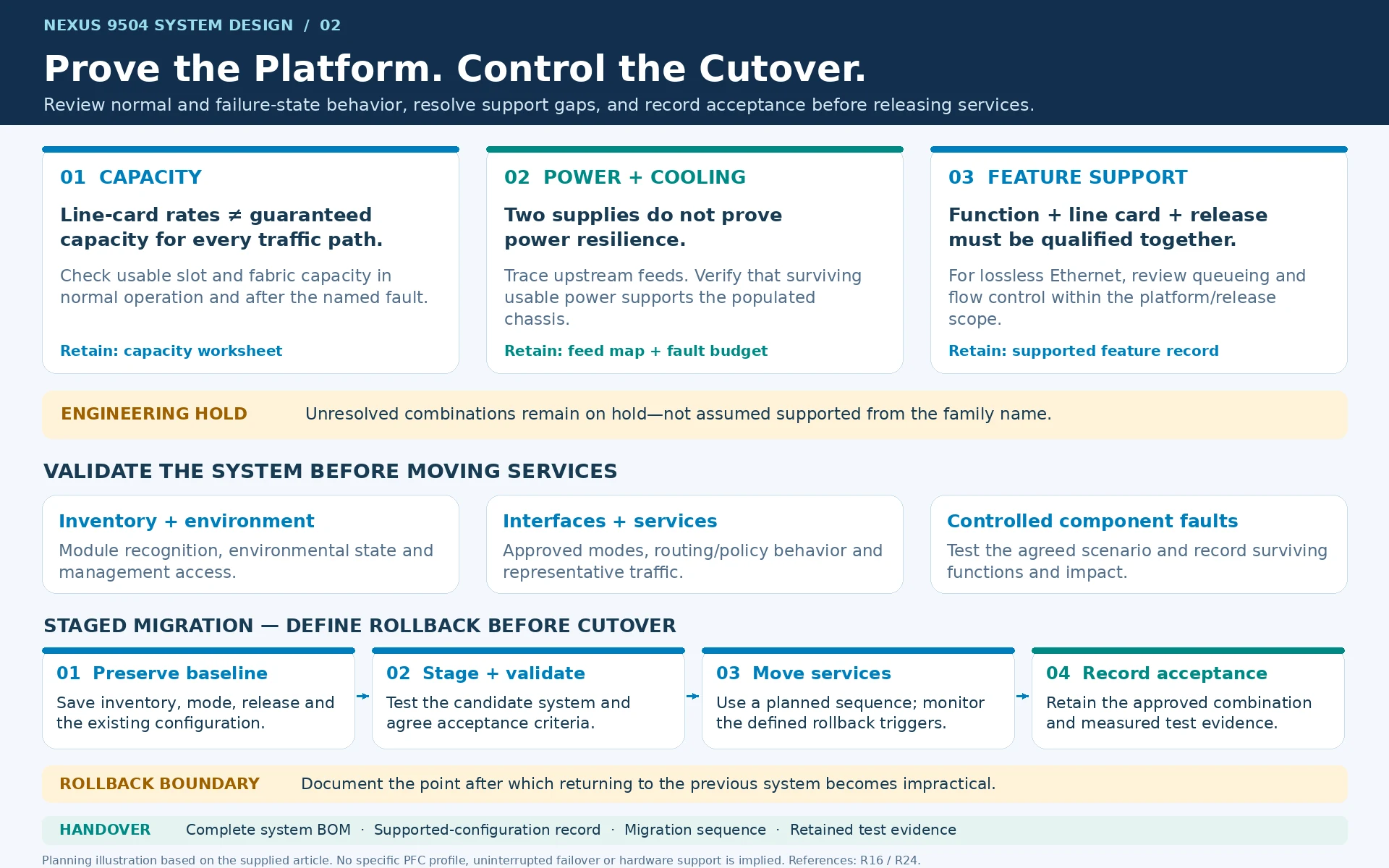
The sum of line-card port rates is not, by itself, the guaranteed capacity of every traffic path. Account for slot and fabric behavior under both normal operation and the failure condition that the project must tolerate.
Keep the design independent of a seller’s photograph
A populated chassis photo can show optional parts, a different airflow arrangement or modules excluded from the offer. Require an itemized packing list with exact identifiers and quantities. Keep installed parts, included spares and evaluation candidates in separate groups.
As an illustrative procurement check, a requirement for resilient operation must identify the component and feed failures it is intended to survive. “Dual power supplies included” does not prove that the remaining supply capacity supports the populated chassis after one source is lost.
Qualify features against the complete platform
Map each required function to the actual line-card and release combination. For example, a lossless Ethernet requirement needs a reviewed queueing and flow-control design, not simply high-speed front-panel ports. Cisco’s priority-flow-control guidance is release- and platform-scoped; it should be used within those boundaries. R24
Where public documentation leaves a combination unresolved, mark it as an engineering hold rather than inferring support from the product family.
Stage the migration and record acceptance
Validate inventory recognition, environmental state, management access and the approved interface modes before moving services. Test routing or policy behavior, representative traffic and the agreed component-failure scenarios. Define rollback triggers before cutover, including the point after which returning to the previous system becomes impractical.
The deliverable is a complete system BOM, a supported-configuration record, a migration sequence and retained test evidence. An enquiry should include the existing inventory, intended mode and release, required interfaces and explicit resilience target—not only a request for a chassis and line cards.
Engineering illustrations
These figures illustrate the design concepts discussed here. They are not measured results, certified configurations or a supplied-equipment list.
Related reading
- Nexus 9504 Configuration Review: Complete the System Before Deployment
- The Cheapest Chassis May Be the Most Expensive Incomplete System