
Nexus 9504 Configuration Review: Complete the System Before Deployment
Review a Nexus 9504 BOM against operating mode, release, module dependencies, fabric capacity, power and system-level acceptance.
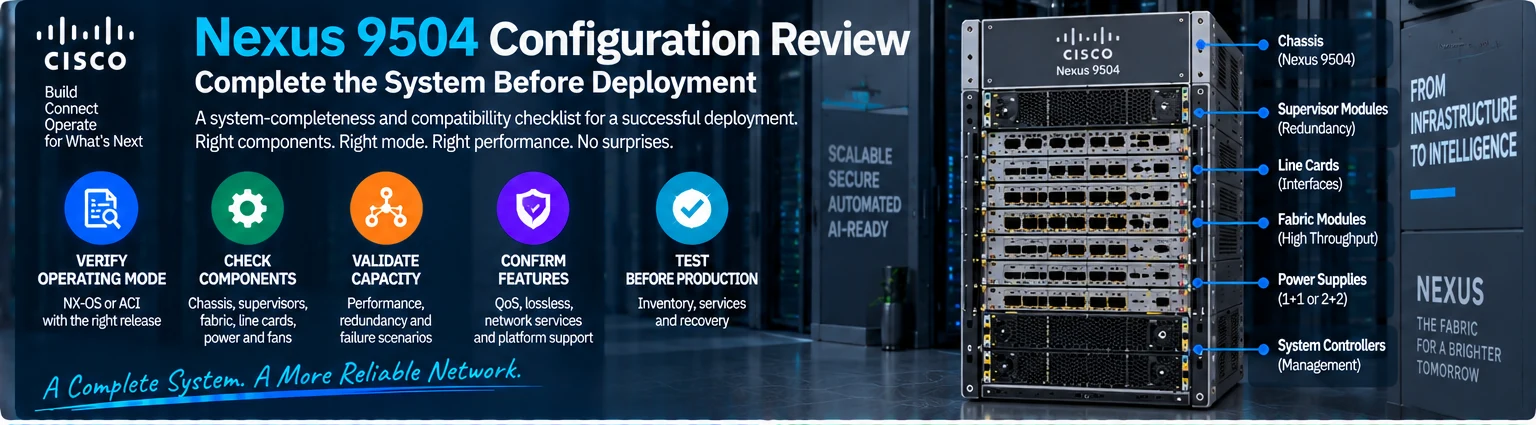
Use this review before ordering, accepting or expanding a Nexus 9504 configuration. It is a system-completeness and compatibility checklist, not a universal installation procedure. The selected operating mode and release determine which hardware and software evidence is relevant.
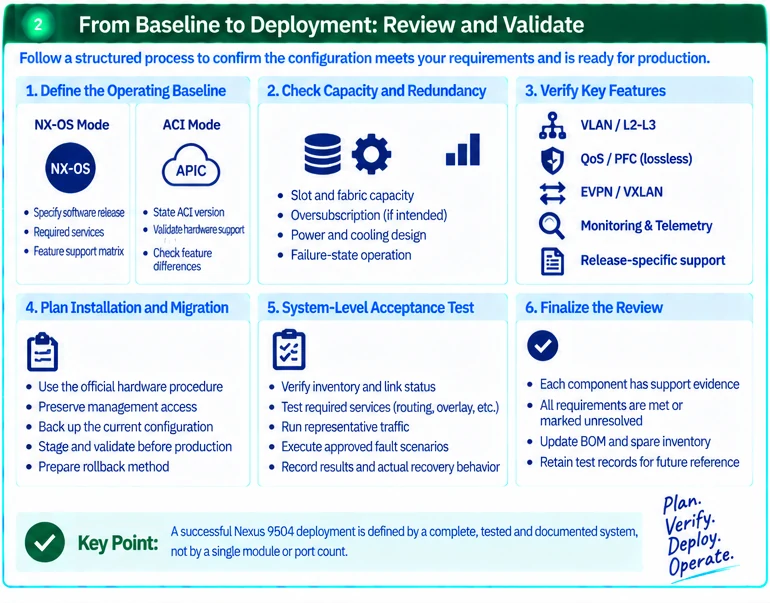
1. Freeze the operating baseline
State NX-OS or ACI, the intended software release and required services. For an existing system, capture inventory and configuration first. An ACI hardware installation guide applies to its stated configuration and should not be used as blanket proof for an arbitrary NX-OS system. R16
Separate an unchanged spare replacement from a change that introduces a new line-card generation, operating mode or software dependency.
2. Reconcile every system role
| Role | Required review |
|---|---|
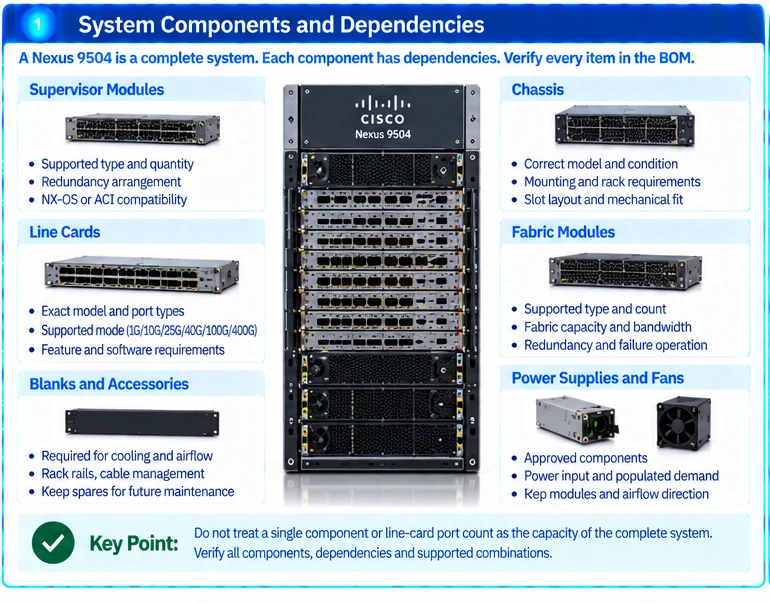
| Chassis | Correct model, installed condition and mounting requirements |
| Supervisors | Supported type, quantity and redundancy arrangement |
| System controllers | Required assemblies for the selected system |
| Fabric modules | Supported type/count and capacity under intended failures |
| Line cards | Exact identifiers, supported mode and usable interfaces |
| Power and fans | Approved components and populated-system requirements |
| Blanks and accessories | Items required for installation, cooling or maintenance |
Require an itemized offer. Distinguish included parts, optional examples and separate spares. A photograph is not a packing list.
3. Check forwarding and feature dependencies
Record slot and fabric capacity relevant to the proposed line cards. Define whether oversubscription is intentional and which traffic patterns the acceptance plan will exercise. Do not infer universal nonblocking behavior from aggregate front-panel rates.
Map required functions to the exact line-card and software baseline. For queueing or lossless-network features, use release-specific guidance and applicable platform restrictions. R24
4. Calculate the failure-state configuration
Identify which power, control or fabric component can be lost while meeting the project requirement. Confirm both supported operation and remaining capacity. These are separate questions: a system may remain operational while its available service capacity changes.
For an illustrative review, “redundant power” should resolve to the selected supply arrangement, input feeds and populated chassis demand. It should not be accepted solely because two supplies appear in an offer.
5. Plan installation and migration
Use the exact hardware procedure and qualified personnel for the work. Preserve management access, backups and an approved rollback method. Identify any software or configuration changes required before a module can be introduced.
Do not combine unresolved compatibility decisions with a production maintenance window. A candidate combination belongs in staging until its required behavior is established.
6. Accept the complete system
Verify inventory, environmental state, management and active interfaces. Test the required services and representative traffic, then execute the approved fault scenarios. Retain test conditions and actual recovery effects.
The review is complete when each required system role has an identified component, support evidence and acceptance result or an explicit outstanding condition. The resulting record should be retained with the BOM so that future spares and expansions preserve the same qualified system boundaries.
Engineering illustrations
These figures illustrate the design concepts discussed here. They are not measured results, certified configurations or a supplied-equipment list.
Related reading
- Nexus 9504 System Design: Line Cards, Fabric, Power and Operating Mode
- The Cheapest Chassis May Be the Most Expensive Incomplete System
References
可直接使用的项目资料
按当前任务选择资料。可以先提交已有清单,后续再补缺项。下载模板为英文。