
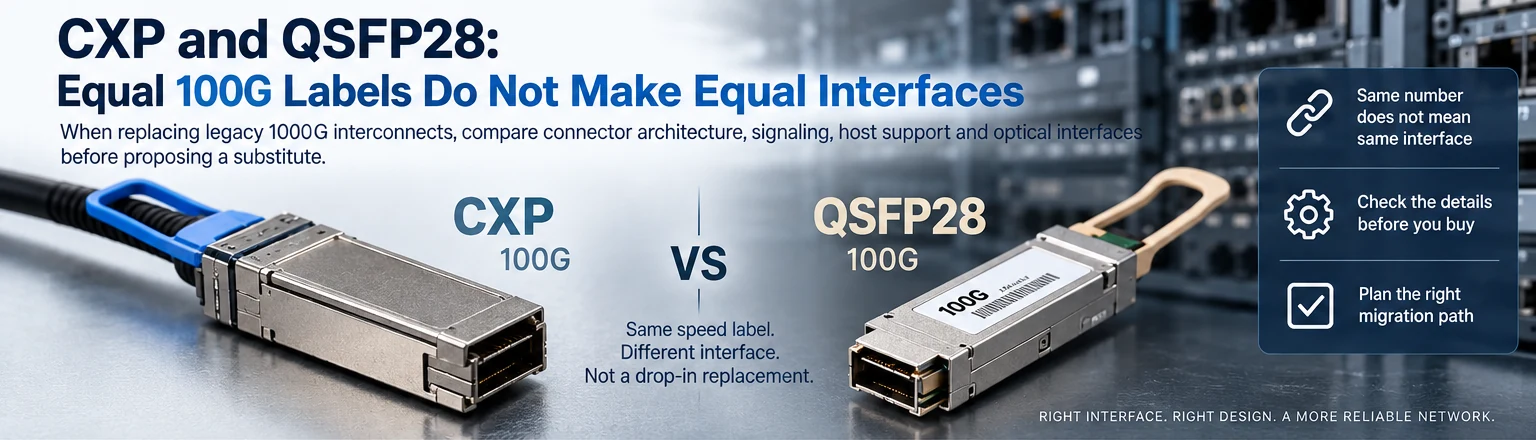
A legacy network and a newer switch may both advertise 100G connectivity while using very different interfaces. That does not make one a drop-in replacement for the other. Aggregate bit rate is only one layer of the connection.
CXP and QSFP28 are a useful example of this problem. The purchasing question is not simply whether both labels contain “100G,” but how each endpoint implements that link.
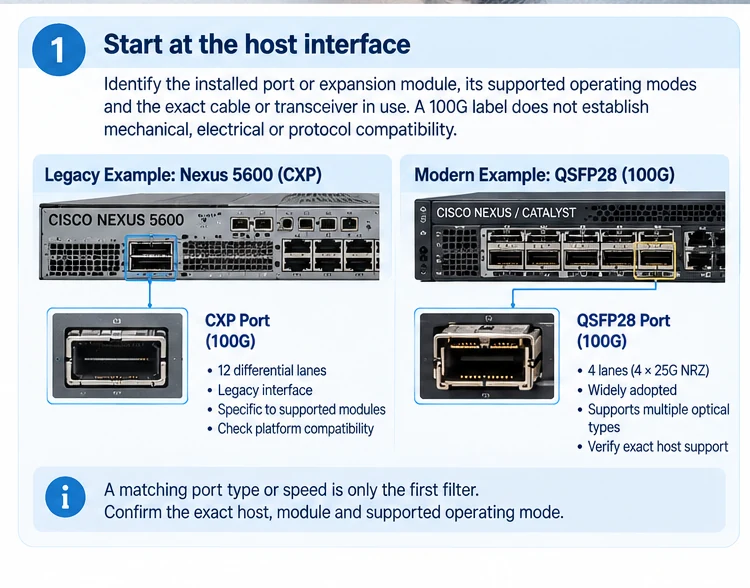
Start at the host interface
Identify the installed port or expansion module, its supported operating modes and the exact cable or transceiver in use. Legacy Nexus documentation describes platform-specific interfaces and expansion combinations; Cisco’s QSFP28 documentation describes a different set of supported 100G products and optical applications. R23R25
Do not infer a compatible host interface from the aggregate rate. Mechanical connector arrangement, electrical lane implementation and port behavior must all be resolved.
A passive adapter changes connections; it should not be assumed to translate arbitrary signaling, protocols or optical standards. A proposed converter or adapter needs documentation for the exact endpoint combination and the function it performs.
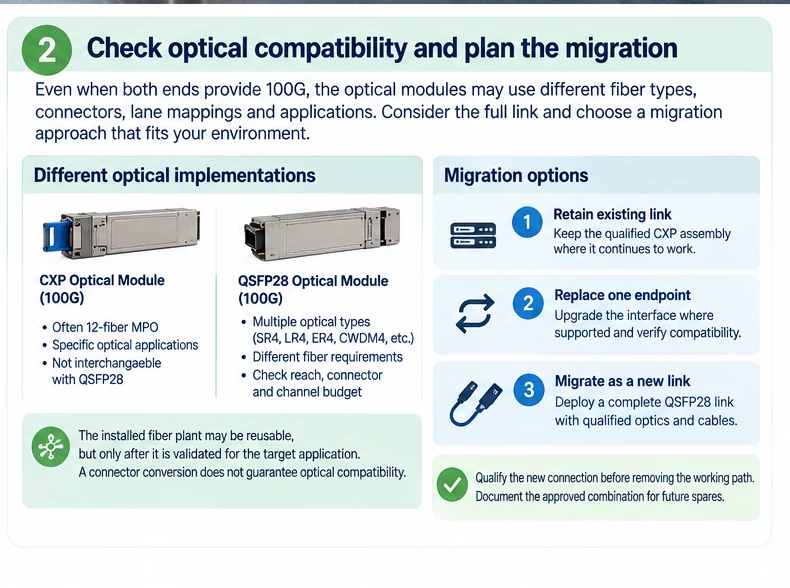
Optical compatibility is another independent question
Even when both hosts provide a supported 100G interface, the optical modules must implement a compatible optical link. Fiber type, connector, active fiber arrangement and reach conditions matter. A 100G transceiver family can contain multiple applications rather than one universal optical specification. R25
The installed fiber plant may be reusable, but only after it is mapped against the target application. A connector conversion does not establish the entire channel’s suitability.
Replacing the link may be simpler than adapting it
Compare three engineering paths: retain a qualified legacy assembly, replace the affected endpoint interface where supported, or migrate the connection as a complete new link. The least expensive component is not necessarily the least complex service-ready option.
An illustrative decision might preserve a working legacy inter-switch connection during a short maintenance phase while moving new server attachment to a separately qualified QSFP28 path. That is a bounded migration strategy, not a claim that the two interfaces are interchangeable.
| Question | What the answer must identify |
|---|---|
| What is installed? | Host, port/module, assembly and operating mode |
| What is being replaced? | One component, one endpoint or the complete link |
| What conversion is proposed? | Its explicit supported electrical/optical function |
| What can be reused? | Channel components with evidence for the target application |
Qualify before removing the working path
Check the vendor’s exact host/module support information and stage the intended connection. Retain the old assembly until the replacement passes the agreed service tests. Record the approved combination so future spares are not selected from rate alone. R49
The objective is not to avoid new interfaces. It is to avoid hiding an architectural change inside a supposedly equivalent cable replacement. Equal bandwidth labels make products comparable at one level; they do not make their implementations interchangeable.
Engineering illustrations
These figures illustrate the design concepts discussed here. They are not measured results, certified configurations or a supplied-equipment list.
Related reading
- Legacy Nexus Expansion: Qualify Modules, Fabric Extenders and Migration Limits
- Nexus 5600 and FEX Selection: Verify the Parent, Module and Topology