
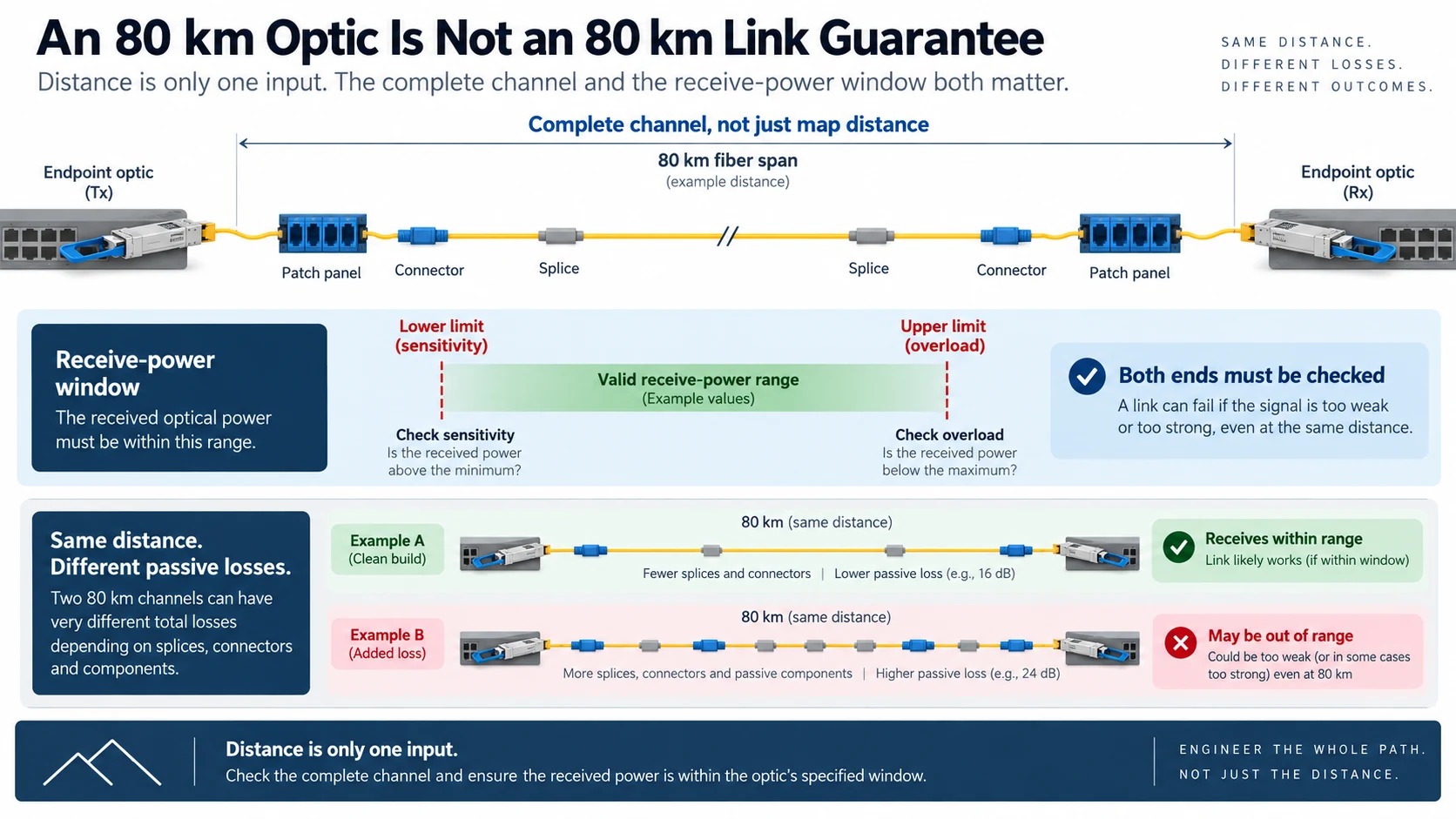
Two fiber routes can be the same length and present very different engineering problems. One may contain few connections and ample optical margin; the other may include aging splices, additional panels or operating conditions that consume that margin.
That is why “80 km” should begin a link review rather than replace one. The advertised reach is conditional on the selected optical application and its documented limits.
Distance is only one input
The route contributes attenuation, but connectors, splices and other passive components also affect received power. The design needs the complete channel, not just a map distance between buildings.
Cisco’s SFP-10G-ZR documentation specifies optical-power limits and conditions in addition to nominal reach. Those details are what turn a distance label into an engineering requirement. R18
Record the exact module at each end and verify host support. A family description or a reseller’s “ZR-compatible” label is not a substitute for the relevant specification and compatibility check. R49
Check both ends of the receive-power window
A receiver needs enough power to detect the signal, but excessive power can also exceed its operating range. A short link is therefore not automatically safe for a long-reach optic.
An illustrative calculation, using hypothetical values rather than a product specification, makes the distinction clear. Suppose a transmitter’s minimum output is 0 dBm and the receiver sensitivity is −16 dBm. The arithmetic difference is 16 dB before applicable penalties and design reserve. A 12 dB channel would leave 4 dB at that simplified boundary. The design must still check maximum transmitter output against receiver overload on the lowest-loss path.
Attenuation, when required, must be selected from the actual transmitter and receiver limits. Do not choose an attenuator solely from cable length or treat a damage threshold as the normal operating limit. R18
Power margin is not the whole qualification
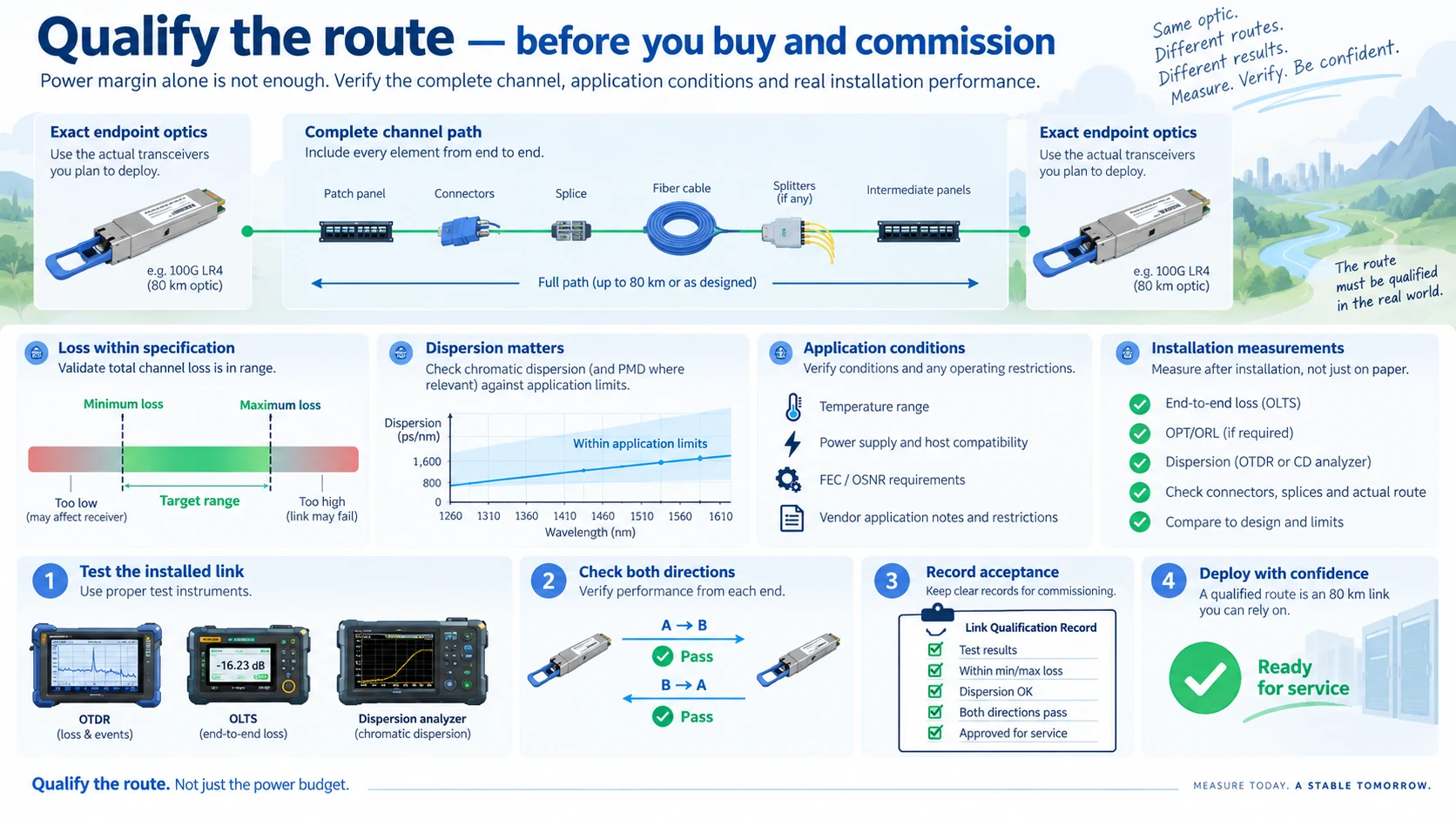
A channel that appears acceptable on a power meter can still violate other application requirements. Dispersion and documented optical penalties matter for relevant long-reach interfaces. The module datasheet and engineering guidance must govern their treatment. R18
Similarly, diagnostic readings from a module are useful operational evidence, not a replacement for every channel measurement. Retain the method, instrument and conditions associated with the acceptance record.
| Design input | Why it matters |
|---|---|
| Exact endpoint optics | Establishes transmitter and receiver limits |
| Complete channel path | Captures loss beyond the main fiber span |
| Minimum and maximum loss | Checks sensitivity and overload separately |
| Application conditions | Includes relevant dispersion and operating restrictions |
| Installation measurements | Confirms the installed path, not only the design estimate |
Qualify the route before committing the purchase
Collect route information and available test results before requesting the final optical combination. Resolve uncertain splices, connectors and passive components while the design can still change.
At commissioning, verify both directions, inspect relevant errors under controlled traffic and retain the actual installed configuration. The defensible conclusion is that a particular link met a defined acceptance method—not that every route shorter than the label will work.
Engineering illustrations
These figures illustrate the design concepts discussed here. They are not measured results, certified configurations or a supplied-equipment list.
Related reading
- Long-Reach 10G Fiber Design: Loss Budget, Receiver Limits and Acceptance
- SFP-10G-ZR Qualification: Check Both Loss Margin and Receiver Overload