
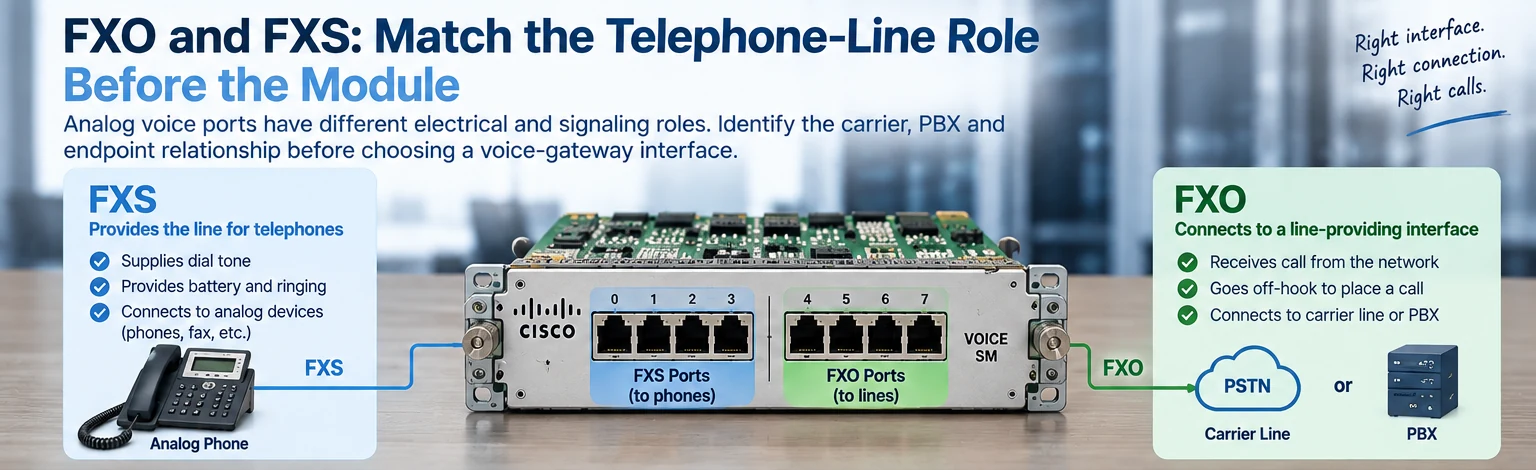
A voice module with the right number of sockets can still be unsuitable for the telephone service. The essential distinction is the role each interface performs, not the connector’s appearance.
FXO and FXS are not interchangeable labels for analog ports. Selecting between them starts with identifying what is connected on the other side.
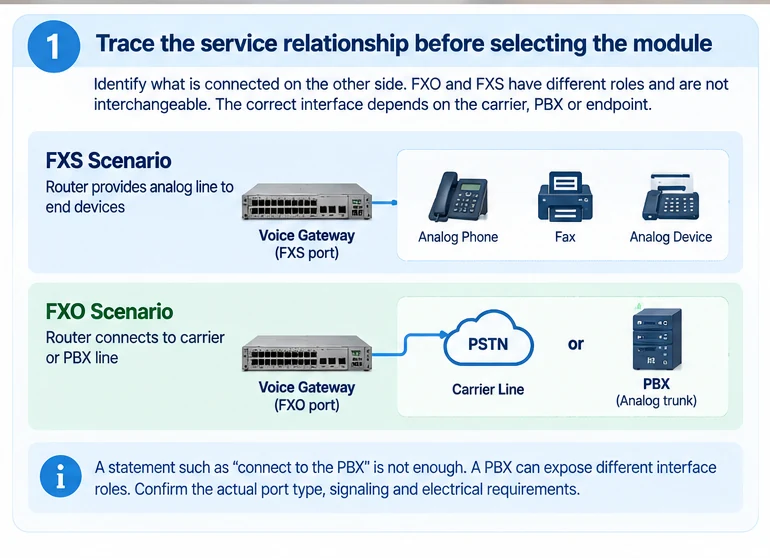
Trace the service relationship
An FXS interface provides the line-side functions expected by a compatible analog telephone endpoint. An FXO interface connects as a subscriber-side device to an appropriate line-providing interface, such as a supported carrier or PBX connection. Exact signaling and electrical requirements remain platform- and service-specific. Cisco’s analog interface documentation distinguishes these functions. R22
Do not decide from a statement such as “connect to the PBX.” A PBX can expose different interface roles. Identify the actual port and signaling, then select the complementary supported gateway interface.
Installation must follow the equipment’s grounding, wiring and safety requirements. A familiar modular connector does not make an undocumented connection safe or correct.
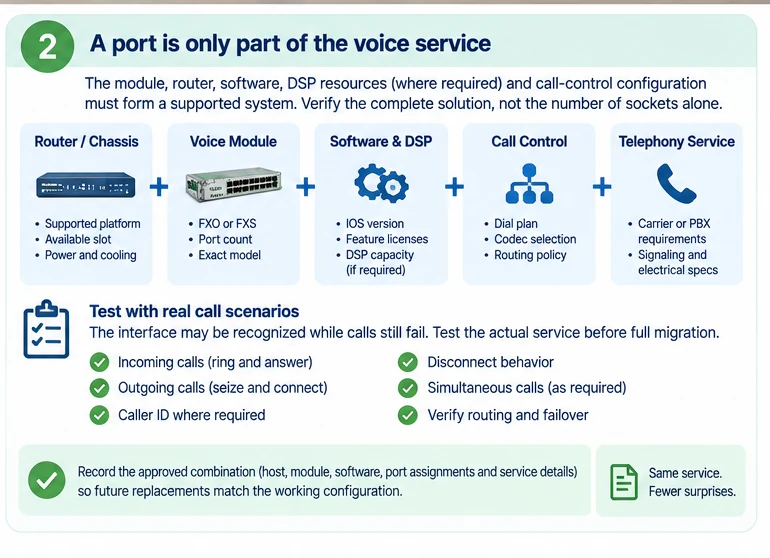
A port does not supply the whole voice service
The host router, voice module, software, DSP resources where required and call-control configuration must form a supported system. Document the codec, simultaneous-call requirement and any special services that must continue to work.
Digital T1/E1 interfaces introduce their own framing, signaling and operating-role questions. Cisco’s digital NIM documentation is separate evidence for those configurations; it should not be treated as an analog-port substitution guide. R21
An inventory should distinguish physical interfaces from the number and type of usable services. Counting sockets alone can conceal a missing processing or configuration dependency.
Use the real call scenarios during acceptance
A link or module can be recognized while calls still fail in one direction. Build a test plan around the service: incoming and outgoing calls, caller identification where required, disconnect behavior, simultaneous use and the intended routing policy.
For an illustrative migration, an office moving an analog service into a gateway should retain a verified test number and a rollback connection. Test the actual carrier and PBX relationship before moving every line. This is a planning example, not a claim that a particular module supports all analog services.
| Information to collect | Why it changes selection |
|---|---|
| Carrier/PBX/endpoint port role | Determines the required complementary interface |
| Signaling and electrical requirements | Establishes whether the service is supported |
| Concurrent calls and codecs | Informs resource and software review |
| Required call behavior | Defines acceptance beyond basic connectivity |
Keep the replacement record specific
Record the host, module, software baseline, port assignments and service details together. A later replacement should reproduce the approved combination, not merely match “four analog ports.”
The practical buying rule is to describe the telephone relationship first and the hardware second. That prevents an apparently economical port purchase from becoming a redesign when the line must actually make and receive calls.
Engineering illustrations
These figures illustrate the design concepts discussed here. They are not measured results, certified configurations or a supplied-equipment list.
Related reading
- Voice Gateway Migration: Analog Roles, Digital Trunks and Cutover Tests
- Voice Interface Selection: FXO, FXS, T1/E1 and PRI Requirements