
Voice Interface Selection: FXO, FXS, T1/E1 and PRI Requirements
Select voice gateway interfaces from their signaling role, platform support, DSP resources, carrier settings and call-level acceptance.
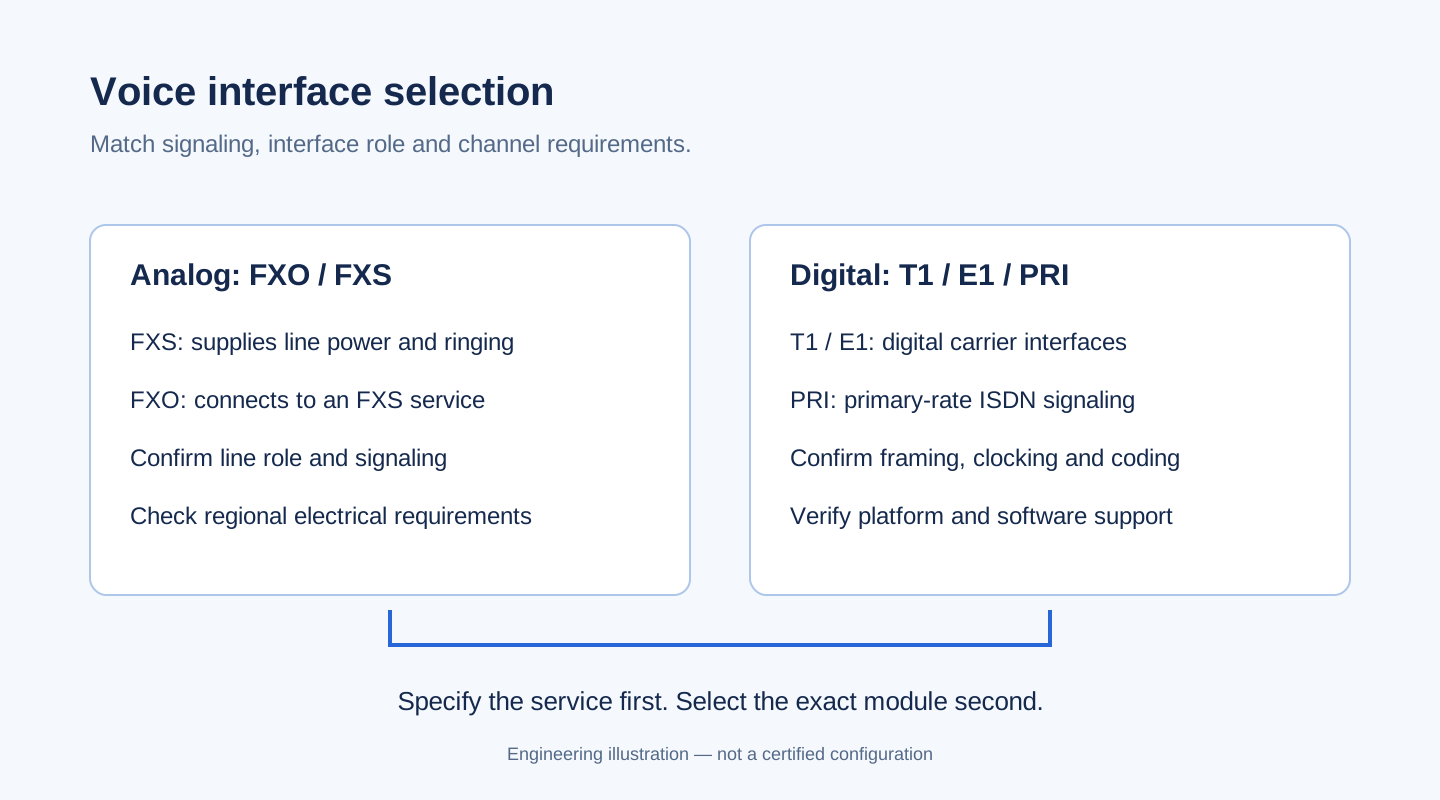
A voice interface must match the role of the connected equipment and the signaling of the service. Connector shape and port count are insufficient. Use this guide to prepare a gateway or module requirement before selecting a specific Cisco interface.
1. Determine the analog role
An FXS interface provides the line-side functions expected by an analog endpoint, while an FXO interface connects as a subscriber-side device to a provided analog line. These roles are complementary, not interchangeable. Confirm the requirements of the actual phone, PBX or carrier service and the supported module. R22
Do not connect two ports solely because they use similar telephone connectors. The electrical and signaling roles must be appropriate.
2. Define digital service characteristics
For T1/E1 services, record the physical handoff, framing, line coding, clocking and signaling arrangement. PRI is a signaling/service configuration associated with the relevant digital interface; it is not simply another connector type.
Cisco’s T1/E1 NIM guidance includes platform and configuration requirements that must be checked for the exact module and host. R21
| Requirement | Information to collect |
|---|---|
| Analog endpoint | Required FXS or FXO role and service behavior |
| Digital circuit | T1/E1 handoff and provider configuration |
| Gateway platform | Exact host, module support and software release |
| Processing | Required DSP or related resources for the intended functions |
| Call capacity | Concurrent calls and codec/transcoding requirements |
| Software rights | Applicable feature and service entitlements |
3. Count calls, not only sockets
Physical ports and supported simultaneous calls are different planning quantities. Required processing, channel allocation and software functions can constrain the usable service. An interface with the correct number of connectors is not automatically a complete gateway configuration.
For an illustrative migration, eight analog endpoints plus a digital carrier handoff should be recorded as separate service groups. Do not combine them into a single port count and assume one module satisfies both.
4. Plan the service transition
Document number routing, inbound and outbound call paths, caller identification, tone or fax requirements where applicable and the network services the gateway depends on. Coordinate carrier changes and preserve the old configuration until acceptance is complete.
Emergency calling and other regulated service requirements must be reviewed through the appropriate provider and organizational process. This selection guide does not establish compliance or authorize test calls to emergency services.
5. Accept actual call behavior
Test inbound and outbound calls, audio in both directions, release behavior and the agreed supplementary functions. Exercise representative concurrent use within the approved scope. Check recovery after the selected gateway or network event.
Retain the host/module/software combination, circuit settings and call-test results. A digital interface showing up or an analog port appearing in inventory is only the beginning of acceptance.
The final selection record should connect each service requirement to its supported hardware, processing and configuration dependencies. That prevents FXO/FXS confusion and avoids treating a voice module as a self-contained solution.
Related reading
- Voice Gateway Migration: Analog Roles, Digital Trunks and Cutover Tests
- FXO and FXS: Match the Telephone-Line Role Before the Module
References
可直接使用的项目资料
按当前任务选择资料。可以先提交已有清单,后续再补缺项。下载模板为英文。