
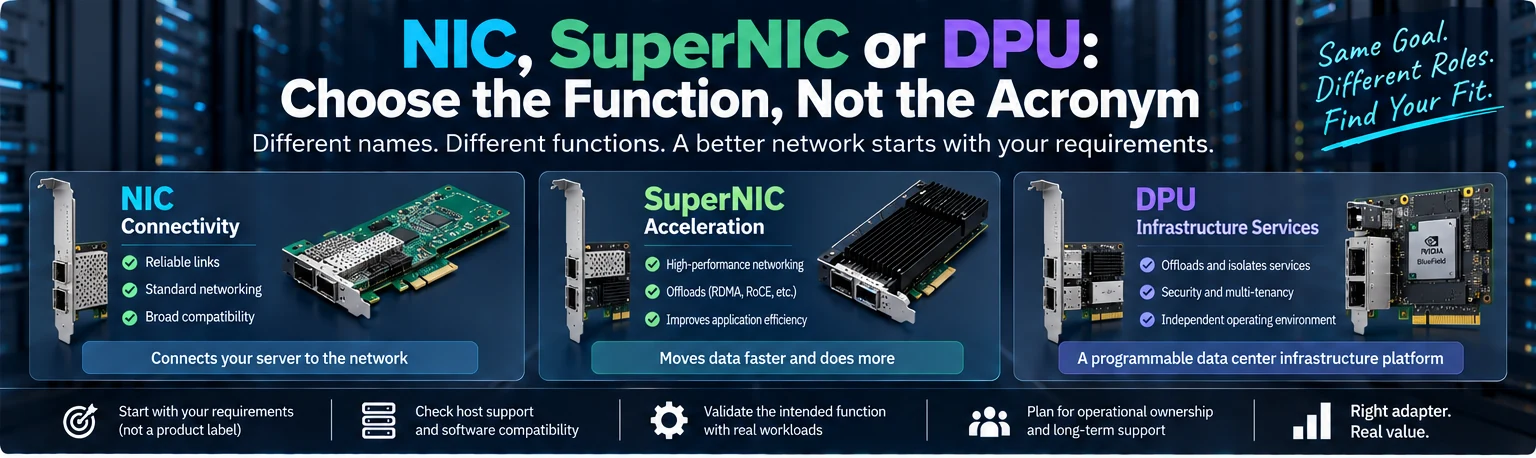
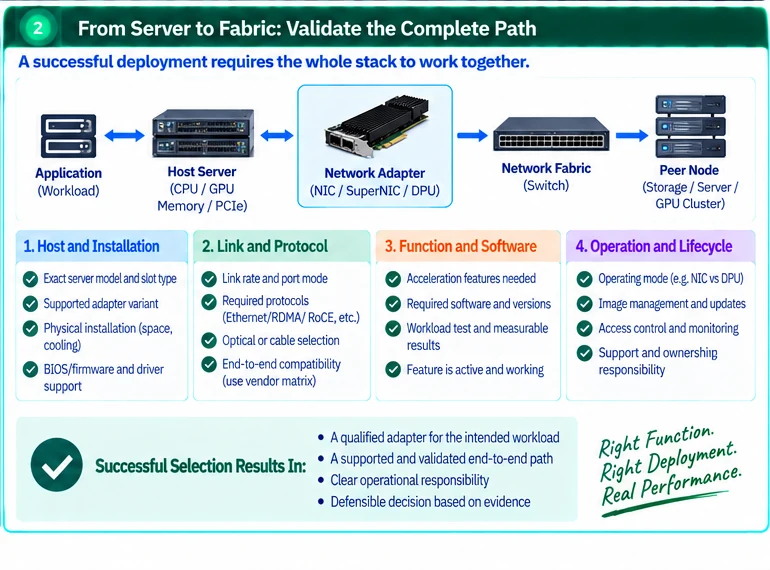
A server needs more than a fast connector. It needs a supported path between its application, memory, network adapter and fabric. Choosing that adapter by the most impressive acronym can add cost and operational work without solving the actual bottleneck.
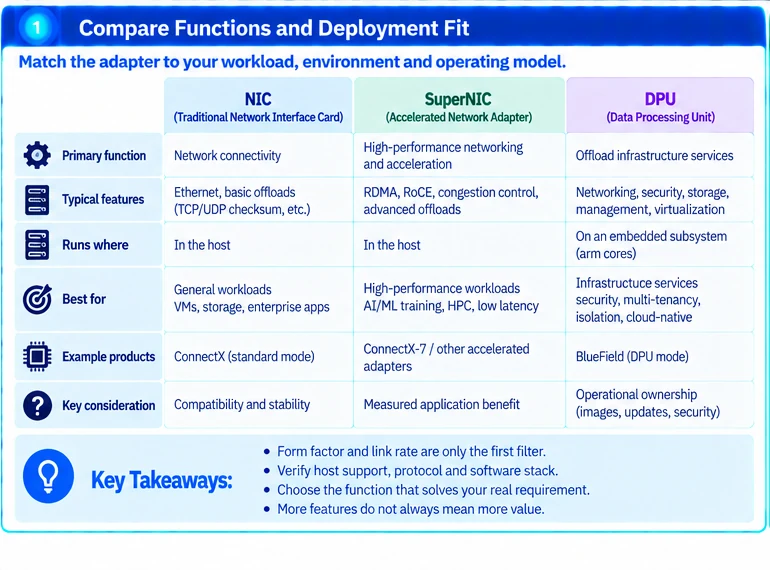
NIC, SuperNIC and DPU should therefore begin a requirements discussion, not end it. The useful distinction is the function the proposed device performs in a specific deployment.
Connectivity is still the foundation
Start with the server interface, physical installation, network protocol and software stack. An adapter must be supported in the intended slot and system, with the required link mode, cooling and driver/firmware combination. A family-level capability does not establish that every ordering variant supports the same protocols or installation. NVIDIA’s ConnectX documentation and versioned platform matrices are evidence sources for this exact-configuration check. R51R10
Then describe the application’s communication path. A storage node, a conventional virtual-machine host and a distributed GPU worker can have similar external link rates while requiring different functions.
Acceleration must be used to have value
A SuperNIC proposal should identify the documented acceleration feature being relied upon, the software that enables it and the workload that benefits. The evaluation must show that the intended path is active; a feature in a datasheet is not a measured application improvement.
For example, a team evaluating distributed training should compare repeatable communication and job-level results under the same model, placement and software conditions. A separate team replacing a service-network adapter may care primarily about compatibility, manageability and stable connectivity. Neither requirement is made more complete by simply buying the product with the longer feature list.
A DPU changes who operates part of the system
When infrastructure services run on an embedded subsystem, the design needs an owner for its images, access controls, updates, telemetry and recovery. These are ongoing responsibilities, not one-time installation details.
The hardware label alone does not even establish the active mode. NVIDIA’s archived DOCA 2.9.4 documentation distinguishes BlueField NIC mode from DPU mode and describes different ownership of networking resources. That is a version-specific example of why operating mode belongs in the deployment record. R56
| Decision | Evidence to request |
|---|---|
| Basic attachment | Supported server installation, protocol and exact adapter variant |
| Communication acceleration | Required software integration and a reproducible workload test |
| Infrastructure offload | Supported service, ownership boundary and recovery procedure |
| Ongoing operation | Image baseline, monitoring, access policy and support responsibility |
Compare outcomes, including added complexity
Consider an illustrative pair of projects. One needs qualified RDMA connectivity for an existing cluster. The other must isolate and operate a supported infrastructure service outside the host software environment. The second project may justify a different device and operating model even when both use the same nominal network rate. This is a requirements comparison, not a benchmark between product families.
A useful purchase request states the workload, server platform, required function, network environment and acceptance method. It also explains which advanced capabilities are unnecessary. That makes the selection defensible—and gives the engineering team something more precise to validate than “the best network card.”
Engineering illustrations
These figures illustrate the design concepts discussed here. They are not measured results, certified configurations or a supplied-equipment list.
Related reading
- ConnectX and BlueField Selection: Host Fit, Protocol and Offload Requirements
- AI Ethernet Fabric Design: From GPU Traffic to a Qualified BOM