
ConnectX and BlueField Selection: Host Fit, Protocol and Offload Requirements
Select ConnectX adapters or BlueField DPUs by exact variant, host integration, protocol support, software stack and operational ownership.
先定功能,再核对主机
| 业务目标 | 产品负责人确认 | 技术人员需要的输入 |
|---|---|---|
| 普通网络连接 | 协议、端口数和应用所需吞吐 | 精确服务器、插槽或 OCP 位、操作系统、对端接口及散热 |
| RDMA / 加速通信 | 应用与通信栈、证明效果的工作负载 | 网卡变型、固件/驱动组合、CPU/GPU 位置及网络配置 |
| DPU 基础设施卸载 | 哪项功能转移到 DPU,由谁运营 | 软件、管理入口、镜像生命周期、恢复负责人及主机集成 |
NIC / SuperNIC / DPU 文章解释功能分工;本页核对主机条件。产品族名称不能替代具体料号。
收集一份能交给技术人员的主机记录
记录服务器与 riser/OCP 位、插槽代际及可用宽度、挡板/供电/风向、CPU/GPU 关联、操作系统、驱动与固件、协议与卸载目标、对端交换机端口、模块或线缆 OPN、已知数量,以及支持依据的版本。PCIe 卡和 OCP 模块的物理接口不同;识别候选时分别记录 Ethernet 与 VPI 变型。具体卡型参见ConnectX-7 硬件手册。
缺少信息时怎样推进
示例:“已有 GPU 服务器,需要两个网络端口,插槽/riser 与对端模块暂未提供。”先由项目工程人员提供服务器配置及对端端口;产品负责人确认负载和卸载目标;采购保留客户原始型号,在核对后确定候选 OPN。不代填未知数量或替代型号。
确定主机侧候选后进入光模块与线缆核对表。可先提交主机资料或原始 BOM,下方六步方法继续解释软件与验收。
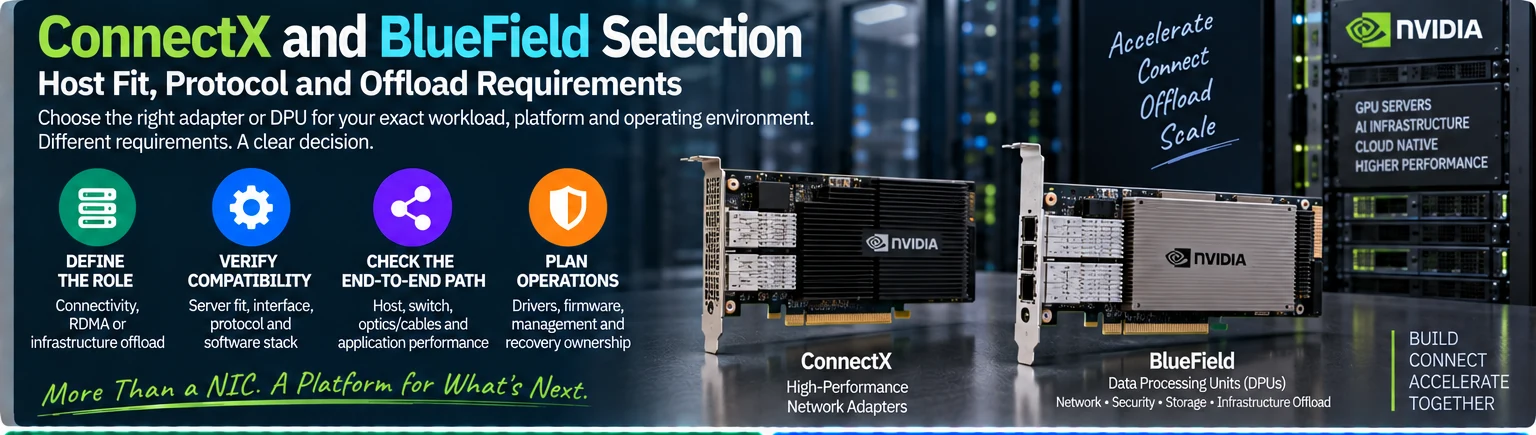
Choose a network adapter from the role it must perform in the host. Basic connectivity, accelerated communication and infrastructure offload are different requirements. A family name or headline link rate does not establish protocol support, physical fit or the software needed to use a device.
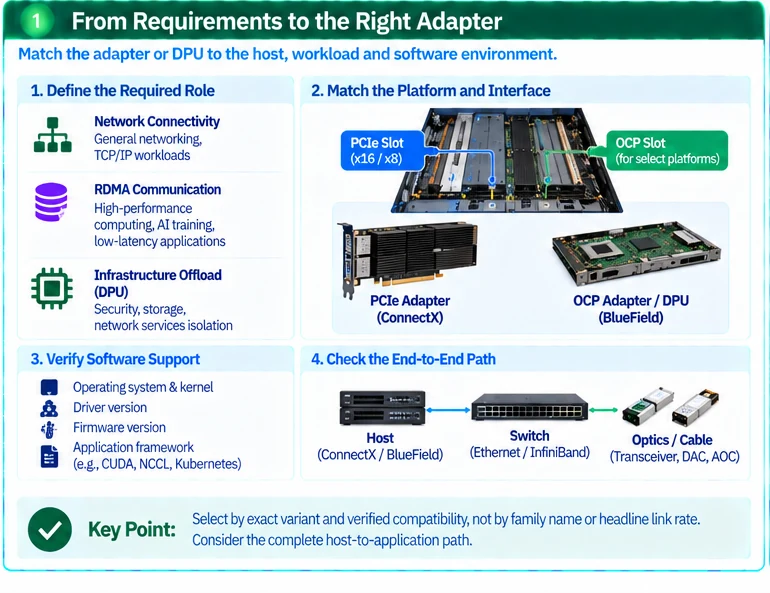
1. Define the required role
State whether the host needs ordinary network access, an RDMA communication path, or a separately managed infrastructure-processing function. Identify the application framework and operating environment.
A DPU should be selected because its processing and isolation model supports a defined requirement, not because its product category sounds more capable. Include the team responsible for its software lifecycle and recovery.
2. Identify the exact adapter and server
Record the complete adapter part number, server model and relevant hardware configuration. Confirm physical form factor, supported host interface, mechanical clearance, power and cooling requirements. PCIe add-in and OCP implementations should not be treated as interchangeable packages.
ConnectX documentation distinguishes adapter variants and their requirements. Protocol and rate support must be checked for the offered identifier rather than inferred from the family name. R51
| Selection dimension | Evidence required |
|---|---|
| Physical integration | Supported server slot or form factor and mechanical fit |
| Host attachment | Supported PCIe arrangement and relevant topology constraints |
| Network interface | Protocol, logical ports, rate and qualified media |
| Software | Operating system, driver, firmware and application dependencies |
| Offload function | Feature actually required and its supported deployment mode |
| Operations | Update, monitoring, access and recovery ownership |
3. Check the host-to-application path
A network port’s nominal rate does not prove that the host can supply equivalent useful traffic. Consider the actual host interface, CPU or GPU locality, application behavior and software configuration. Do not translate an adapter’s port specification directly into a workload-performance promise.
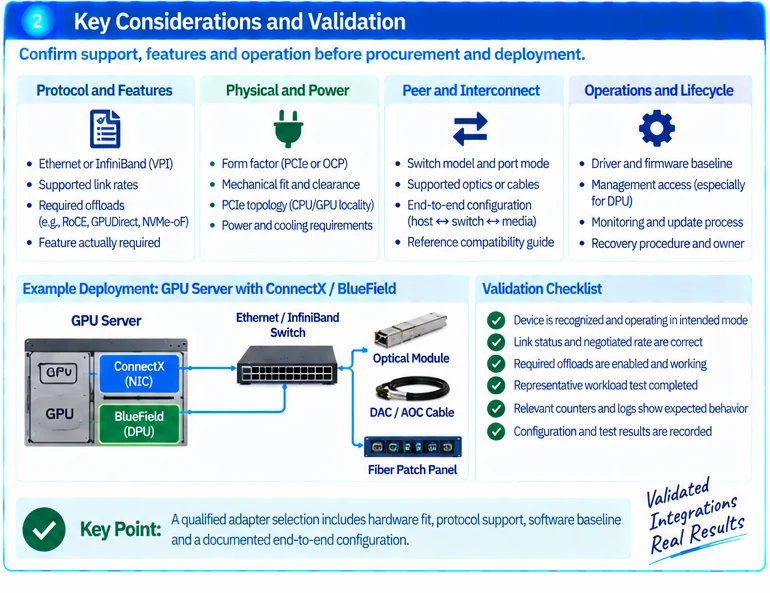
For a GPU server, record which adapter is associated with which host or GPU path under the platform design. Test the intended placement rather than assuming all slots are operationally equivalent.
4. Qualify the peer and interconnect
Identify the switch port and its operating mode, then select the supported module or assembly at both ends. NVIDIA’s platform-linking guidance illustrates how the host, switch and interconnect choices form one configuration. R05
Ethernet-only and VPI or InfiniBand-capable variants must not be conflated. An adapter linked from an InfiniBand solution page still requires its own protocol-support evidence.
5. Freeze the software baseline
Record the driver and firmware combination, operating system and any container, orchestration or acceleration dependencies. Versioned platform-support documents apply to their stated environment; do not treat one release’s support table as a permanent guarantee. R10
For a DPU, include its management access, image lifecycle and restoration procedure. An unowned secondary operating environment can become a maintenance gap.
6. Accept the required function
Verify device recognition, link mode, relevant offloads and representative workload behavior. Retain the test conditions and host placement. Test recovery only within an approved scope.
The output is a host-specific adapter qualification, not a generic ranking of NICs, SuperNICs and DPUs. Supply the server configuration, application, protocol and offload requirement when requesting a candidate device.
Engineering illustrations
These figures illustrate the design concepts discussed here. They are not measured results, certified configurations or a supplied-equipment list.
Related reading
- NIC, SuperNIC or DPU: Choose the Function, Not the Acronym
- AI Ethernet Fabric Design: From GPU Traffic to a Qualified BOM
References
可直接使用的项目资料
按当前任务选择资料。可以先提交已有清单,后续再补缺项。下载模板为英文。