
Cisco · legacy-campus
Legacy Catalyst Maintenance: Exact Replacements and a Controlled Exit Plan
Maintain installed Catalyst networks with traceable spare selection, service-risk review and a staged replacement boundary.
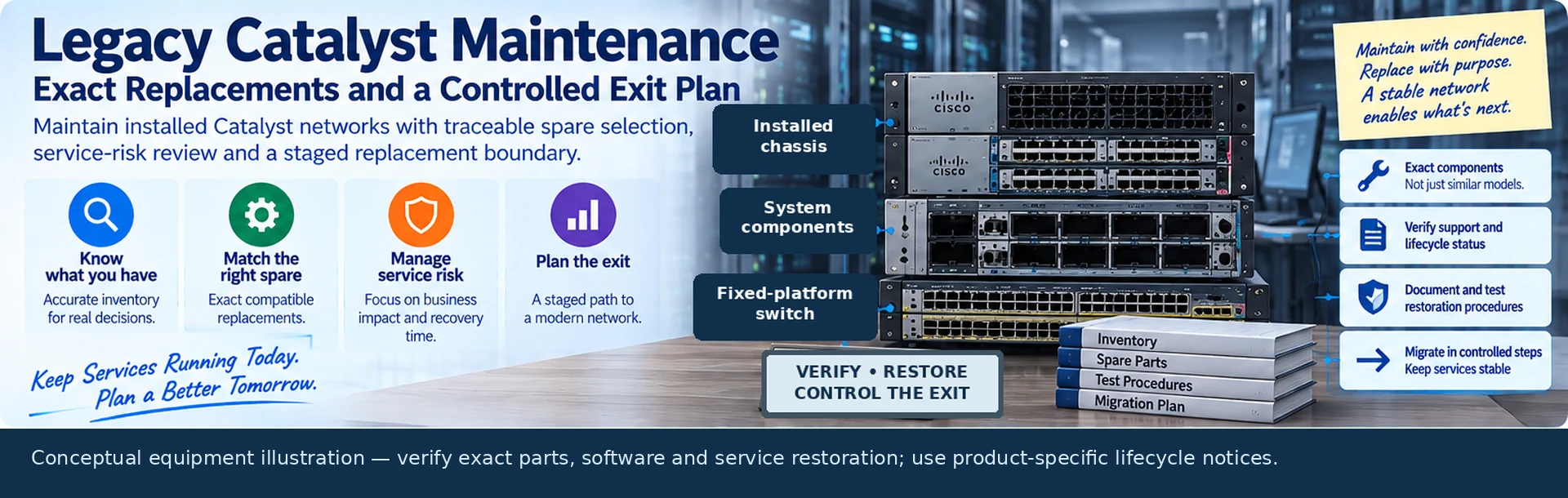
Keeping an installed Catalyst network operational is a different engineering task from designing a new campus. The maintenance objective is continuity for defined services, not the indefinite preservation of every old component. A useful plan connects exact replacements, operational risk and a realistic migration boundary.
Build an inventory that supports a replacement decision
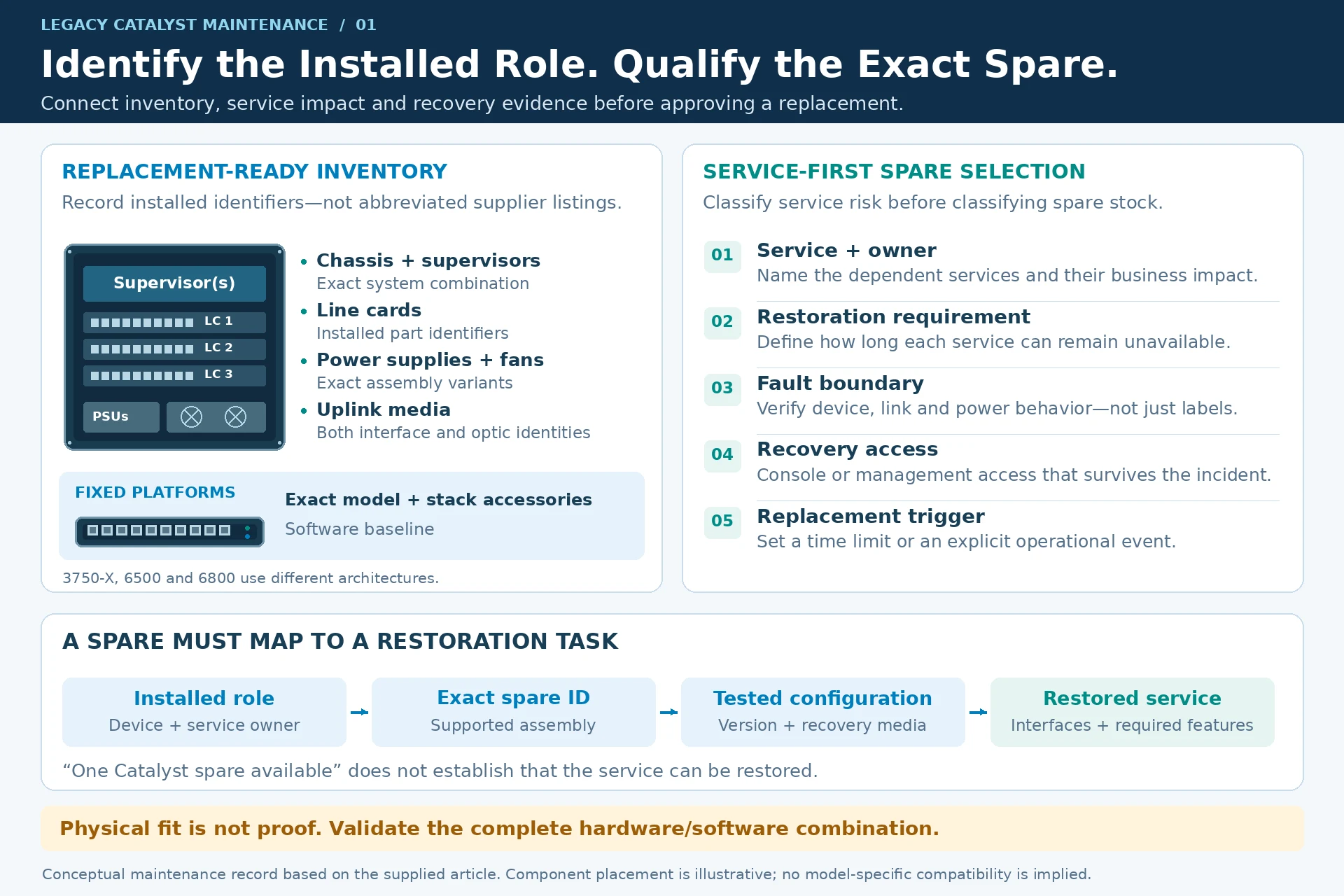
Capture chassis, supervisor, line cards, power supplies, fan assemblies and uplink media separately. For fixed switches, include the precise model, stack accessories and software baseline. Record installed identifiers rather than relying on a supplier’s abbreviated listing.
Catalyst 3750-X, 6500 and 6800 names cover different architectures and component dependencies. Documentation for a supervisor or line card applies within stated system combinations; physical insertion or a familiar connector is not sufficient evidence. R26
Classify services before classifying spare stock
Identify the business effect of losing each device and the time available to restore it. A spare that is acceptable for a noncritical office segment may not satisfy the recovery requirement for a production dependency. Conversely, stocking every historical part can create cost without improving recovery.
| Maintenance question | Required output |
|---|---|
| Which services depend on the unit? | Named owners and impact description |
| What failure can redundancy tolerate? | Verified device, link and power behavior |
| Which spare restores the service? | Exact compatible assembly and usable configuration |
| How is access recovered? | Console or management path that survives the incident |
| When must the platform be replaced? | Time limit or explicit operational trigger |
Separate condition from support coverage
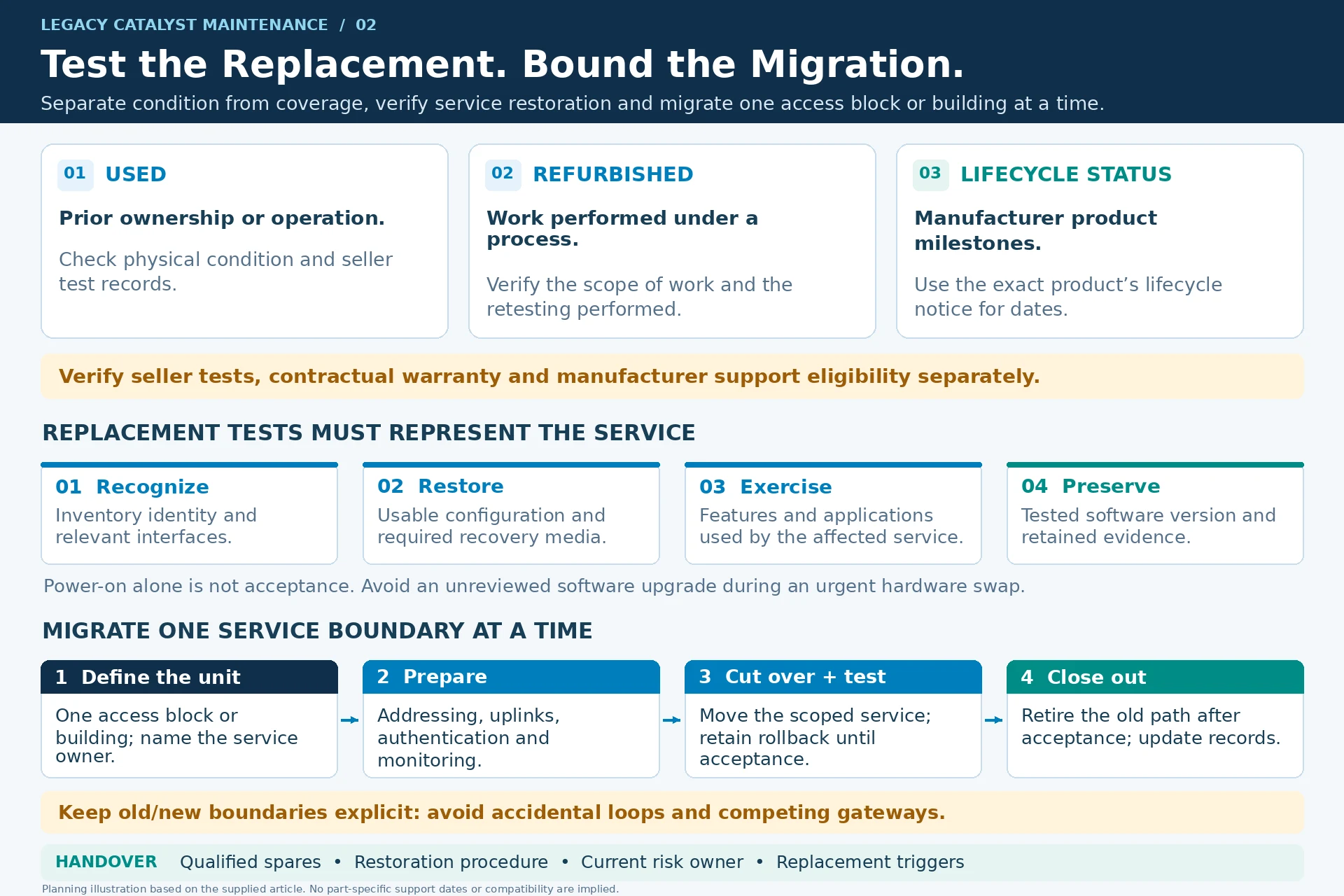
A used component describes prior ownership or operation. Refurbishment describes work performed under a particular process. Lifecycle status concerns the manufacturer’s product milestones. None of these automatically establishes the others. Verify seller test records, contractual warranty terms and manufacturer support eligibility separately.
Use product-specific lifecycle notices for dates. Cisco’s general policy explains milestone concepts, but does not establish a support deadline for every installed model. R19
Make replacement tests representative
A power-on test establishes only a narrow result. For a planned spare, check inventory recognition, relevant interfaces, configuration restoration and the features the affected service uses. Retain the tested software version and any required recovery media. Do not introduce an unreviewed software upgrade during an urgent hardware swap unless the recovery procedure explicitly requires it.
An illustrative maintenance record should answer: “This identified spare restores this installed role under this configuration.” “One Catalyst spare available” is not equivalent.
Plan the exit in service-sized steps
Choose a migration unit such as one access block or building. Resolve addressing, uplink design, authentication, monitoring and rollback before the cutover. Keep the old and new network boundaries explicit so that a partial migration does not create accidental loops or competing gateways. Campus design guidance can inform the destination architecture, but must be adapted to the installed services. R45
The completed plan includes qualified spares, a restoration procedure, current risk ownership and replacement triggers. This allows a legacy platform to serve a bounded purpose without presenting aging infrastructure as a universal long-term solution.
Engineering illustrations
These figures illustrate the design concepts discussed here. They are not measured results, certified configurations or a supplied-equipment list.
Related reading
- Legacy Catalyst Replacement Checklist: Match Components and Preserve Services
- Used, Refurbished and End-of-Life: Three Different Buying Questions