
Network engineering
Large Campus Network Design: Modular Access Blocks and Clear Failure Domains
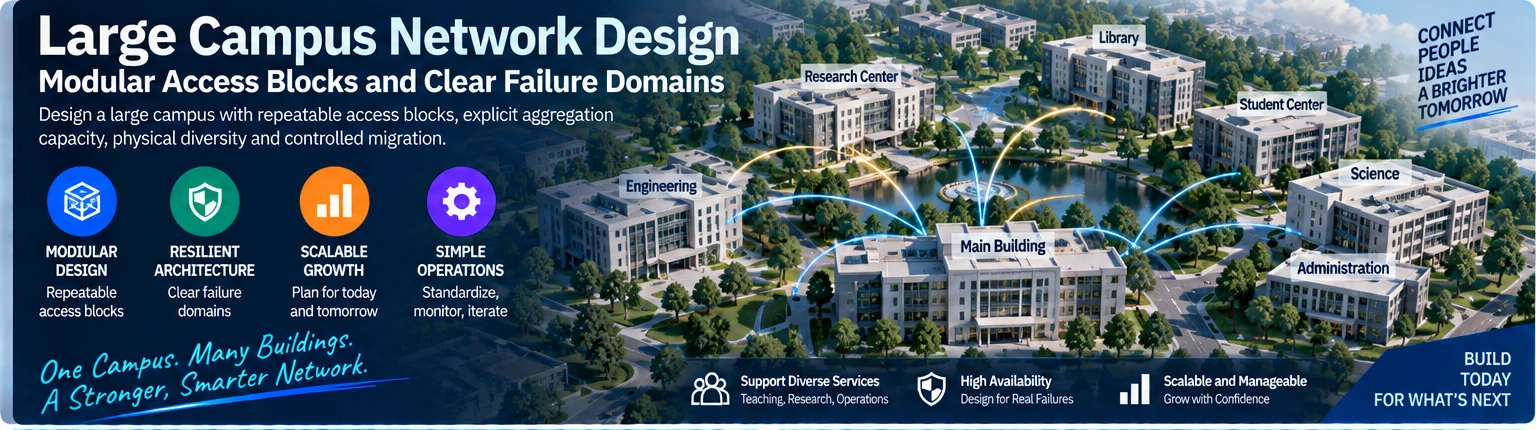
Design a large campus with repeatable access blocks, explicit aggregation capacity, physical diversity and controlled migration.
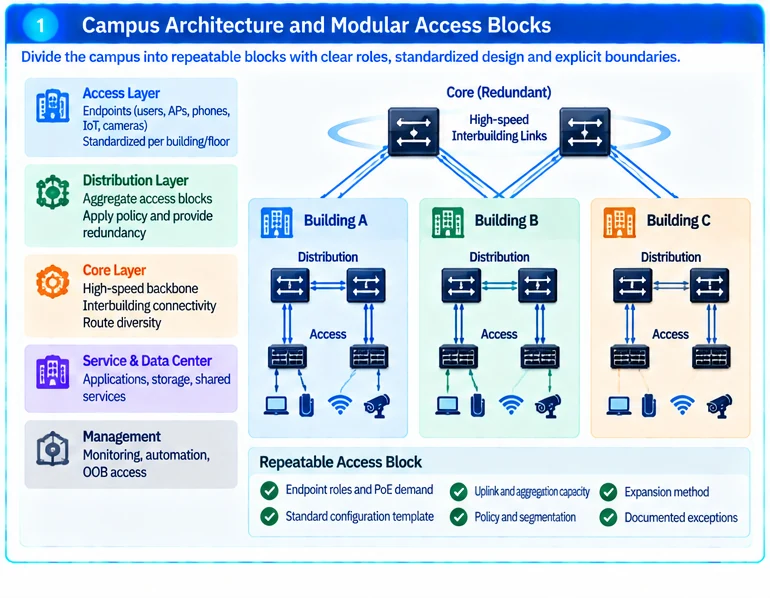
A large campus network should be divided into units that can be expanded, changed and diagnosed without treating the entire estate as one maintenance event. Buildings and access blocks provide useful planning boundaries, but their network, power and physical-route dependencies must be explicit.
Define repeatable access blocks
Group endpoints by building, floor or service area and identify their data, power and policy needs. Standardize the configuration where the requirements match, while recording exceptions such as laboratories, dense wireless areas or operational systems.
Campus design guidance offers architectural patterns for access and distribution. Select a pattern based on the site’s scale, availability objectives and operating capability rather than copying the largest example. R45
Budget aggregation under failure
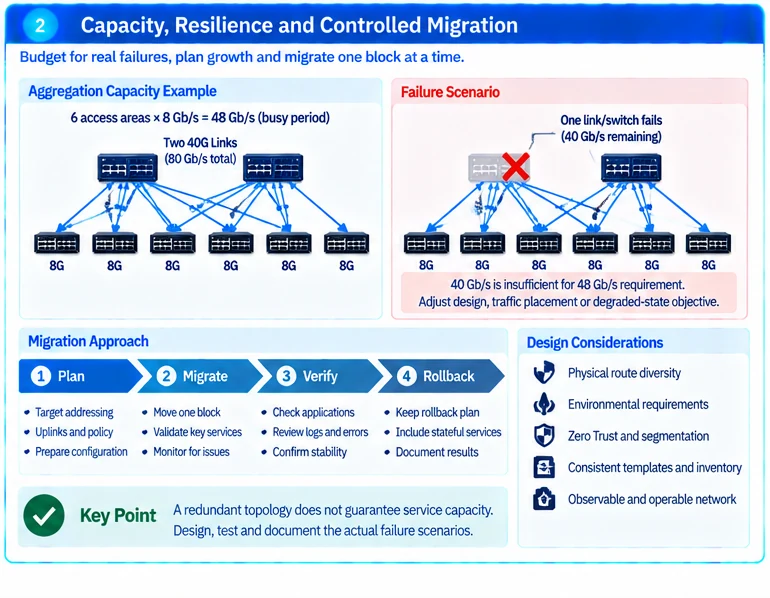
For an illustrative distribution block, six access areas each require 8 Gb/s during the defined busy period, totaling 48 Gb/s. Two 40G aggregation paths provide 80 Gb/s of nominal capacity normally, but one surviving path provides only 40 Gb/s. The arithmetic exposes a mismatch with a requirement to preserve all 48 Gb/s after that failure.
The solution might be higher-rate surviving paths, different traffic placement or an explicitly lower degraded-state objective. It should not be hidden by calling the topology redundant.
| Design boundary | Requirement to document |
|---|---|
| Access block | Endpoint roles, PoE demand and expansion method |
| Distribution | Traffic aggregation and surviving capacity |
| Core or interbuilding layer | Route diversity and service reachability |
| Policy | Allowed communications and enforcement ownership |
| Operations | Monitoring, change scope and recovery access |
Coordinate hardware and service templates
Exact access-switch variants differ in port, uplink, power and stacking behavior. A standard campus template should reference qualified configurations rather than a family name with interchangeable accessories. R12
Keep identity and application authorization separate from physical location. Segmentation provides an enforcement structure, but it is not a complete trust decision by itself. R35
Migrate one fault domain at a time
Prepare the target addressing, uplinks, policy and management configuration before moving an access block. Define how the old and new systems coexist and prevent unintended loops or competing gateways.
Validate representative applications in each migrated block, including authentication, addressing and name resolution. Monitor error and congestion behavior during the transition. Preserve a rollback route that accounts for configuration and stateful-service changes, not only cable placement.
Operate through consistent evidence
Use common inventory fields, configuration baselines and acceptance records across buildings. Keep exceptions visible with owners and review conditions. A repeatable block that cannot be audited is not truly standardized.
The final design should show how one building can grow or fail without creating unexplained consequences elsewhere. A useful project brief includes building maps, endpoint groups, traffic observations, route constraints and the required service level during planned maintenance and faults.
Engineering illustrations
These figures illustrate the design concepts discussed here. They are not measured results, certified configurations or a supplied-equipment list.
Related reading
- Campus Core Design: Chassis Dependencies, Capacity and Resilience
- Campus Fiber Infrastructure: Design Between Buildings, Not Just Between Ports