
Network engineering
Retail Chain Networks: Standardize the Store, Document the Exceptions
Build repeatable retail networks with controlled POS, guest and device access, site-specific uplinks and a practical recovery procedure.
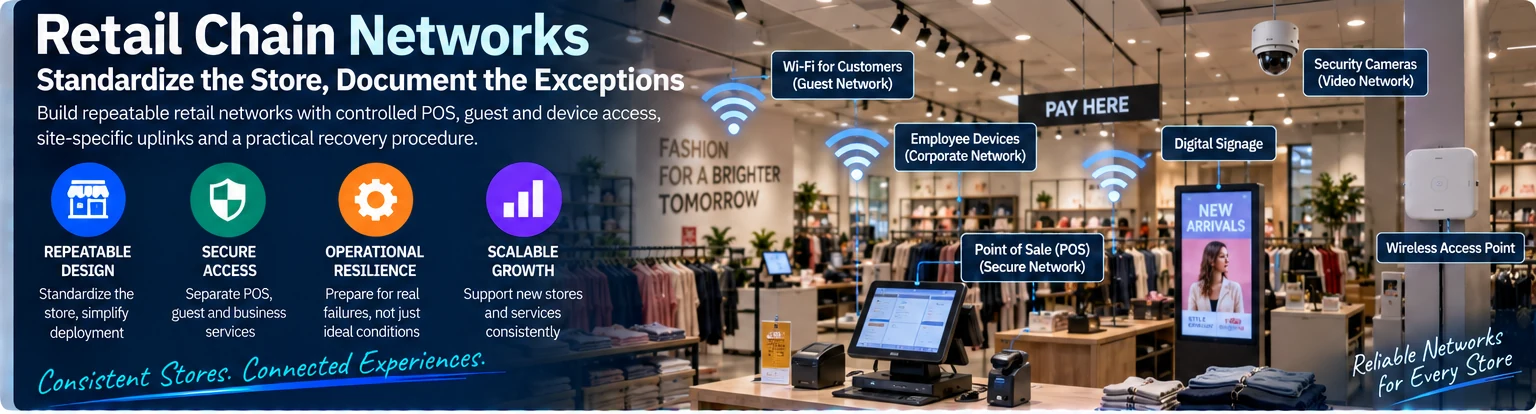
A retail network should be repeatable across stores without pretending that every location has identical circuits, floor plans or power conditions. Standardize the service model and configuration controls, then record site-specific exceptions. This reduces accidental variation while preserving the information needed for support.
Define store roles before equipment quantities
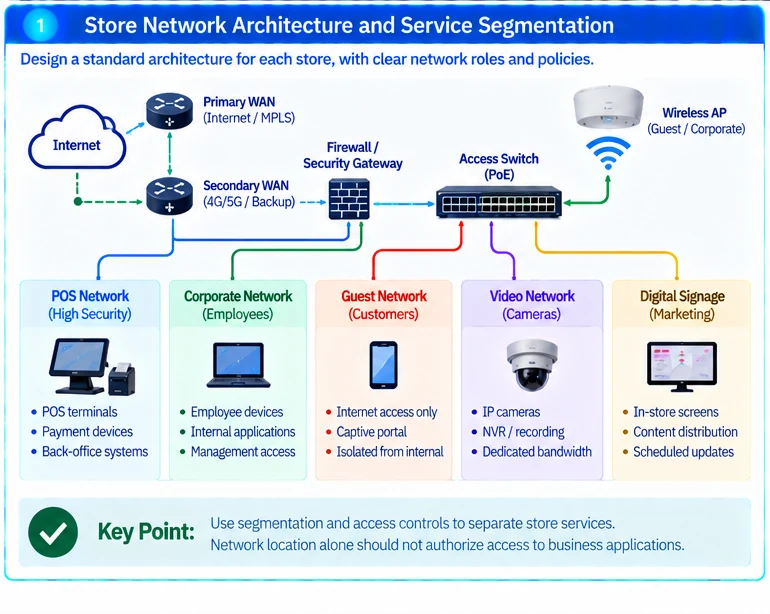
Identify point-of-sale systems, employee devices, guest access, cameras, signage and infrastructure management. Record the approved application paths and the owner of each service. Keep payment-related requirements under the organization’s applicable security and compliance process; this design does not certify compliance.
Network location alone should not authorize broad access to business applications. Use appropriate identity and service controls alongside segmentation. R35
Build a template with explicit variables
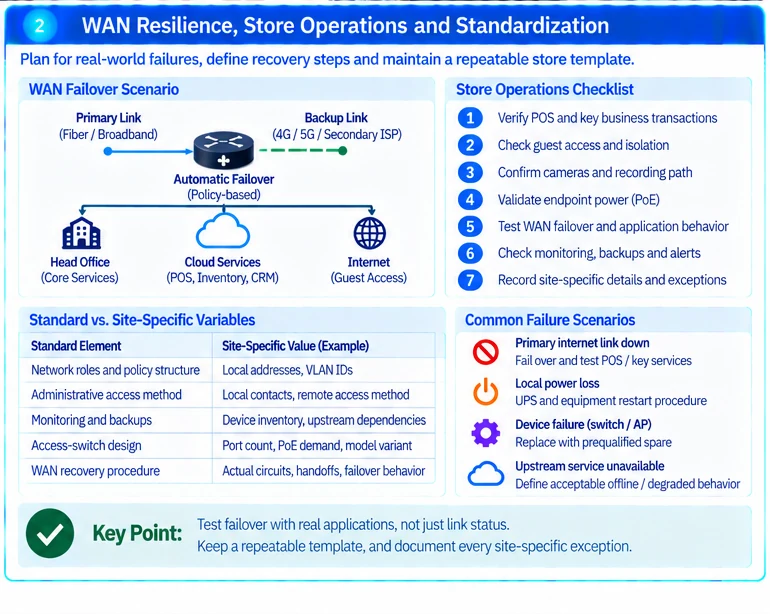
| Standard element | Site-specific value |
|---|---|
| Network roles and policy structure | Local addresses and required service exceptions |
| Administrative access method | Authorized operators and recovery contacts |
| Monitoring and backups | Device inventory and upstream dependencies |
| Access-switch design | Port count, PoE demand and expansion needs |
| WAN recovery procedure | Actual circuits, handoffs and failover behavior |
A template should not hide a different uplink type or a reduced power budget behind the same store label. Verify powered endpoints against the available switch allocation and their required operating modes. R32
Design for a store operator’s recovery capability
Decide which failures can be handled locally and which require remote or onsite engineering. Provide a small, safe diagnostic sequence: identify the affected service, check approved status indicators, confirm the support path and escalate with the correct store and device identifiers.
Do not require untrained staff to improvise configuration changes or electrical work. A prequalified spare can help only when its installation and configuration process are defined.
Test WAN failure as an application event
A backup circuit may establish connectivity while existing sessions are interrupted or provider-dependent services need time to recover. Test the actual business transactions under the approved failover scenario. Do not describe dual-WAN operation as interruption-free without evidence.
Where stores connect to centralized services, consider what remains usable during upstream impairment. Define the application’s permitted offline or degraded behavior with its owner rather than assuming the network can provide it.
Use a repeatable opening and change checklist
Before acceptance, verify critical transactions, guest isolation, camera paths, endpoint power, management access and monitoring. Retain the as-built inventory and approved exceptions. Campus and branch design principles can inform the architecture, but the store’s service and staffing constraints should determine its complexity. R45
The result is a store network that can be deployed consistently and supported with context. For a rollout brief, provide store types, endpoint counts, application dependencies, available circuits and local support capability. Those inputs define a standard that is repeatable without becoming blind to site differences.
Engineering illustrations
These figures illustrate the design concepts discussed here. They are not measured results, certified configurations or a supplied-equipment list.
Related reading
- Office Network Design for Growing Businesses: Capacity Without Unnecessary Complexity
- Small-Office Wi-Fi: Reliable Coverage with a Supportable Wired Foundation