
Network engineering
Manufacturing WLAN: Design for Mobile Workflows and Production Constraints
Plan factory wireless around client movement, changing RF conditions, wired dependencies and controlled operational acceptance.
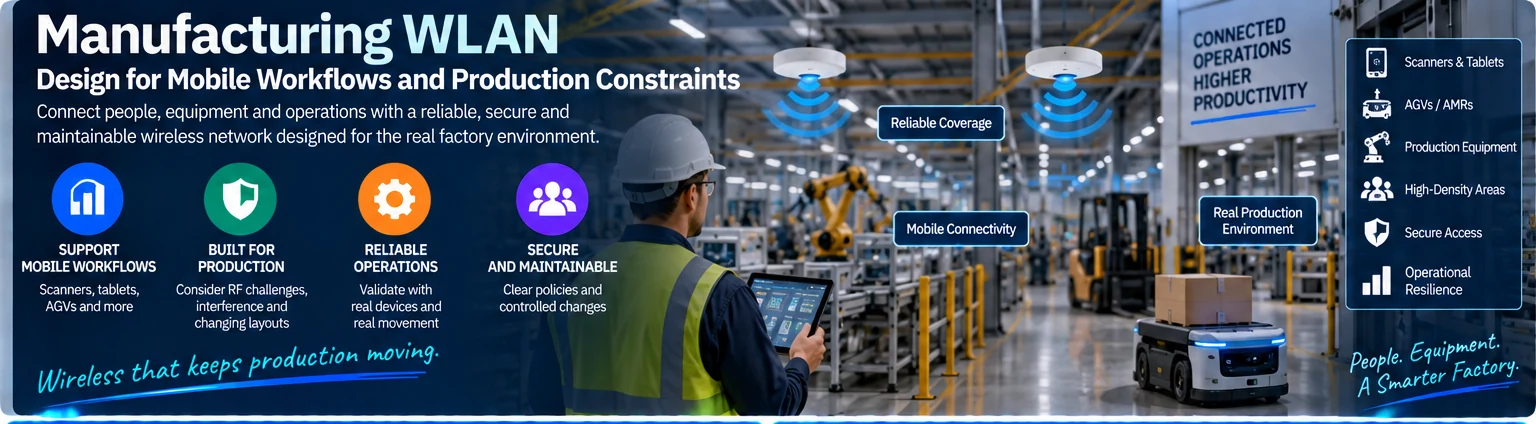
A factory WLAN must support the way people and equipment move through a changing physical environment. Metal structures, machinery, stored materials and moving vehicles can alter radio conditions. A design based only on an empty floor plan may not represent production use.
Define the supported workflows
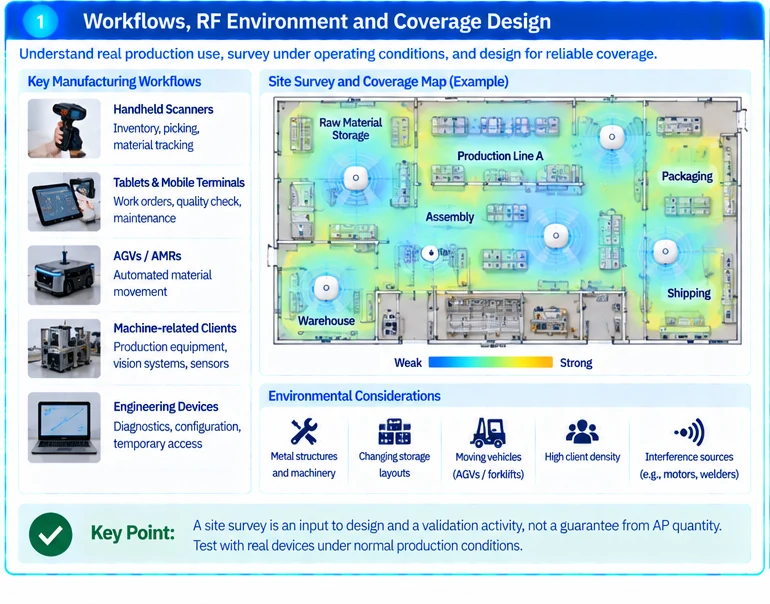
Identify scanners, tablets, mobile terminals, engineering devices and any machine-related clients. Record where each operates, whether it moves during a transaction and what interruption the application can tolerate. Use the actual client models in validation because radio and roaming behavior vary by implementation.
Do not assume that a general enterprise WLAN is suitable for safety-critical control or deterministic motion applications. Such uses require their own engineering and approval process. OT guidance emphasizes the operational and safety constraints that distinguish production systems from ordinary office IT. R34
Survey the operating environment
Assess representative production conditions, including occupied storage areas and normal machinery states. Map movement paths rather than testing only static points. A site survey is an input to design and a validation activity, not a guarantee derived from AP quantity. R37
| Workflow condition | What to examine |
|---|---|
| Stationary terminal | Coverage and transaction reliability at its actual position |
| Moving scanner | Roaming and transaction continuity along the route |
| Dense work area | Concurrent client demand and airtime contention |
| Changing storage area | Coverage changes as materials and vehicles move |
| Maintenance event | Dependence on uplinks, authentication and controller services |
Include wired and power dependencies
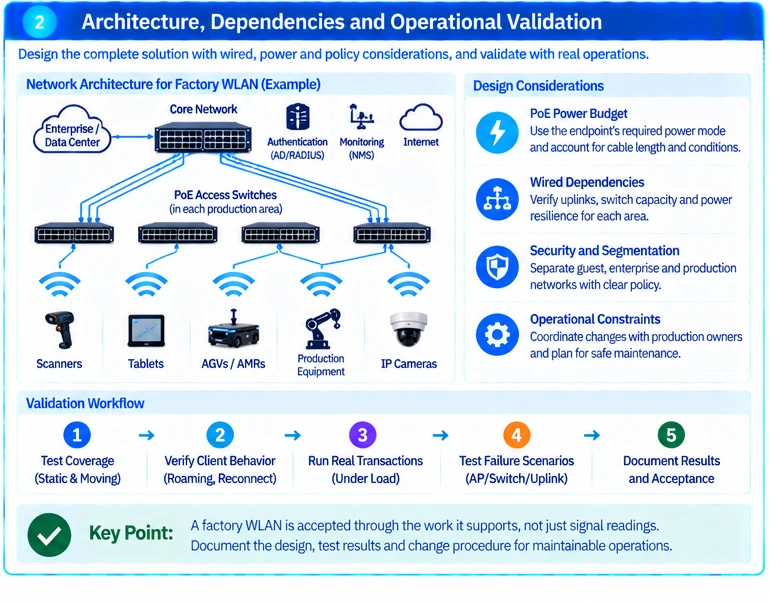
Verify access-switch ports, uplinks and the AP power mode required by the design. A reduced power allocation can affect supported AP functions, so confirm the endpoint’s documented behavior rather than assuming all powered states are equivalent. R32
Identify which cabinets and upstream services support each production area. A resilient RF layout can still share a single unprotected wired or power dependency.
Design policy without breaking the process
Separate guest, enterprise and production-related access according to approved service requirements. Document authentication and authorization dependencies, including what happens when those services are unavailable. Coordinate changes with the production owner and preserve a recovery path. R34
Avoid a large simultaneous cutover across unrelated production zones. Use a bounded pilot area that reflects the real client and environmental conditions.
Accept application behavior on the floor
Run representative transactions while clients follow normal movement routes. Record failed operations, reconnect behavior and relevant radio observations. Repeat checks under expected concurrent use and after an approved fault or maintenance event.
The handover should include AP placement, survey assumptions, client inventory, wired dependencies and a controlled change procedure. A factory WLAN is accepted through the work it supports, not through a favorable signal reading taken in an empty building.
Engineering illustrations
These figures illustrate the design concepts discussed here. They are not measured results, certified configurations or a supplied-equipment list.
Related reading
- Enterprise WLAN Design: Capacity, Coverage and Client Experience
- Industrial Ethernet Ring Design: Recovery Without Hidden Failure Assumptions