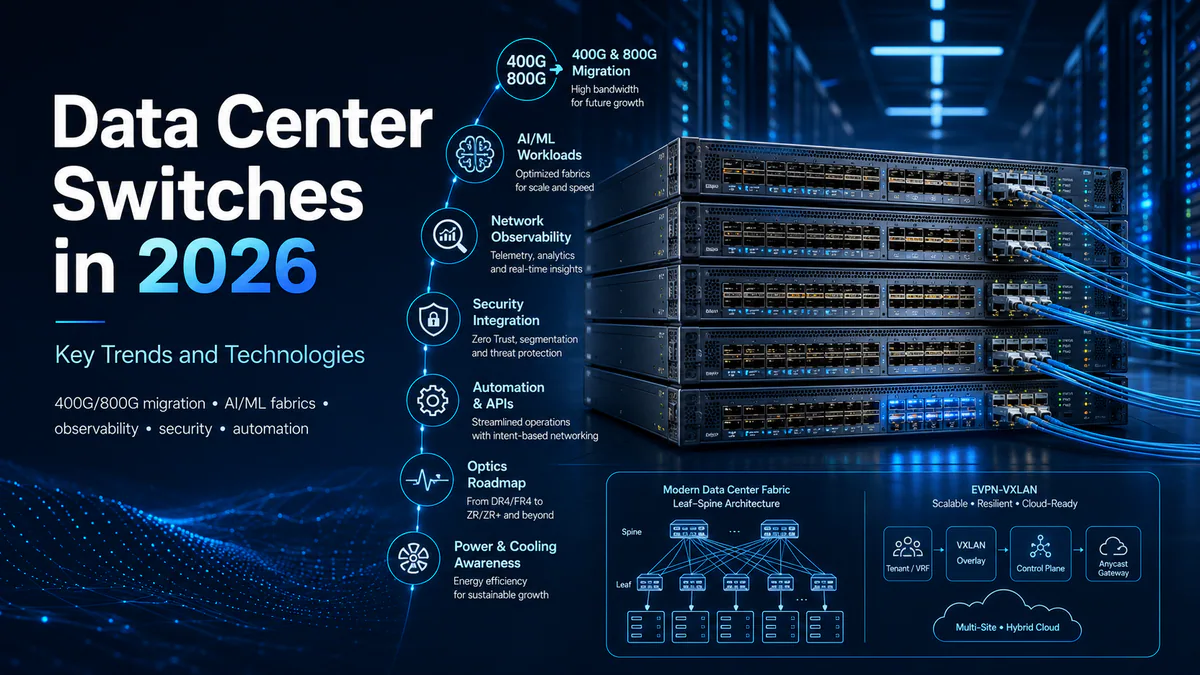
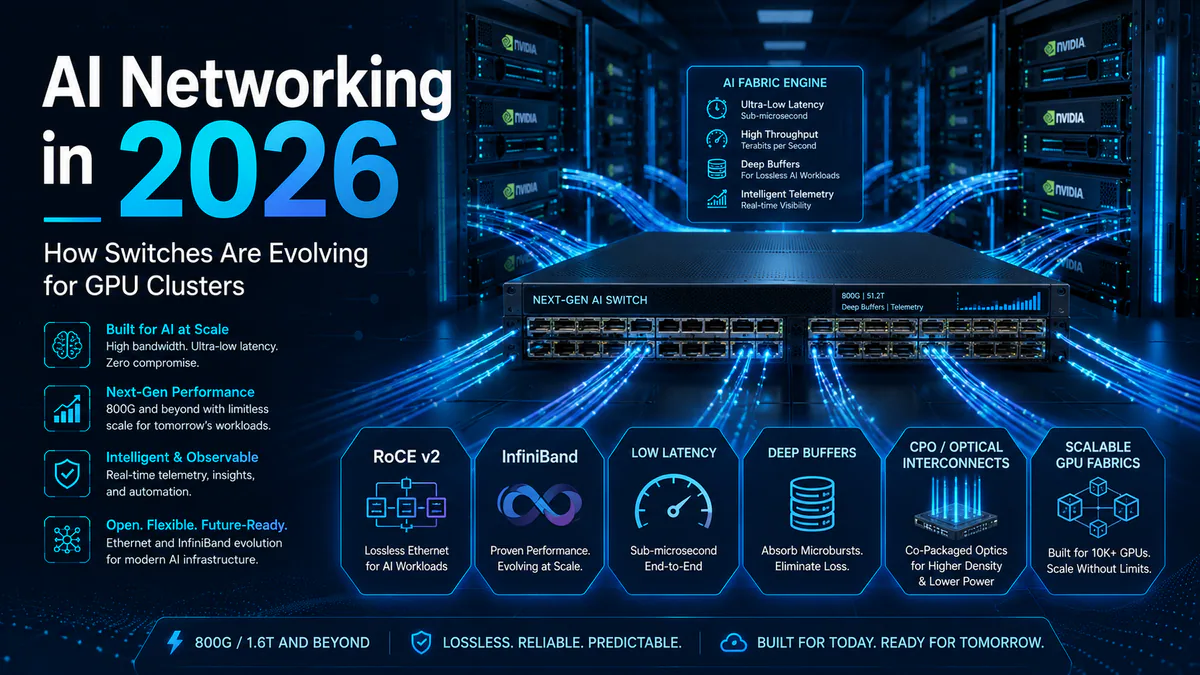
The artificial intelligence revolution is not merely a software upgrade; it is a fundamental restructuring of the underlying infrastructure. As we approach 2026, the demand for high-performance computing (HPC) has outpaced the capabilities of traditional networking architectures. The convergence of machine learning training and inference workloads is placing unprecedented strain on network fabrics, requiring a new breed of hardware that can keep pace with the speed of neural network growth.
At the heart of this transformation is the data center switch, which must now function not just as a connectivity layer, but as an intelligent pipeline orchestrator for massive GPU clusters. This article delves into the technical shifts defining AI networking in 2026, analyzing why standard Ethernet is being augmented, how protocols like RoCE and InfiniBand are converging, and what network engineers must consider when designing the infrastructure for the next generation of AI workloads.
The Hardware Bottleneck in Traditional Data Centers
For years, network capacity was designed to keep up with server throughput. However, the introduction of high-core-count GPUs (such as the NVIDIA H100 and Blackwell generations) has created a new bottleneck. In a traditional GPU cluster, the GPUs are the compute engine, but the network is the nervous system. If the nervous system is slow, the brain (GPU) remains idle.
In 2026, latency is no longer acceptable. Standard Layer 2/3 switching often introduces micro-jitters that disrupt the training loops of large language models (LLMs). To maintain training efficiency, switches must ensure that the bandwidth between GPUs remains constant and predictable. This is particularly true when utilizing the distributed training paradigm, where gradients are exchanged across thousands of cards every second.
The challenge is not just bandwidth; it is bandwidth efficiency and packet loss prevention. When a packet is dropped in a high-speed fabric, it can trigger backpressure across the entire cluster, cascading delays that can stall a training job for minutes. This is why AI networking is shifting focus from best-effort delivery to guaranteed delivery services within the Ethernet fabric.
Protocol Evolution: RoCE v2 vs. InfiniBand
One of the most significant debates in 2026 concerns the transport protocol for AI workloads. Historically, InfiniBand held the crown for high-performance computing due to its low-latency and lossless nature. However, Ethernet is catching up rapidly, driven by improvements in switching ASICs and the standardization of RDMA over Converged Ethernet (RoCE) version 2.
Comparison of Network Fabrics
| Feature | RoCE v2 (Ethernet) | InfiniBand |
|---|---|---|
| Cost | Lower (Leverages standard cabling) | Higher (Proprietary cables/cables) |
| Scalability | High (Easier to scale across racks) | Moderate (Topology constraints) |
| Lossless Support | PFC + ECN (Complex to tune) | Native (Integrated in hardware) |
| Standardization | Open standard (IEEE 802.3) | Proprietary |
In 2026, many enterprises are opting for RoCE v2 because it allows for better integration with standard data center infrastructure. The key differentiator is how the switch handles congestion. Modern data center switch architectures implement Priority Flow Control (PFC) queues dynamically. When a congested link is detected, the switch pauses specific traffic queues rather than flooding the whole network.
While InfiniBand remains superior for single-tenant, isolated GPU clusters, RoCE v2 is winning in multi-tenant cloud environments where the cost of proprietary InfiniBand switches is prohibitive. The evolution lies in the switch’s ability to manage these protocols without vendor lock-in.
The Role of the Modern Data Center Switch
The architecture of the switch itself has evolved to support the specific needs of AI. It is no longer sufficient to simply have 25Gbps or 100Gbps ports; the switching fabric must be able to handle aggregate traffic at line rate without dropping packets during peak load.
Key Hardware Features for AI
- Increased Buffer Depth: AI traffic bursts are common. Switches now come with deep packet buffers to absorb these bursts, preventing packet loss during peak transfer times.
- ASIC Acceleration: Hardware-based offloading of RDMA protocols reduces CPU overhead on the server side, allowing GPUs to focus on computation rather than network management.
- Optical Transceivers: The integration of 56G or 112G optical modules (QSFP-DD) is standard for top-of-rack switches, ensuring that the uplink speed matches the downlink speed to avoid backlogs.
These features are critical for the data center switch to act as a reliable conduit. In 2026, we are seeing the rise of CPO (Co-Packaged Optics) technologies in higher-end models, where optical components are placed closer to the switching ASIC. This reduces signal degradation and power consumption, two major concerns when running power-hungry GPU racks 24/7.
Scalability for Multi-Million GPU Clusters
One of the primary concerns for enterprise buyers is scalability. As clusters grow from hundreds to thousands of nodes, the network topology becomes complex. A simple two-tier architecture (spine-leaf) is often insufficient for massive GPU clusters designed for large-scale model training.
Network engineers are moving towards a three-tier architecture or utilizing leaf-spine designs with higher port density. The 2026 trend involves switches that support high port counts with minimal blocking. A switch with 54 ports of 100Gbps, for example, allows for dense connections between compute racks without requiring excessive aggregation layers that introduce latency.
Moreover, the switch must support multi-path routing protocols like ECMP (Equal-Cost Multi-Path). This ensures that traffic from a specific GPU can utilize any available path to reach its destination, balancing the load across the entire fabric. If a specific link fails, the traffic is rerouted seamlessly without the interruption that standard TCP/IP would cause. This resilience is a hallmark of enterprise-grade AI networking.
The Future: CPO and Optical Interconnects
Looking slightly beyond the current year, the industry is eyeing Co-Packaged Optics (CPO) as the solution to the power crisis. In 2026, traditional pluggable transceivers (like SFP28 or QSFP56) are showing signs of nearing their limits in terms of power density. CPO integrates the optical module directly with the switch ASIC, sharing the power and cooling requirements.
While CPO is often associated with InfiniBand or proprietary standards, Ethernet is adopting the concept to reduce costs. By integrating optics directly with the switch logic, manufacturers can reduce the footprint of the module and improve bandwidth efficiency. This is particularly important when supporting high-bandwidth GPU clusters where every watt of power saved is crucial for operational expenditure.
Conclusion: A Necessary Transition
The year 2026 represents a critical transition point for the data center switch. We are moving from a training-centric workload model, which prioritized raw throughput, to an inference-centric model, which prioritizes low-latency and deterministic latency. While this sounds minor, in the context of AI, the shift implies that the network fabric must now guarantee sub-microsecond latency to handle the demands of real-time inference services.
For IT leaders and engineers, the implications are clear. AI Networking is no longer an afterthought but a core design constraint. Selecting the right switch model—whether for RoCE-based Ethernet or InfiniBand environments—requires a deep understanding of the workload profile, the scale of the GPU cluster, and the long-term scalability of the facility.
The future of AI depends on the ability to connect GPUs faster than they can compute. In 2026, the data center switch is the linchpin holding the entire ecosystem together. As models grow larger and more complex, the switch must evolve in lockstep to ensure that the potential of artificial intelligence is not capped by the limitations of the underlying network. The evolution of this hardware marks not just a technological upgrade, but a paradigm shift in how we deliver computing services globally.