The data center networking landscape continues to evolve rapidly. As enterprises accelerate digital transformation, network infrastructure must keep pace with increasing bandwidth demands, lower latency requirements, and the need for greater intelligence.
Major Trends Shaping 2026
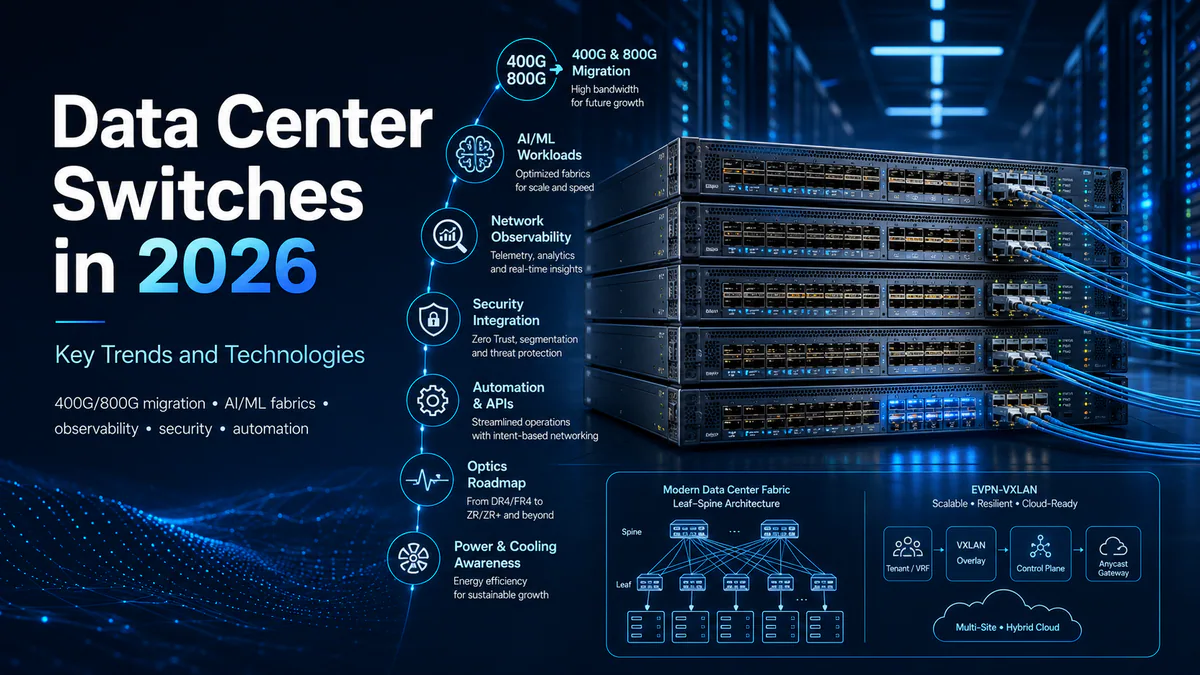
1. 400G and 800G Migration
The transition from 100G to 400G has moved from early adoption to mainstream deployment. Key drivers include:
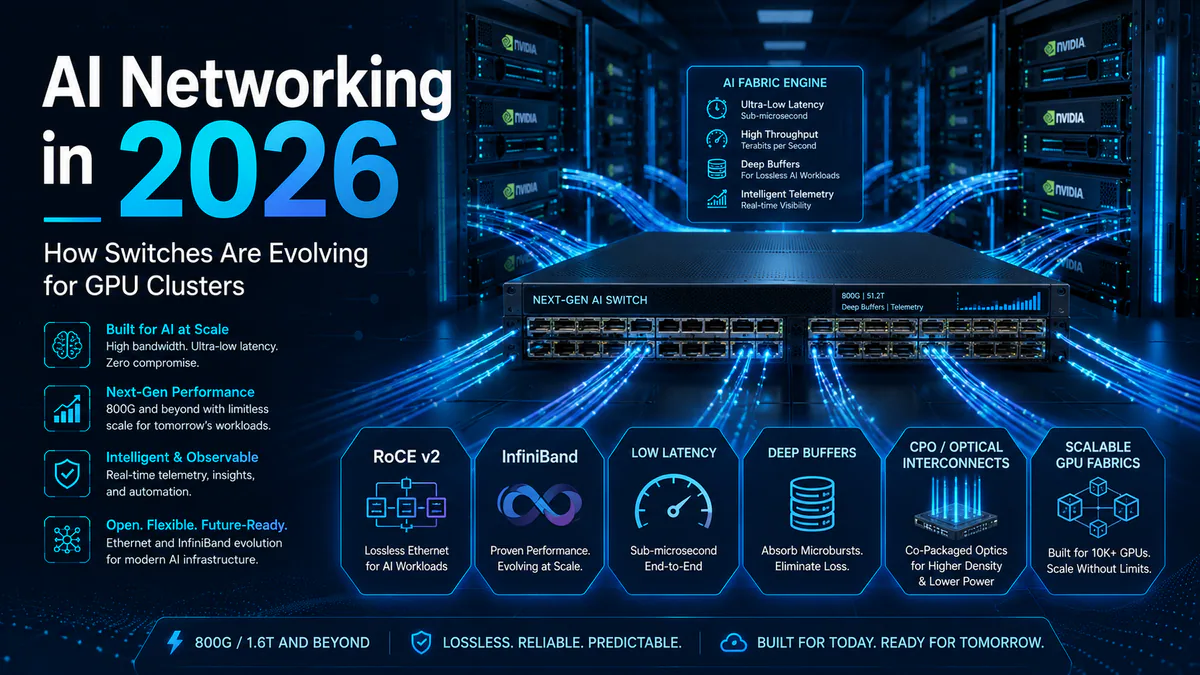
- AI/ML workloads: GPU clusters require high-bandwidth, low-latency networks
- Cloud-native applications: Microservices architectures generate massive east-west traffic
- Storage evolution: NVMe over Fabrics demands consistent high performance
800G ports are now appearing in early deployments, primarily for AI training clusters and HPC environments.
2. Silicon Innovation
Modern merchant silicon delivers:
- Higher port densities: 64x400G in a singleRU
- Lower power consumption: <20W per 400G port
- Advanced buffering: Enterprise-class buffer sizes for bursty workloads
3. Network Observability
Intent-based networking and advanced telemetry provide:
- Real-time visibility: Streaming telemetry at scale
- AIOps integration: ML-driven anomaly detection
- Automated troubleshooting: Root cause analysis automation
4. Security Integration
Modern switches embed security features:
- MACSec encryption: Hardware-level data plane security
- Secure boot: Chain of trust from boot to runtime
- Policy enforcement: Microsegmentation capabilities
Procurement Checklist for Data Center Refreshes
Switch upgrades are rarely isolated purchases. The hardware decision affects optics, cabling, airflow, software licensing, operations, and the deployment calendar. Before shortlisting products, teams should document the expected traffic pattern and the physical constraints of the site.
| Decision Area | Questions to Confirm |
|---|---|
| Port roadmap | Do servers need 25G, 50G, 100G, or 400G access over the next three years? |
| Fabric design | Will the network use traditional aggregation, leaf-spine, or EVPN-VXLAN? |
| Optics plan | Which links can use DAC/AOC, and which require SR, DR, FR, LR, or coherent optics? |
| Operations | Does the platform support telemetry, API access, rollback, and configuration templates? |
| Power and cooling | Can the rack support the wattage and airflow direction of the selected switch? |
The most common mistake is choosing port speed before validating the complete link budget. A 400G-ready switch does not guarantee a successful 400G migration if the fiber plant, patch panels, and transceiver supply chain are not aligned.
Recommended Configurations
AI/ML Infrastructure
- 800G spine switches
- 400G leaf switches with RoCEv2 support
- Low-latency Ethernet fabric
Enterprise Data Center
- 48x25G/48x100G access switches
- 32x400G aggregation switches
- VXLAN/EVPN fabric
Operational Implications
Higher bandwidth also increases the cost of mistakes. A misconfigured QoS policy, link flap, or inconsistent MTU value can affect many more workloads than it did in a 10G or 25G environment. For this reason, modern data center switch projects should include a validation plan before production cutover.
Recommended validation steps include:
- Lab-test representative optics and cables before committing to bulk purchasing.
- Confirm RoCE settings such as PFC, ECN, buffer allocation, and MTU on every fabric tier.
- Validate automation workflows against a staging fabric rather than production devices.
- Capture baseline telemetry before migration so post-cutover anomalies can be identified quickly.
- Keep a rollback plan for firmware, configuration, and physical cabling changes.
Buyer Takeaways
For many organizations, the right answer in 2026 is not simply “buy the fastest switch.” A balanced design should match workload sensitivity, growth forecasts, rack power limits, optics availability, and the operating team’s skill set. AI training clusters may justify aggressive 400G or 800G investments, while enterprise application environments may benefit more from stable 25G access and 100G aggregation with strong observability.
Looking Ahead
The convergence of compute, storage, and networking continues to accelerate. Organizations planning their 2026 network infrastructure should prioritize:
- Scalability: Architecture that can grow from 100G to 400G+ without major redesign
- Intelligence: Built-in analytics and telemetry capabilities
- Automation: Programmable interfaces for infrastructure-as-code
Stay ahead of the curve by comparing data center switches against your required port density, automation model, optics roadmap, and operational support requirements.